Attribute-based access control (ABAC) for AI agents governs what an agent may do by evaluating runtime attributes of each action – the agent’s risk level, its declared capabilities, the data classification involved, the namespace, the time of day, and whether the tool’s contract has drifted – rather than relying on static role assignments.
It’s the access-control model that actually fits agents, because agents act in situations a role-based list could never anticipate.
Why RBAC doesn’t fit agents
Role-based access control (RBAC) works by giving roles to identities and permissions to roles. It’s served enterprise software well for decades. But it assumes a fairly static world: this user has this role, so they get these permissions. Agents break that assumption.
The right permissions for an agent depend on context that shifts call by call. The same agent calling the same tool can be perfectly fine in one moment and dangerous the next – depending on what data is involved, what time it is, whether the agent’s behavior looks normal, and whether the tool it’s calling has been tampered with. RBAC has no way to express any of that. ABAC does.
RBAC asks ‘what role does this identity have?’ ABAC asks ‘given everything that’s true about this specific action right now, should it be allowed?’ Agents need the second question.
The six attributes that matter for agents
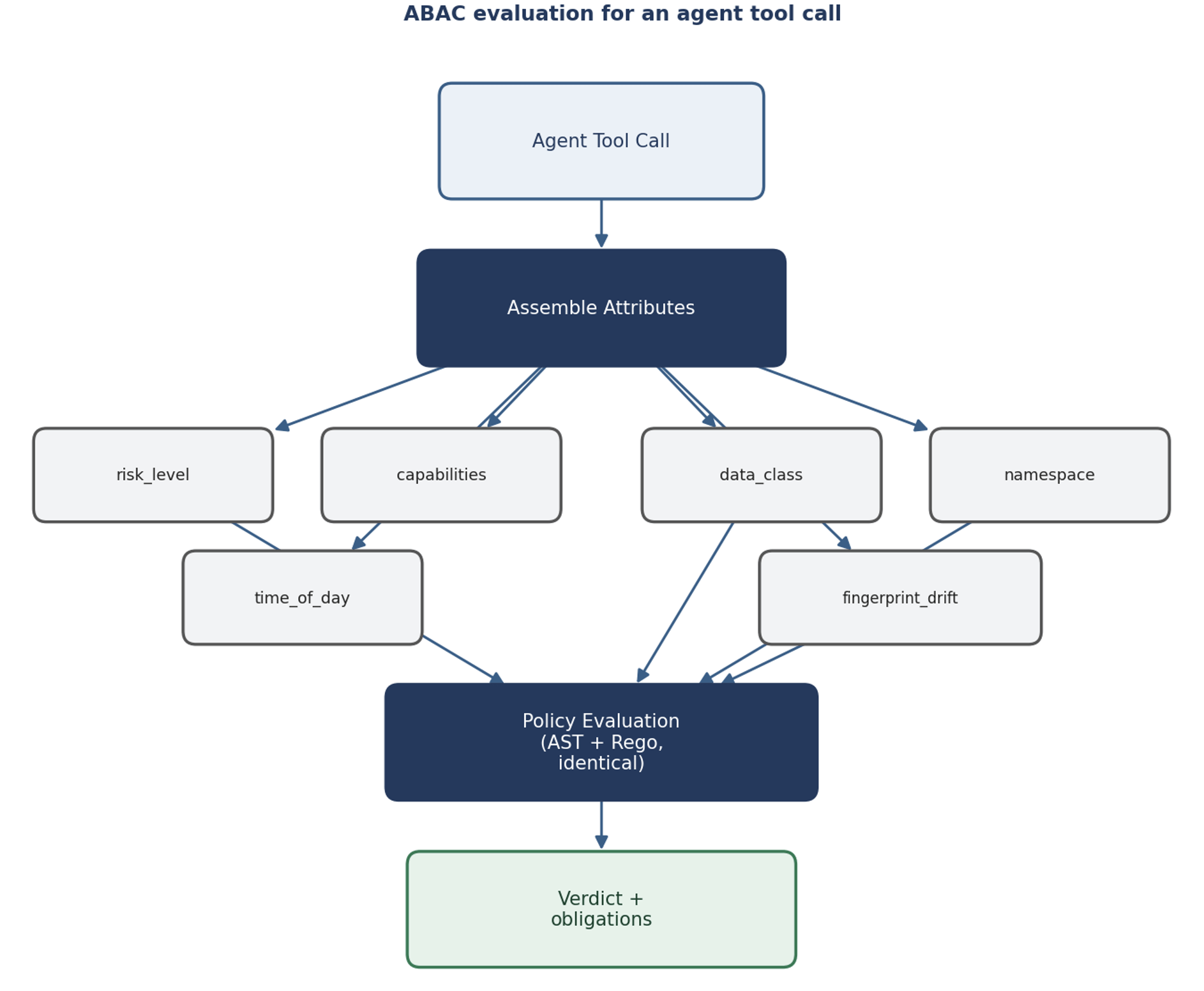
A production agentic ABAC system evaluates policies against operands that capture the runtime context of each decision – six of them matter most:
Attribute | What it captures | Example policy |
agent_risk_level | Risk classification of the calling agent | Deny production-DB writes from any agent above medium risk |
agent_capabilities | What the agent is declared able to do | Require approval if an agent without ‘external_calls’ attempts an HTTP request |
data_class | Classification of the data in the action | Mask PII on any result containing restricted-class data |
namespace | The workspace / environment of the action | Stricter policies in prod than in dev or staging |
time_of_day | Wall-clock time of the decision | Require approval for high-impact actions outside business hours |
fingerprint_drift | Whether the tool’s contract changed since pinning | Block any call to a drifted tool until re-reviewed |
How the decision is computed
When an agent attempts a tool call, the policy engine gathers the attributes for that specific call and evaluates them against the policy set. Out comes a verdict – ALLOW, DENY, REQUIRE_APPROVAL, or MASK – plus any obligations (think ‘mask the email field’ or ‘log full arguments’).
Engine parity: why two evaluators
A subtle but important design point: solid agentic ABAC systems run each decision through two engines – an AST evaluator and a Rego/OPA path – kept byte-for-byte identical. The same inputs always produce the same verdict on both. This isn’t redundancy for its own sake; it’s proof that the policy means the same thing no matter which engine runs it, and it lets teams write policies in either dialect knowing the runtime decision will match.
Each attribute is wired through three sync points – the AST condition, the Rego code generation, and the Rego input map – so adding a new one means updating all three. That discipline is what keeps the two engines equivalent over time.
Obligations: beyond allow and deny
ABAC verdicts carry obligations – required side effects that ride along with an ALLOW. The most common is masking: the call goes through, but specified fields (PII, secrets) are redacted before the tool sees them or before the result returns to the agent. Obligations let you say “yes, but” instead of being stuck choosing between blocking a useful action and exposing sensitive data.
Putting ABAC to work
- Classify your agents by risk level and spell out their capabilities explicitly.
- Tag your data and tools with classifications the policy engine can read.
- Write policies in terms of attributes, not roles – ‘high-risk agents can’t touch restricted data’ instead of ‘agent X can’t call tool Y’.
- Lean on obligations (mask, redact, log) to allow useful actions safely instead of blocking them outright.
- Include fingerprint_drift in high-stakes policies so supply-chain tampering gets caught at decision time.
🔗 Internal link: Primary CTA: /platform/agentic-security/ (ABAC section). Link ‘fingerprint_drift’ / ‘supply-chain tampering’ to Post 8. Link ‘verdict’ types to Post 1 (pillar). Link ‘two engines’ parity discussion to Post 1.
How DeepintShield approaches this
DeepintShield’s policy engine is attribute-based by design, weighing the operands this post describes – agent risk level, capabilities, data class, namespace, time of day, and tool fingerprint drift – to return a verdict and obligations on every call. Policies run through both an AST evaluator and a Rego path kept byte-for-byte identical, and decisions are cached for microsecond-scale evaluation. If you’ve outgrown role-based access for your agents and need decisions that reflect the real risk of each action, DeepintShield is one way to put ABAC enforcement inline.