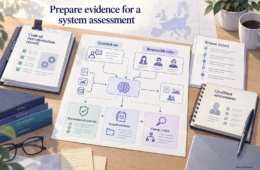
An AI Bill of Materials (AIBOM) is a structured, verifiable inventory of every tool, model, and dependency that makes up an agentic AI system – including each component’s declared behavior, its cryptographic fingerprint, and whether that fingerprint has drifted since it was last verified.
If you already produce a Software Bill of Materials (SBOM) for traditional apps, AIBOM is the direct equivalent for AI agents. This post covers what goes in one, why it matters, and how it turns into a compliance artifact.
The problem AIBOM solves
Modern AI agents are built from parts you didn’t write: MCP tool servers, third-party APIs, foundation models from several providers, retrieval sources. Every one of those is a supply-chain dependency, and every one can be compromised – a tool silently re-described to carry malicious instructions, a typosquatted server posing as a trusted one, a model swapped for a tampered version.
Traditional software solved the same problem with the SBOM: a manifest of every library and version, so when a vulnerability drops you can answer “are we affected?” in minutes instead of weeks. The AIBOM takes that idea and applies it to the agentic supply chain.
If you can’t list every tool your agent can call and confirm none of them have changed, you can’t honestly say the agent is secure. The AIBOM is that list.
What’s in an AIBOM
A complete AIBOM lists every tool in the workspace, along with the attributes that matter for supply-chain integrity:
Field | What it captures | Why it matters |
Component name + source | The tool and where it came from | Identifies what’s in the supply chain |
Action class | What the tool is declared to do (read / write / execute / external_call) | Establishes expected behavior |
Sensitivity | The tool’s risk tier | Drives policy and review priority |
Args schema | The declared shape of the tool’s arguments | Baseline for divergence detection |
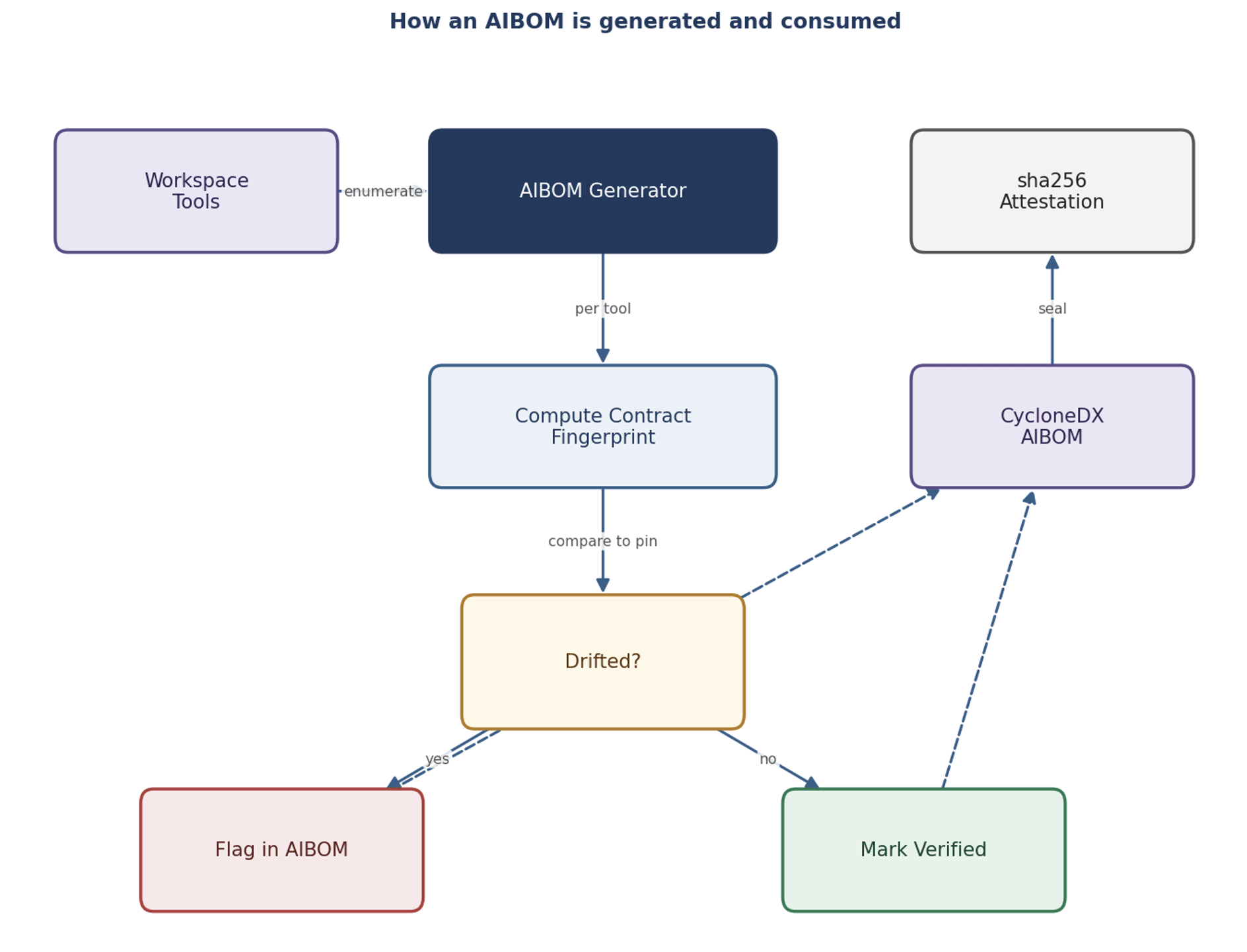
Contract fingerprint | A hash of the declared behavior at last pin | The thing that changes when a tool is tampered with |
Pin status | Whether the tool is pinned and when | Distinguishes verified from unverified tools |
Drift state | Whether the current contract differs from the pinned one | The supply-chain tamper signal |
CycloneDX: the format that matters
An AIBOM is most useful when it’s in a format auditors already accept. CycloneDX is the leading SBOM standard – the same format security teams use for software dependencies. Exporting your AIBOM in CycloneDX flavor means it drops straight into the tools, scanners, and audit workflows that already exist, instead of being a one-off artifact nobody knows how to read.
The export includes an attestation digest – a sha256 hash over the canonical component list – that acts as the document’s tamper-evident seal. Pinned and drifted counts sit right at the top, so a reviewer can see the whole agent’s supply-chain health at a glance.
Why procurement will demand it
Here’s the part to pay attention to if you sell AI products to enterprises. Procurement and vendor-risk teams already require SBOMs for software purchases – table stakes in regulated industries, and increasingly common everywhere. As agentic AI moves into production, those same teams are extending the requirement to AI.
Two forces are speeding this up. First, regulation: frameworks like the EU AI Act and NIST AI RMF push toward demonstrable supply-chain governance for AI. Second, the OWASP Agentic ASI Top 10 names supply-chain compromise (ASI04) as a top-tier risk – which gives security teams a recognized standard to point at when they ask for evidence.
🔗 Internal link: Link ‘OWASP Agentic ASI Top 10’ to Post 2. Link ‘supply-chain compromise (ASI04)’ to Post 8 (Fingerprint Drift). Link ‘EU AI Act’ to Post 28.
The practical upshot: vendors who can hand a prospect a clean CycloneDX AIBOM during security review get through procurement faster than those who can’t. It’s one of the cheapest credibility wins available when you’re selling agentic AI into the enterprise – and one of the few competitors mostly haven’t built yet.
Getting started with AIBOM
- Inventory every tool your agents can call – MCP tools, internal APIs, and third-party services included.
- Pin each tool to its current contract fingerprint to set the verified baseline.
- Turn on drift detection so any later change to a tool’s contract trips a signal.
- Export the AIBOM in CycloneDX format and fold it into your security-review package.
- Regenerate it on a schedule and after any tool change, so the inventory stays current.
🔗 Internal link: Primary CTA: /platform/agentic-security/ (AIBOM section) and /compliance/. Link back to Post 1 (pillar).
How DeepintShield approaches this
DeepintShield generates an AIBOM out of the box: it keeps a live inventory of every tool in the workspace and exports it as a CycloneDX AI Bill of Materials – complete with each tool’s action class, contract fingerprint, pin status, drift state, and a sha256 attestation digest over the whole inventory. Because auditors already accept CycloneDX for software SBOMs, the AIBOM drops straight into existing vendor-risk and procurement review. If your buyers are starting to ask for AI supply-chain evidence – or you just need it for your own governance – DeepintShield produces it as a deliverable instead of a manual chore.