Fingerprint drift is the signal raised when an AI tool’s contract – its name, declared behavior, and argument schema – has changed since it was last pinned and verified.
It’s the runtime tripwire for supply-chain attacks on agentic systems – catching the moment a trusted tool turns into an untrusted one, before the agent acts on it.
The supply-chain problem for AI tools
AI agents depend on tools they didn’t write – MCP servers, third-party APIs, internal services. Each is a supply-chain dependency, and supply chains get attacked. The particular danger for agents is that a tool can change after you’ve approved it. You vet a tool, decide it’s safe, wire it into your agent. Later – through a compromised server, a malicious update, or an injected descriptor – the tool’s behavior changes. Your approval is now out of date, and nothing tells you that unless you’re watching for the change.
This is OWASP Agentic ASI Top 10’s supply-chain risk (ASI04), and it’s sneaky because the tool keeps the same name and interface. Static checks just see a familiar, approved tool. The only way to catch the attack is to notice that the tool’s contract has drifted from its approved state.
🔗 Internal link: Link ‘OWASP Agentic ASI Top 10’s supply-chain risk (ASI04)’ to Post 2.
You approved the tool once. Supply-chain attacks change it afterward. Fingerprint drift is what notices the change you never authorized.
Tool pinning: establishing the baseline
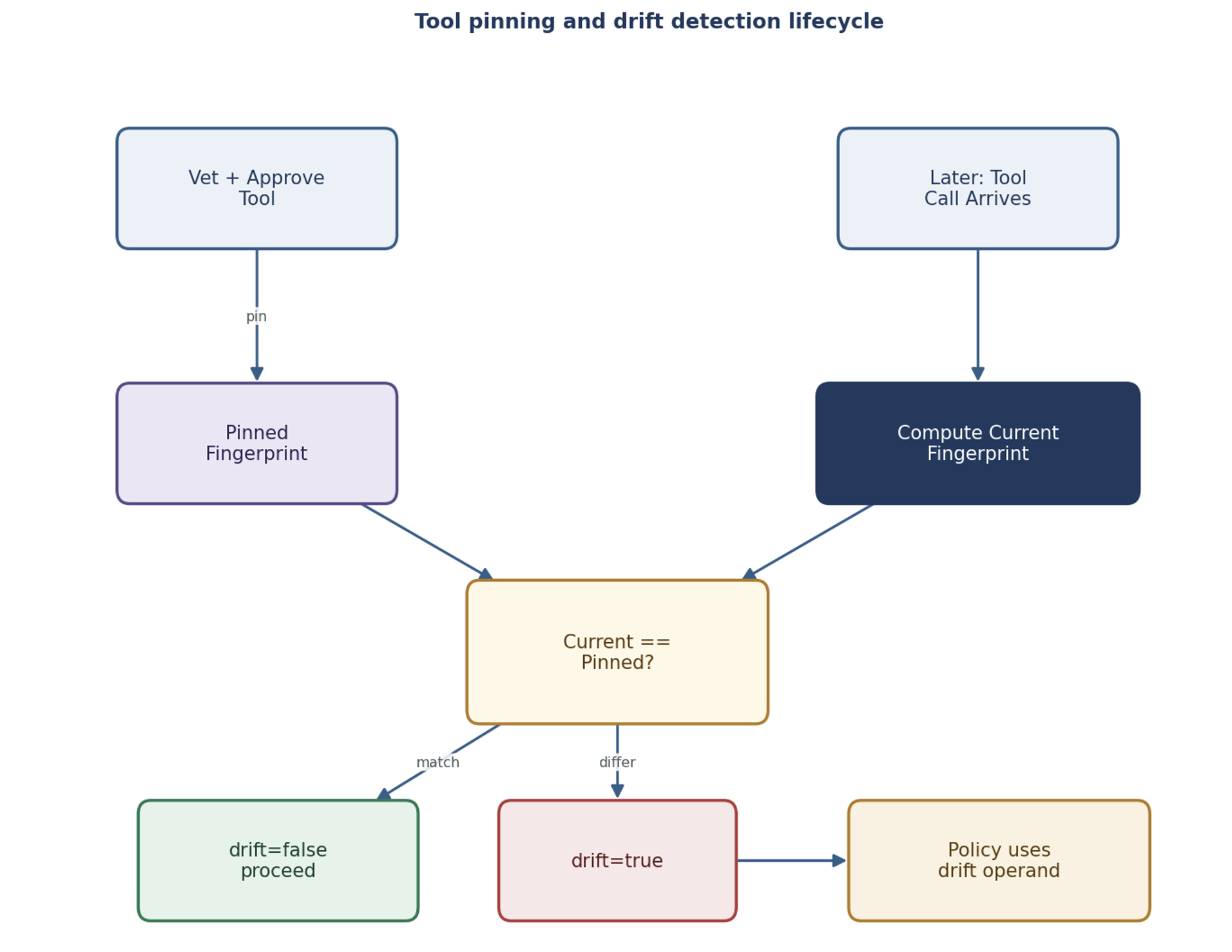
Fingerprint drift only works if you’ve pinned the tool first. Pinning captures the tool’s contract at a known-good moment as a cryptographic fingerprint – a hash over its name, action class, argument schema, and source. That pinned fingerprint becomes your reference point: “this is what the tool was when we approved it.”
Drift as a policy operand
What makes fingerprint drift powerful is that it isn’t just an alert – it’s an attribute your policies can evaluate at decision time. The fingerprint_drift operand sits alongside attributes like agent risk level and data class in the ABAC policy engine. So you can write policies like “deny any call to a tool whose fingerprint has drifted” or “require human approval for drifted tools handling restricted data.”
Because the check happens at the decision point, a drifted tool is caught before the agent runs the call – not discovered later in a log review. The supply-chain attack gets stopped right in the execution path, which is the only place stopping it actually helps.
🔗 Internal link: Link ‘ABAC policy engine’ and ‘fingerprint_drift operand’ to Post 5 (ABAC for AI Agents).
What drift detection catches
Attack | What changes | How drift catches it |
Descriptor injection | The tool’s description gains malicious instructions | Description is part of the fingerprint; hash changes |
Typosquatting | A lookalike tool impersonates a trusted one | Its fingerprint won’t match the pinned legitimate one |
Re-described MCP tool | Action class changes (e.g., read → execute) | Action class is fingerprinted; drift trips |
Schema tampering | Argument schema is altered to accept dangerous inputs | Args schema is part of the fingerprint |
Source swap | The tool is served from a different origin | Source is part of the fingerprint |
Drift and the AIBOM
Fingerprint drift and the AI Bill of Materials are two views of the same underlying mechanism. The AIBOM is the inventory – every tool, its pinned fingerprint, and its current drift state, exported as a CycloneDX document. Drift detection is the runtime enforcement – the policy check that acts on that state at decision time. Together they give you both the audit artifact (here’s every tool and whether it’s drifted) and the live control (drifted tools get blocked or queued).
🔗 Internal link: Link ‘AI Bill of Materials’ / ‘CycloneDX document’ to Post 3 (AIBOM Explained).
Operationalizing drift detection
- Pin every tool to its contract fingerprint at the moment you approve it.
- Compute the current fingerprint on every call and compare it to the pin.
- Expose fingerprint_drift as a policy operand so drifted tools trigger your chosen verdict.
- Set per-tool postures – high-risk tools block on drift, lower-risk ones can just flag and alert.
- Re-pin on purpose after a legitimate tool update, so intended changes don’t show up as false positives.
Supply-chain attacks on AI tools are quiet by design – they reuse trusted names and interfaces. Fingerprint drift is the control that makes the quiet change loud, turning an invisible compromise into a blocked call and an audit entry. For any agent that leans on tools it didn’t write, it’s not optional.
🔗 Internal link: Primary CTA: /platform/agentic-security/ (AIBOM + drift). Link back to Post 1 (pillar), Post 2 (ASI04), Post 3 (AIBOM), Post 4 (TIE), Post 5 (ABAC). This closes Cluster 1 – the cluster is fully interlinked.
How DeepintShield approaches this
DeepintShield builds in tool pinning and drift detection as a core capability: it captures each tool’s contract fingerprint at a known-good moment and compares the current fingerprint on every call, raising a fingerprint_drift signal when they differ – catching descriptor injection, typosquatting, re-described MCP tools, schema tampering, and source swaps. The drift signal is available as an ABAC operand, so policy can react to it automatically. For teams worried about supply-chain tampering of the tools their agents already trust, DeepintShield is one way to turn drift from an invisible risk into an enforced control.