A hash-chained audit log records every decision in a way that makes tampering detectable: each entry includes a cryptographic hash of the previous entry, so deleting, modifying, or reordering any record breaks the chain and is provable at audit time.
For AI systems making thousands of autonomous decisions, it’s the difference between hoping your logs are intact and being able to prove it.
Why ordinary logs aren’t enough
Most systems log decisions to a database or a log file. That’s fine for debugging, but it has a weakness that matters for compliance and incident response: ordinary logs can be changed without leaving a trace. Anyone with database access – an insider, or an attacker who got it – can delete the record of a harmful action, change a verdict, or reorder events to hide what happened. The log ends up saying whatever someone wants it to say.
For an AI agent that can move money, read patient records, or take consequential actions, “we think the logs are accurate” doesn’t cut it. Regulators, auditors, and incident responders need “we can prove the logs haven’t been altered.”
A hash chain doesn’t stop an attacker with full access from tampering. It makes the tampering impossible to hide. For compliance, that’s the property that matters.
How hash chaining works
The mechanism borrows the same cryptographic primitives that underpin blockchains, but keeps it simple. Each audit record includes a hash of the record before it. That hash is computed over the previous record’s content – including its own previous-hash field. The result is a chain where every link depends on all the links before it.
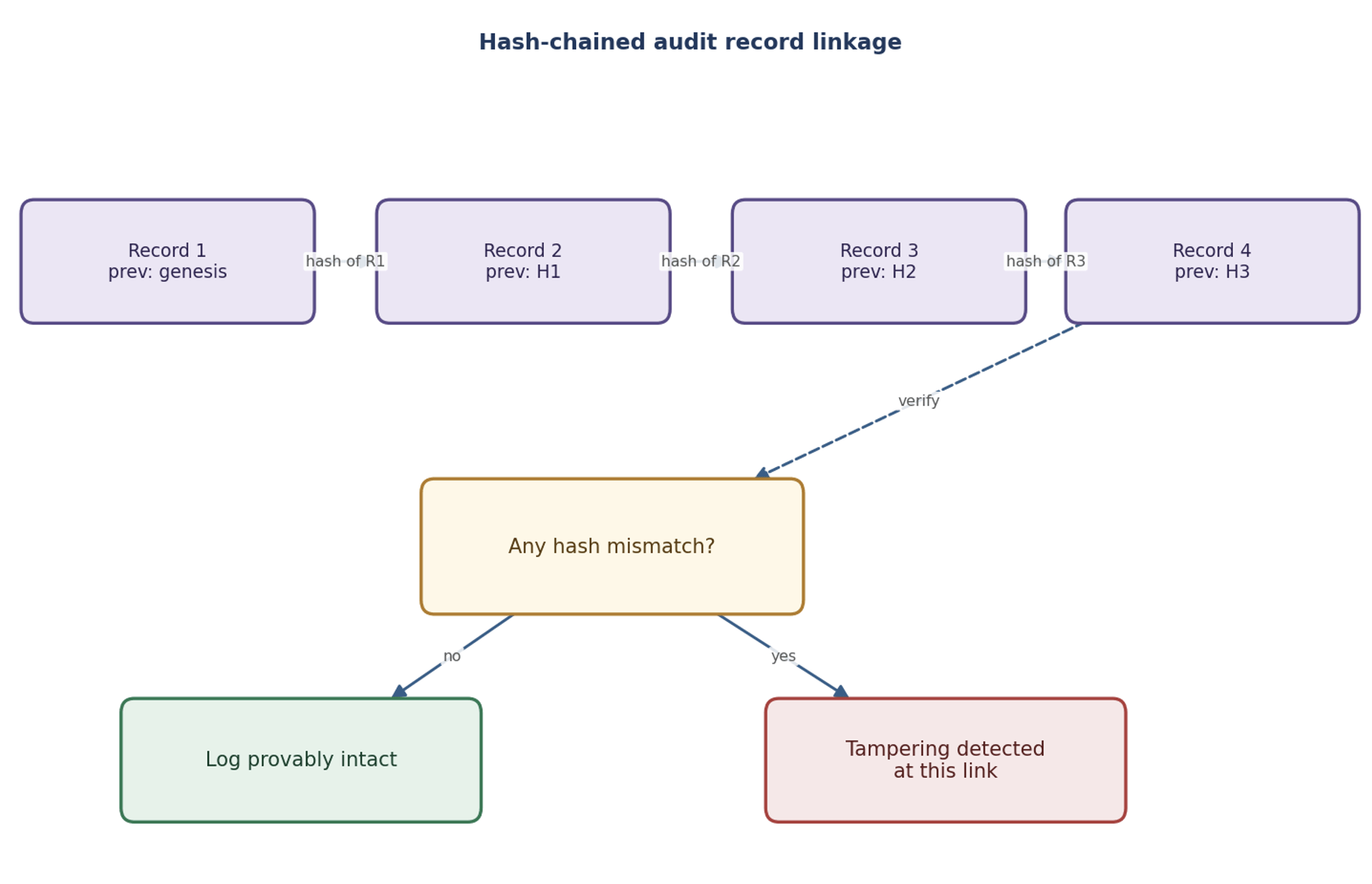
Now say an attacker deletes Record 2 or changes a verdict inside it. Record 3’s stored previous-hash no longer matches the actual hash of the (now modified or missing) Record 2. The chain breaks right there, and verification immediately shows both that tampering happened and where. To cover it up, the attacker would have to recompute every hash that follows in the chain – and if the chain’s head is anchored or published periodically, even that fails.
What gets logged for an AI decision
In an agentic system, each hash-chained record captures the full context of a decision, so the audit trail is real evidence, not just a timestamp:
- The principal – which agent or identity made the call
- The tool and arguments involved
- The verdict (ALLOW / DENY / REQUIRE_APPROVAL / MASK) and any obligations
- The policy that produced the verdict
- The decision ID, which links to the full guardrail trace
- The previous record’s hash – the chain link
Because the decision ID is a valid trace identifier, any audit record ties straight back to the full evidence: the inputs, the policy evaluation, the principal chain, and the outcome – all with cryptographic provenance.
Why this is becoming a requirement
Several forces are converging to make tamper-evident audit a baseline expectation for AI. Regulated industries – banking, healthcare, insurance – already require strong audit trails for consequential decisions, and AI decisions are getting more consequential by the month. Emerging AI governance frameworks (the EU AI Act’s logging requirements for high-risk systems, NIST AI RMF’s emphasis on traceability) push the same way. And the AI-TRiSM model for runtime AI governance explicitly calls for evidentiary logging as a control.
🔗 Internal link: Link ‘EU AI Act’ to Post 28. Link ‘AI-TRiSM’ to Post 29. Link ‘guardrail trace’ to Post 17 (Five Stages of Guardrails).
For an enterprise deploying agents, a hash-chained audit log answers the question every auditor and incident responder eventually asks: “can you prove what the agent did, and prove the record hasn’t been altered?” Being able to say yes – with cryptographic evidence – is what turns an AI deployment from a compliance liability into a defensible one.
Implementing tamper-evident audit
- Write every agentic decision and guardrail finding to an append-only, hash-chained store.
- Include enough context per record (principal, tool, verdict, policy, decision ID) to make it real evidence.
- Provide a verification routine that walks the chain and reports any break.
- Support export (CSV/JSON) so auditors can work with the evidence in their own tools.
- Consider anchoring the chain head externally now and then, as a defense against full-access tampering.
🔗 Internal link: Primary CTA: /platform/agentic-security/ (audit section) and /compliance/. Link back to Post 1 (pillar).
How DeepintShield approaches this
DeepintShield writes every policy decision to a hash-chained, tamper-evident audit log of exactly the kind described here: each entry includes a hash of the previous one, so any deletion, change, or reorder breaks the chain and shows up at audit time. Evidence is exportable for compliance, and the log records who called what, when, and what verdict came back. For teams that need to prove what their AI did – to regulators, auditors, or incident responders – DeepintShield is one way to get real evidentiary logging instead of logs you just hope are intact.