Shadow agents are AI agents operating in your environment that haven’t been formally registered, cataloged, or brought under governance.
They’re the agentic version of shadow IT – and like shadow IT, they’re often where the worst incidents start, because you can’t apply policy, audit, or integrity checks to an agent you don’t even know exists.
How shadow agents appear
Shadow agents spread for the same reason shadow IT did: capable people solving problems faster than central governance can keep up. A developer wires up a LangGraph agent to automate a workflow. A data team spins one up to triage tickets. A product manager builds something with an internal agent framework over a weekend. Nobody’s acting maliciously – they’re being productive. But each new agent is making decisions, calling tools, and touching data, often without security ever knowing it exists.
The result, in most organizations adopting agents at any scale, is that the official registry undercounts reality. The security team thinks it governs ten agents. There are thirty.
Your AIBOM is only complete if it covers every agent. Each shadow agent is a hole in your inventory and a blind spot in your audit log.
Why shadow agents are dangerous
An ungoverned agent is dangerous in specific, compounding ways:
- No policy enforcement: its tool calls never pass through your PEP/PDP, so none of your ABAC rules apply. It can do whatever its code and credentials allow.
- No audit trail: its decisions aren’t in your hash-chained audit log, so when something goes wrong, you can’t reconstruct what it did.
- No integrity checking: the tools it calls aren’t pinned or fingerprinted, so supply-chain tampering against it slips by unnoticed.
- Unknown blast radius: because you don’t know it’s there, you can’t reason about what it could do if compromised. It’s a risk you haven’t even measured.
This is exactly why the OWASP Agentic ASI Top 10 lists rogue agents (ASI10) as a top-tier risk. A rogue agent isn’t always malicious – often it’s just unmanaged, which is dangerous enough.
🔗 Internal link: Link ‘OWASP Agentic ASI Top 10’ / ‘rogue agents (ASI10)’ to Post 2. Link ‘hash-chained audit log’ to Post 7. Link ‘AIBOM’ to Post 3.
Discovery: turning shadow into known
The fix is agent discovery – surfacing every agent that touches your infrastructure, registered or not. The mechanism is simple: the decision engine logs every principal that makes a decision through the platform, and any agent making calls that aren’t in the official registry gets flagged as a shadow agent
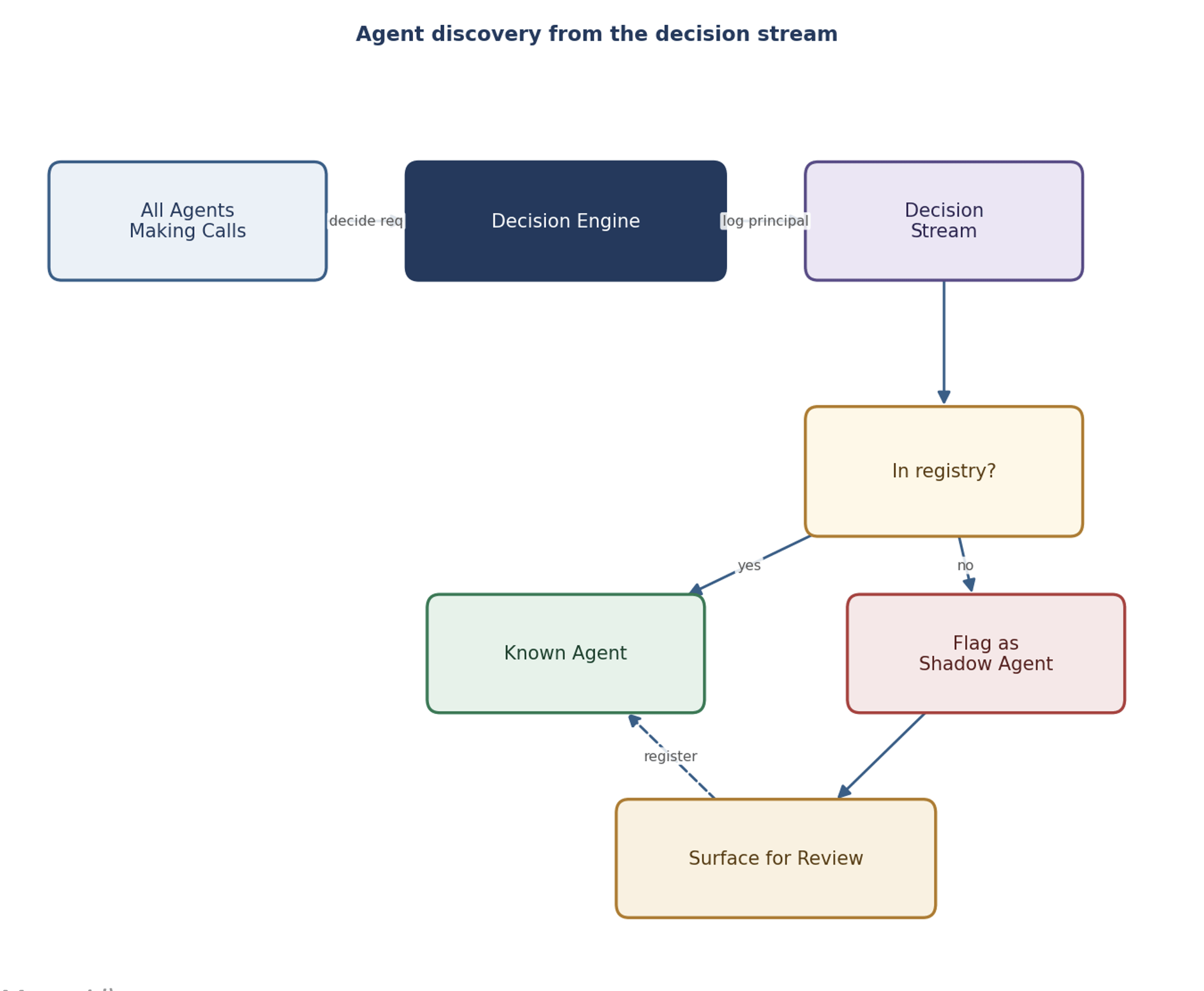
Once you’ve discovered a shadow agent, you can bring it under governance: register it, classify it by risk level, assign capabilities, and – until it’s reviewed – hold it in shadow enforcement mode, where its decisions are evaluated and logged but its actions stay constrained.
Discovery plus rollout: a safe path
Discovery pairs naturally with staged rollout. A newly discovered agent doesn’t have to be either trusted or blocked on the spot. Shadow mode evaluates its decisions and records what would happen without actually enforcing – so you can watch its behavior before granting real permissions. Once it’s behaved correctly for a while, you promote it to canary, then full enforcement. The unknown agent becomes a known, governed one through a controlled process instead of a guess.
🔗 Internal link: Link ‘staged rollout’ / ‘shadow mode’ to Post 1 (pillar, rollout concept).
Operationalizing discovery
- Route every agent decision through a central enforcement point so discovery sees everything.
- Review the discovery feed regularly – treat new shadow agents the way you’d treat new shadow-IT findings.
- Register and classify discovered agents quickly; an unclassified agent is a pending risk.
- Hold unknown agents in shadow enforcement until you’ve reviewed them, rather than allowing or blocking blindly.
- Reconcile the discovery feed against your AIBOM so your inventory stays complete.
🔗 Internal link: Primary CTA: /platform/agentic-security/ (Discovery section). Link back to Post 1 (pillar) and Post 2 (ASI10).
How DeepintShield approaches this
DeepintShield’s discovery is built for exactly this gap: because its decision engine logs every principal that makes a decision through the platform, it surfaces agents that aren’t in the official registry and flags them as shadow agents the moment they make a call. From there, you can bring them under governance through its staged shadow/canary/enforce rollout. For teams that suspect – correctly, in most cases – that the real number of agents is higher than the registered one, DeepintShield is one way to make the shadow set visible and governable.