Reasoning-Effort Controls: Match the Model to the Task
A request to extract an invoice date and a request to compare several engineering designs ask different things of a model. Reasoning-effort controls help allocate deliberation to the task where the selected model supports them. The useful setting is the one that meets the application’s quality requirement with a measured response time and resource cost.
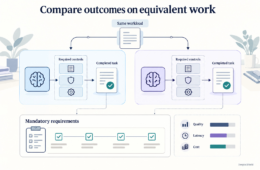
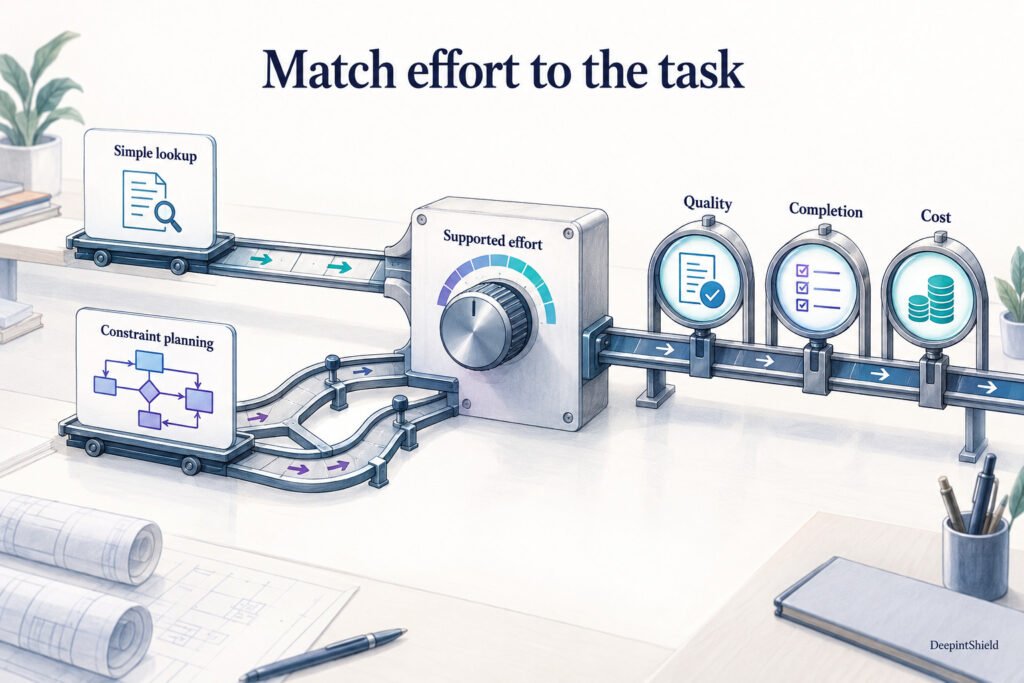
Figure: Simple lookup and constraint-planning tracks meet an adjustable supported-effort control. Quality, completion and cost are assessed separately after the task.
Understand effort levels and token budgets
Providers expose reasoning in different forms. Some models accept an effort level, while others support a token budget or a model-specific thinking configuration. DeepintShield accepts normalized reasoning controls and translates them for the selected provider, but that translation does not make every setting valid for every model.
Check the documented model and endpoint combination before changing a setting. An omitted control may use provider defaults rather than disable reasoning. A reasoning-token budget is also different from the maximum length of the visible answer. Keep those two purposes clear in configuration and in cost analysis.
Choose tasks with an observable result
Begin with examples the team can score: extracting required fields, classifying support requests, comparing evidence, or generating code that passes meaningful checks. A concise task may work well with a lower supported effort level. A multi-step question may benefit from more deliberation, but that is a hypothesis to test rather than a rule about every request.
For an invoice extractor, compare the returned date, supplier and total against the original document. For a policy assistant, inspect whether the answer includes the correct exception and citation. Fluent wording is not enough to show that one effort setting meets the task’s requirements.
Keep provider-specific continuation intact
Reasoning-enabled responses can contain more than visible text. DeepintShield’s Chat responses expose supported reasoning details, while Responses requests retain native reasoning output items and stream events. These outputs do not guarantee access to the model’s complete internal reasoning.
When a workflow continues after a tool call, preserve the required response items and signatures with the compatible provider and model. Do not summarize opaque continuation state into ordinary conversation text. A routing change that looks equivalent at the prompt level may need different request or continuation handling.
Visual guide: Reasoning-Effort Controls: Match the Model to the Task
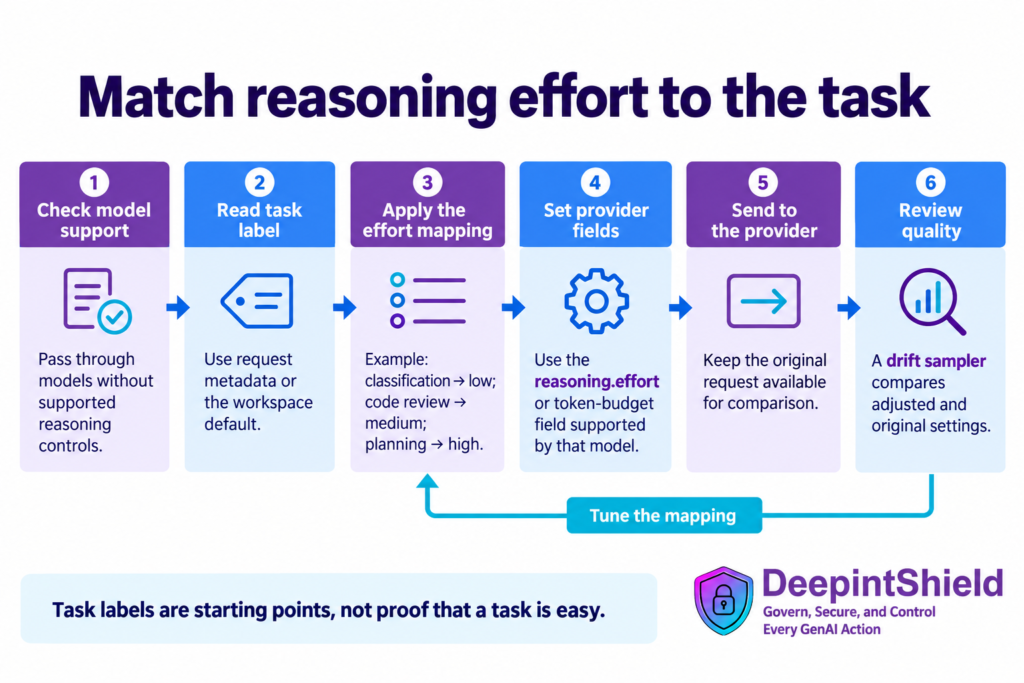
Figure: Illustrative optimization workflow: Reasoning-effort pipeline from model capability detection through task labels, configurable effort tiers, provider-specific fields and quality review. Available controls depend on the configured implementation.
Review the settings with the model release
Keep the endpoint, provider, model identifier and requested reasoning controls in the experiment record. Measure quality, reported usage and response time on the same request set. Include longer and less common examples so the chosen default reflects the application rather than only its easiest tasks.
DeepintShield also offers reasoning-effort throttling as a separate cost-control setting on supported plans. Check the effective workspace configuration alongside the application request. Re-test after model or routing changes, because supported values and their practical effect can differ. Use a deliberate default and a documented exception path for tasks that need another setting.
Choose an evaluation task with a checkable answer
Compare reasoning settings on a task such as extracting constraints from a shipping request and selecting a valid delivery option. Prepare requests with one clear solution, conflicting requirements and insufficient information. A useful answer may be a valid option, a request for clarification or a statement that no option fits. Score those outcomes against a reviewed rule set; longer explanations and more visible reasoning text are not independent measures of correctness.
Hold the model, prompt and source data constant while changing the supported reasoning setting. Record the effective parameter after gateway translation, the output limit, elapsed time and observed usage. The destination model determines which effort or budget controls it accepts. DeepintShield documents model-dependent translation and precedence, so avoid sending multiple contradictory controls merely because one unified request object allows both fields. Reasoning reference
Test the continuation path as part of the experiment
Some tasks need a tool result before the model can finish. Preserve the provider’s returned output items and any required opaque continuation state when making the next request. Use a synthetic tool result with a stable call identifier, then verify that the resumed answer incorporates it correctly. If the application discards required state, an apparent model-quality failure may actually be a malformed continuation assembled by the integration.
Do not move provider-specific signatures or reasoning state to a different provider and assume they remain meaningful. If routing changes mid-workflow, design a supported reconstruction strategy using the business context that can legitimately be transferred. Test incomplete and failed terminal outcomes separately from completed answers. A stream that prints several convincing sentences before interruption has not necessarily delivered the requested result, and increasing effort will not fix an application that mistakes a disconnected stream for completion.
Set operating defaults by task class
Group results by the task’s actual difficulty and consequence. A short classification may achieve the required quality at a modest setting, while a multi-constraint planning question may benefit from another configuration. Keep a review path for unusually complex or ambiguous requests rather than escalating every request automatically. Include the cost and latency of that escalation in the workflow’s measurements, and confirm that the new path stays within approved model access and output constraints.
When a model revision becomes available, re-run the held-out cases and inspect parameter compatibility before copying the previous settings. A familiar effort label can select different model behavior, and the available choices may change. Retain the tested configuration with the evaluation result so an operator can reproduce it later. If a change degrades reliability, restore the previous supported route while investigating; do not compensate by increasing every token limit without understanding whether the lost quality is recoverable.
Inspect the difficult cases separately from the average. A shipping request with several interacting date and capacity constraints may need a different tested configuration from a simple status lookup. Record why that distinction was chosen and what happens when the request is misclassified. Increasing reasoning effort is not a substitute for missing inventory facts or a reliable service-side feasibility check.
Frequently asked questions
Does more reasoning always improve an answer?
No. The effect depends on the task and model. Use supported settings, test the complete result, and compare the additional reported usage and delay with the quality improvement that matters to the application.
Does a higher reasoning setting guarantee a better answer?
No. Its effect depends on the model, task and request configuration. It may increase computation without resolving missing evidence or ambiguous requirements. Compare supported settings on checkable tasks, inspect incomplete outcomes and include the whole continuation path before deciding which configuration should become the default.
Documentation and further reading
Related guide: Cascade Routing for LLMs: Balance Cost and Quality