Agentic Security: Why AI Actions Need Clear Controls
A sales assistant that reads product details has a different responsibility from one that changes a quoted price. Agentic security becomes relevant at that transition from producing information to performing an action. The product principle is straightforward: make the allowed action, responsible identity and required review clear before giving an agent the credentials to execute it.
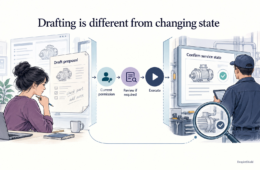
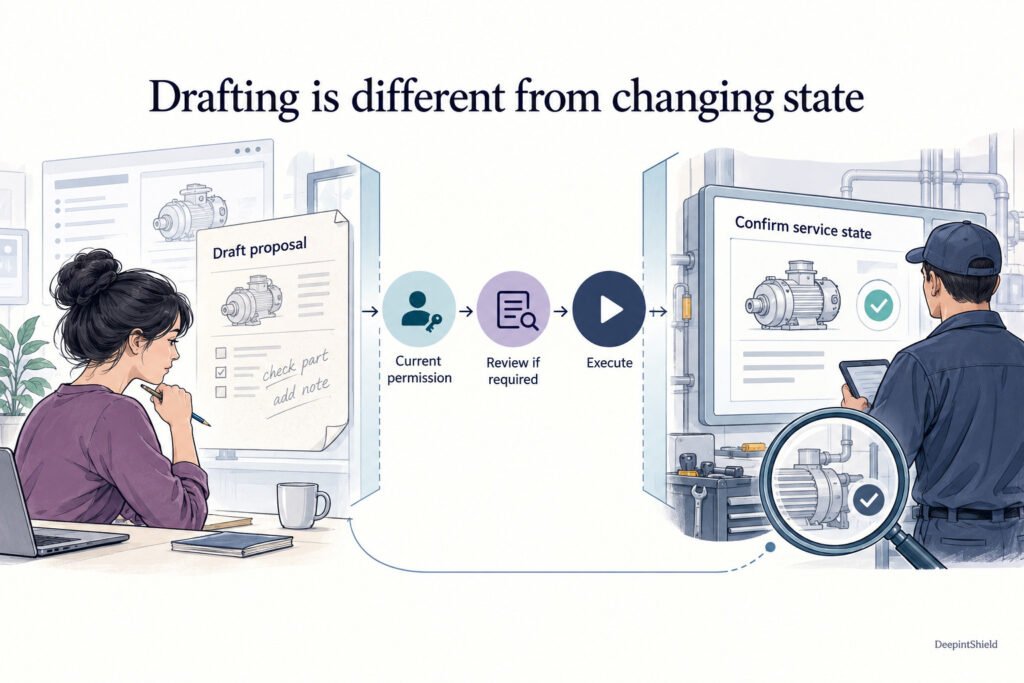
Figure: A drafted work order crosses a controlled threshold only after permission and any required review. The destination’s confirmed service state is checked separately from authorization.
Start with business actions people recognize
List the tasks in plain language: read the catalog, prepare a quote, apply a discount, send the offer. Then connect each task to its actual tool and target resource. This lets business owners and engineers discuss the same boundary instead of treating every function as equally sensitive.
An agent may be able to prepare a draft while a price change needs another permission or independent approval. Keep those choices in the access model, not only in the prompt. A well-written instruction can guide the model, while the execution layer provides the decision that determines what may actually run.
Use identity, contracts and permissions together
Identity establishes which workload is making a request. A tool contract describes the interface presented to the model. Authorization connects the caller to the particular resource, tool and action. These layers complement content checks on supported prompts, retrieved material and responses.
DeepintShield brings its server-owned MCP execution paths to a common authorization boundary when Agentic security is enabled. Only an exact Allow permits execution. Tool-definition drift is reviewed before a changed contract is accepted, and high-impact actions can be held for a designated reviewer under separation-of-duties rules.
Make the control visible to the people operating it
A useful operator view should explain which action was requested, what decision applied and what happens next. Pending review should look different from a completed action, and an unavailable authorization service should not appear as a business approval. Stable application handling and readable evidence make these distinctions easier to maintain.
In DeepintShield, the work queue and activity records support that review process. Confirm that the actual framework and tool route send the expected evidence. Calls outside the supported enforcement path need their own controls and should not be counted as covered simply because the same application also uses the gateway.
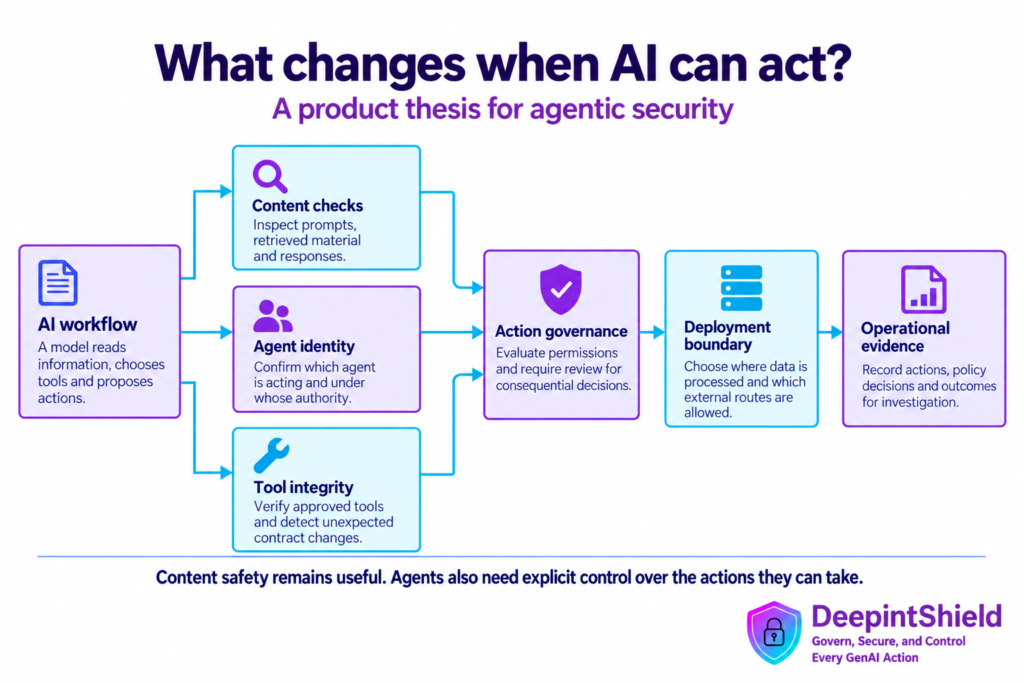
Visual guide: Agentic Security: Why AI Actions Need Clear Controls
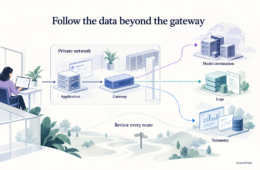
Figure: An agentic-security diagram contrasts content checks with added controls for agent identity, tool integrity, action approval, deployment boundaries and evidence.
Expand capability through a tested workflow
Begin with one action the team understands. Test valid access, missing permission, independent approval and an unavailable dependency. Review the tool’s own credentials and destination access as well, because gateway governance complements the service’s existing security responsibilities.
When the workflow adds a new tool or purpose, repeat the review. Deployment choices also remain relevant: a local gateway can still use an approved external provider, and the team should understand that data route. Judge the security design by the decisions and evidence it produces for real work, rather than by an assumed market category or a broad promise of autonomy.
Design the transition from drafting to acting
A facilities assistant might initially answer questions about maintenance schedules, then gain the ability to create a work order. That new capability introduces target selection, scheduling, cost and notification consequences. Define the work-order operation narrowly: which building it may address, which fields it may supply and which changes need additional review. Keep reading a schedule separate from submitting or cancelling work. A clear action model lets an owner approve useful automation without granting every capability exposed by the underlying service account.
Use the actual tool and business resource identifiers in that design. An appealing tool description helps the model choose an operation, but the execution boundary needs trusted identity and a current permission decision. The MCP tool execution guide describes DeepintShield’s governed paths when Agentic authorization is enabled. Verify that the framework reaches those paths. A local helper that independently calls the maintenance API does not acquire equivalent protection merely because its model requests use the same gateway.
Separate decision, execution and business completion
Model the application states explicitly. A proposed action is not yet authorized; a pending review has not executed; an allowed call may still fail in the destination service. After execution, verify the returned identifier or authoritative service state before telling the user that the work order exists. If the connection fails after submission, reconcile with the destination before blindly repeating a consequential operation. Application-level deduplication or service-supported idempotency should be designed for that operation; do not assume the gateway provides a universal exactly-once guarantee.
Preserve the distinctions in operational evidence as well. Link the request to the permission decision and, where available, the resulting business record. If the destination rejects a required field, show that failure without describing the security decision as incorrect. If authorization is unavailable, the governed boundary should not treat that condition as permission. The agentic security guide provides the authorization behavior to test, while the application owner remains responsible for service-specific recovery and truthful user-facing completion messages.
Expand authority one reviewed operation at a time
Begin with representative legitimate work orders and controlled negative cases: another building, an unapproved category, a changed tool schema and an expired approval. Check both the decision and the destination state. Include a harmless request that resembles a suspicious phrase to assess unnecessary blocking, but do not let a content detector’s confidence determine business permission. DeepintShield’s guardrails documentation describes supported content surfaces; these checks complement the relationship and action boundary rather than replacing it.
When the assistant later gains cancellation or contractor-contact capabilities, review the new consequences and update the tests. Check the destination credentials for excess authority and ensure that direct access paths are controlled separately. Establish who handles unresolved reviews, failed calls and unexpected completed actions. This creates a practical basis for increasing automation: a named owner can inspect what changed, see why the operation was allowed and understand how to recover. Broad autonomy claims are less useful than a demonstrated, maintainable boundary around the work the assistant actually performs.
Frequently asked questions
When should a team add agentic security controls?
Review them before an AI workflow receives meaningful access to tools or business data. The appropriate controls depend on the action and its consequences, and should be revisited as the workflow changes.
Does successful authorization mean the business task succeeded?
No. Authorization permits a specific operation under the checked conditions. The destination may reject it, time out or return an error. The application should track execution separately and confirm the resulting business state before announcing completion. Recovery also needs operation-specific handling so an uncertain response does not trigger duplicate consequential work.
Documentation and further reading
Related guide: Agentic AI Security: How PEP and PDP Protect Tool Calls