
AI Logs
LLM Hallucination Checks: Grounding and Answer Quality
LLM Hallucination Checks: Grounding and Answer Quality A useful AI answer should address the question and show where its factual claims come…
Meet DeepintShield at Bengaluru Tech Summit 2026, 17 to 19 November, BIEC Hall 1, booth H1A106. Book 20 minutes
Platform · Hallucination Defense
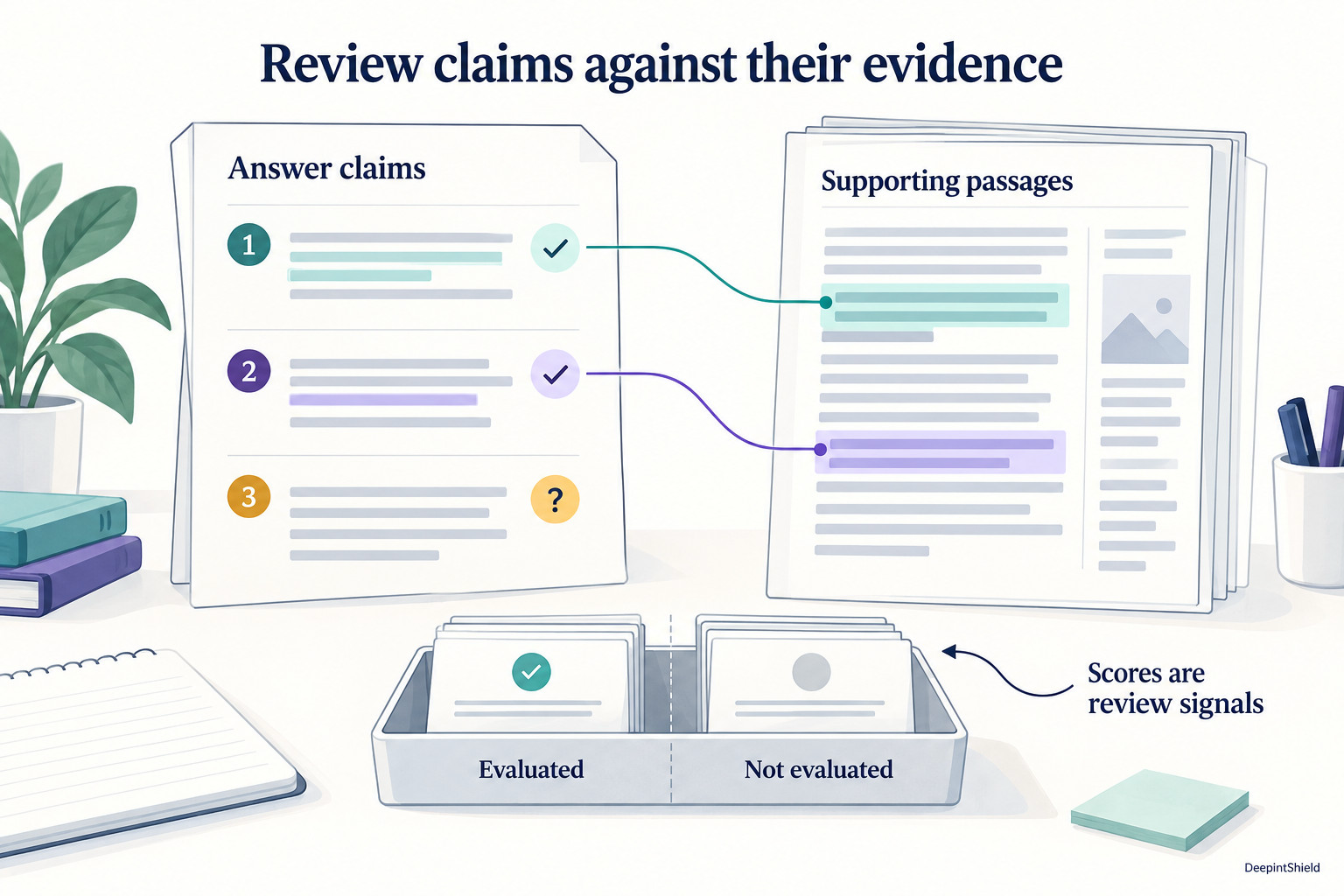
LLM hallucination detection checks whether a model’s answer is supported, relevant and consistent. DeepintShield adds grounding instructions before the model runs, scores sampled answers with five detectors and an overall risk score, and can return the same approved answer to equivalent questions. Scoring runs after the response, so users do not wait.

Grounded answers start with trusted context: RAG Security checks what is retrieved, and Hallucination Defense checks what the model says.
A confident answer with no support in the source can mislead a customer, an employee or an auditor.
The same question gets different answers on different days, which is hard to defend in regulated work.
Without a score, teams cannot see whether answer quality is improving or report it to risk owners.
Hallucination Defense combines checks before the model runs with scoring after it answers. See how the gateway handles a request end to end.
With Response Consistency on, a pinned golden answer or a verified earlier match can be returned first.
Directives ask the model to stay grounded, cite sources and hedge when unsure, with no extra model calls.
After the response, five detectors score sampled answers and combine them into an overall risk score.
Adjust strictness, the consistency threshold and the sample rate as the scores come in.
Each control works on its own, so you can start with grounding and scoring, then add consistency for high-stakes topics.
Stay grounded, don’t make things up, require sources, hedge when unsure and reduce randomness, at low, medium or high strictness.
Faithfulness, answer relevance, coherence, helpfulness and citation precision, combined into an overall hallucination-risk score.
Scoring runs asynchronously on a sample of traffic. A 10% sample rate is the recommended starting point.
Modes from Exact-Match to Semantic + Pinned and Strict give equivalent questions the same answer.
Load approved answers from CSV. Entries are versioned, scanned by guardrails and fail closed.
A verifier can check borderline semantic matches, or all of them, before an earlier answer is reused.
Hallucination Defense and Response Consistency are available on the Business plan and above. The helpfulness detector uses one extra judge call. Compare plans.
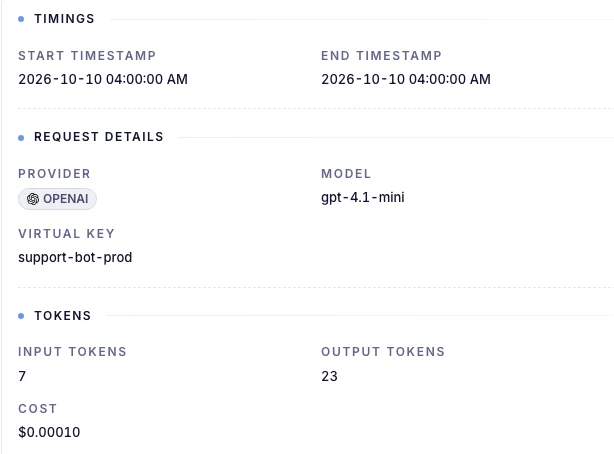
Hallucination Defense runs on the same gateway traffic as guardrails and cost controls. Every request already has a detail record with timing, tokens, cost and guardrail results, which you review in Observability & Audit. The consistency settings are explicit and documented:
 Tap to enlarge(opens the full-size image in a new tab)
Hallucination Defense works on requests that pass through the gateway. Point your existing client at DeepintShield with a virtual key, then turn on grounding, scoring and consistency in the gateway settings. All options are in the Hallucination Defense docs.
import openai

client = openai.OpenAI(
    base_url="https://app.deepintshield.com/openai",  # Point to DeepintShield
    api_key="sk-ds-your-virtual-key"
)import os
from langchain_openai import ChatOpenAI
llm = ChatOpenAI(
model="anthropic/claude-sonnet-4-5",
base_url="https://app.deepintshield.com/v1",
api_key=os.environ["DEEPINTSHIELD_VIRTUAL_KEY"],
)
print(llm.invoke("Hello!").content)Mapped to
Mapping supports your own assessment; it does not replace it.
LLM Hallucination Checks: Grounding and Answer Quality A useful AI answer should address the question and show where its factual claims come…
DeepintShield team · · 5 min read

AI Chatbot Reliability: Keep Answers Tied to Policy A customer asking about a refund needs an answer that fits the actual booking…
DeepintShield team · · 5 min read

RAG Re-Ranking: Choose Useful Context for Your LLM Retrieval often returns passages about the right topic without identifying the ones that answer…
DeepintShield team · · 5 min read
An LLM hallucination is an answer that sounds confident but is not supported by the sources or facts the model was given. It matters most where answers drive decisions, such as finance, healthcare or customer support.
Five detectors score each sampled answer: faithfulness, answer relevance, coherence, helpfulness and citation precision. Their results combine into one overall hallucination-risk score that you can track over time.
No. Scoring runs asynchronously after the response is returned, and grounding directives add no extra model calls. The helpfulness detector's judge call is part of that after-the-response scoring.
A golden answer is an approved response that you pin for a known question. The Golden Registry loads golden answers from CSV, versions them, scans them with guardrails and fails closed, so equivalent questions get the approved wording.
Response Consistency has five modes: Off, Exact-Match, Semantic, Semantic + Pinned and Strict. Strict fixes sampling at temperature 0, seed 42 and top-p 1, and semantic matches must clear a similarity threshold of 0.93 by default.
Hallucination Defense and Response Consistency are on the Business plan and above. See the plan comparison for what each plan includes.
Score and gate retrieved chunks for injection, poisoning, personal data and source trust before they reach the model.
Explore RAG security
Logs, metrics and a hash-chained ledger for every request, verdict and agent decision.
Explore observability
Twelve techniques, from prompt caching to cascade routing, that cut repeated and oversized model work.
Explore cost optimization
Book a demo to see Hallucination Defense on Cloud Business, or start free and route your first requests.