
AI Logs
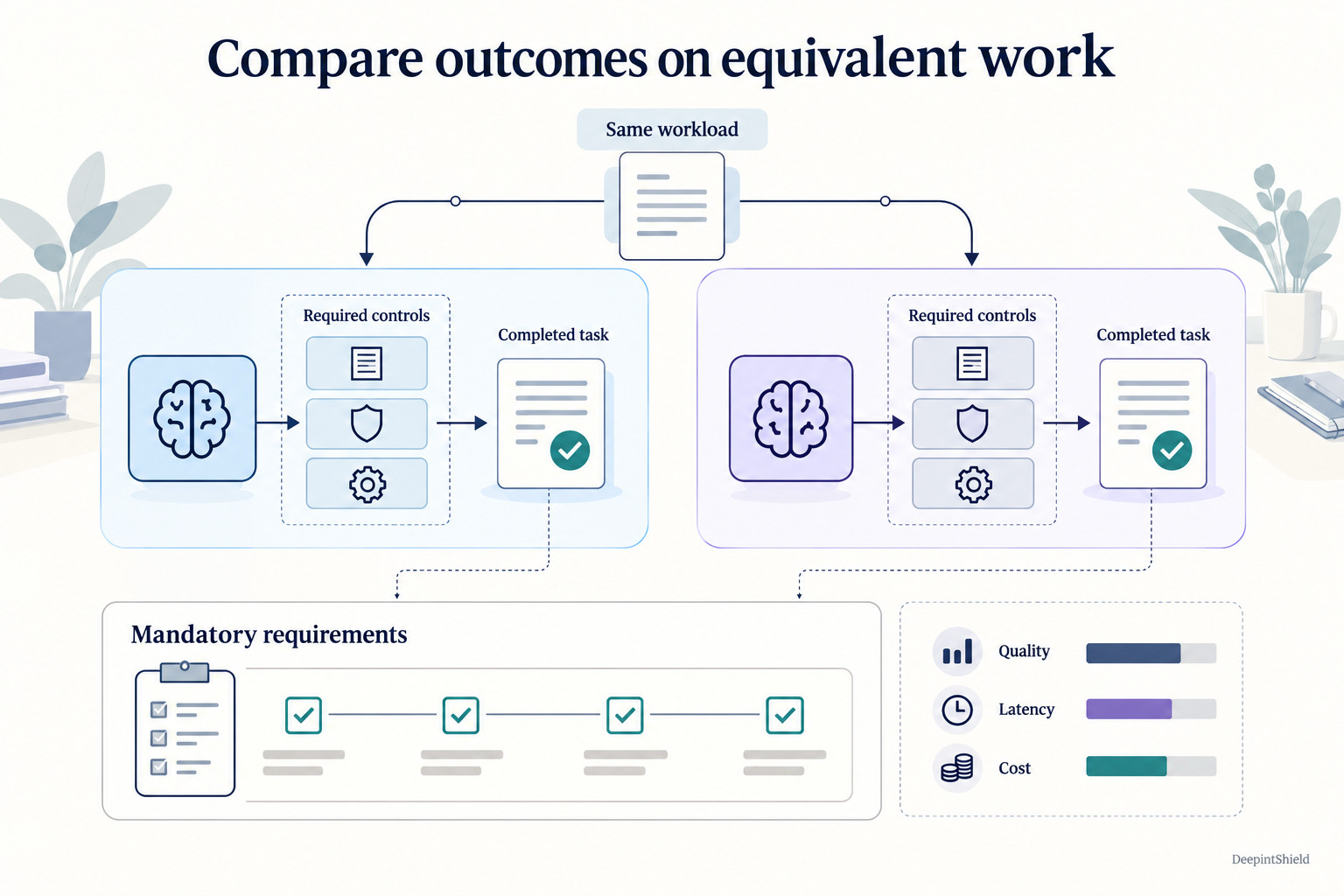
AI Gateway Comparison: Eight Questions to Test
AI Gateway Comparison: Eight Questions to Test An AI gateway comparison becomes more useful when every feature claim is linked to a…
Meet DeepintShield at Bengaluru Tech Summit 2026, 17 to 19 November, BIEC Hall 1, booth H1A106. Book 20 minutes
Platform · AI Gateway
An AI gateway is a single entry point between your applications and the LLM providers they call. The DeepintShield AI gateway puts 29 built-in model providers behind one OpenAI-compatible API, with weighted load balancing, fallbacks, budgets and request logging built in. Run it as a managed service or inside your own environment.

Once more than one team ships an LLM feature, the same three problems appear.
Each team calls providers in its own way, so switching models or adding a control means changing every codebase.
When one provider returns errors or 429 responses, an app with no fallback path fails in front of customers.
Provider keys live in many places, and nobody can see or cap what each team or customer spends.
Requests reach one OpenAI-compatible endpoint, authenticated with a DeepintShield virtual key.
Model access, budgets and rate limits are checked for the customer, team, virtual key and provider.
Weighted load balancing selects a key; errors and timeouts move the call to your fallbacks.
Tokens, cost and latency are logged and exposed to OpenTelemetry and Prometheus.
Routing, resilience and spend control live in the gateway, so each application stays simple.
Keep OpenAI, Anthropic, Google GenAI, Bedrock or LiteLLM client code; change the base URL and the key.
Spread traffic across keys and providers by weight, with per-key model lists and Azure or Bedrock deployment mappings.
Errors, 429s and timeouts move the call to your backup providers in order; a circuit breaker removes failing keys.
On Team and above, traffic shifts to the best-performing keys by error rate, latency and utilisation.
Set budgets and request or token limits per customer, team, virtual key and provider; over-budget providers leave the route.
Add rules that steer requests between providers: 1 on Developer, 10 on Team, 25 on Business, unlimited on Enterprise.
The Model Hub lists every configured provider and model, and GET /v1/models returns the live list. Override prices for negotiated rates, and see cost by virtual key, team and customer. Provider prompt caching is on by default, which lowers input cost on supported providers with no change to your app.
Point your existing OpenAI client at the gateway and use a virtual key instead of a provider key. Select any provider with a provider/model prefix, such as openai/gpt-4o-mini. Provider credentials stay on the gateway. For new projects, the Quick Start walks through the first call.
import openai

client = openai.OpenAI(
    base_url="https://app.deepintshield.com/openai",
    api_key="sk-ds-your-virtual-key"
)pip install openai
export OPENAI_BASE_URL="https://app.deepintshield.com/v1"
export OPENAI_API_KEY="sk-ds-your-virtual-key"from openai import OpenAI
with OpenAI() as client:
response = client.chat.completions.create(
model="openai/gpt-4o-mini",
messages=[{"role": "user", "content": "Hello!"}],
)
print(response.choices[0].message.content)Mapped to
Product facts
An AI gateway is a single entry point between your applications and the model providers they call. It gives every app one API and applies routing, fallbacks, budgets and logging in one place, instead of in each codebase. See the full request path.
Usually only the base URL and the API key change. Point an OpenAI, Anthropic, Google GenAI or Bedrock client at the gateway and authenticate with a virtual key. Compatibility is route-specific, so test the exact endpoints and SDK version your application uses.
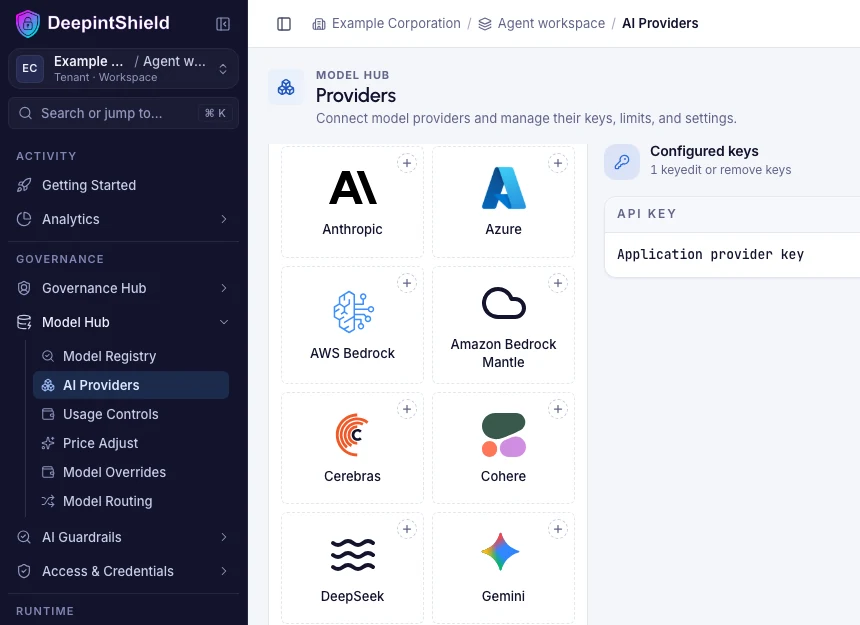
DeepintShield ships 29 built-in model providers, plus custom OpenAI-compatible endpoints. They include OpenAI, Anthropic, Azure, AWS Bedrock, Vertex AI, Google Gemini, Mistral, Cohere, Groq, DeepSeek, xAI, Ollama and vLLM. Browse all integrations.
The gateway tries your fallback providers in the order you set. Network errors, 5xx responses, 429 rate limits, timeouts and unavailable models trigger a fallback; validation errors and policy blocks do not. If every attempt fails, you get the original error. Read the fallback docs.
It adds some, and the amount depends on your workload, policies and deployment. DeepintShield publishes mechanisms rather than an end-to-end figure: speculative dispatch makes allow-path latency max(guards, model) instead of guards + model, and eligible deterministic guard decisions are reused in about 1.42 µs (local microbenchmark, no I/O). Measure it on your own traffic.
The Developer plan is free for 50,000 requests a month, and Cloud Team starts at $49 a month. You bring your own provider keys and pay providers directly, with 0% token markup. Compare plans and pricing.
AI Gateway Comparison: Eight Questions to Test An AI gateway comparison becomes more useful when every feature claim is linked to a…
DeepintShield team · · 5 min read
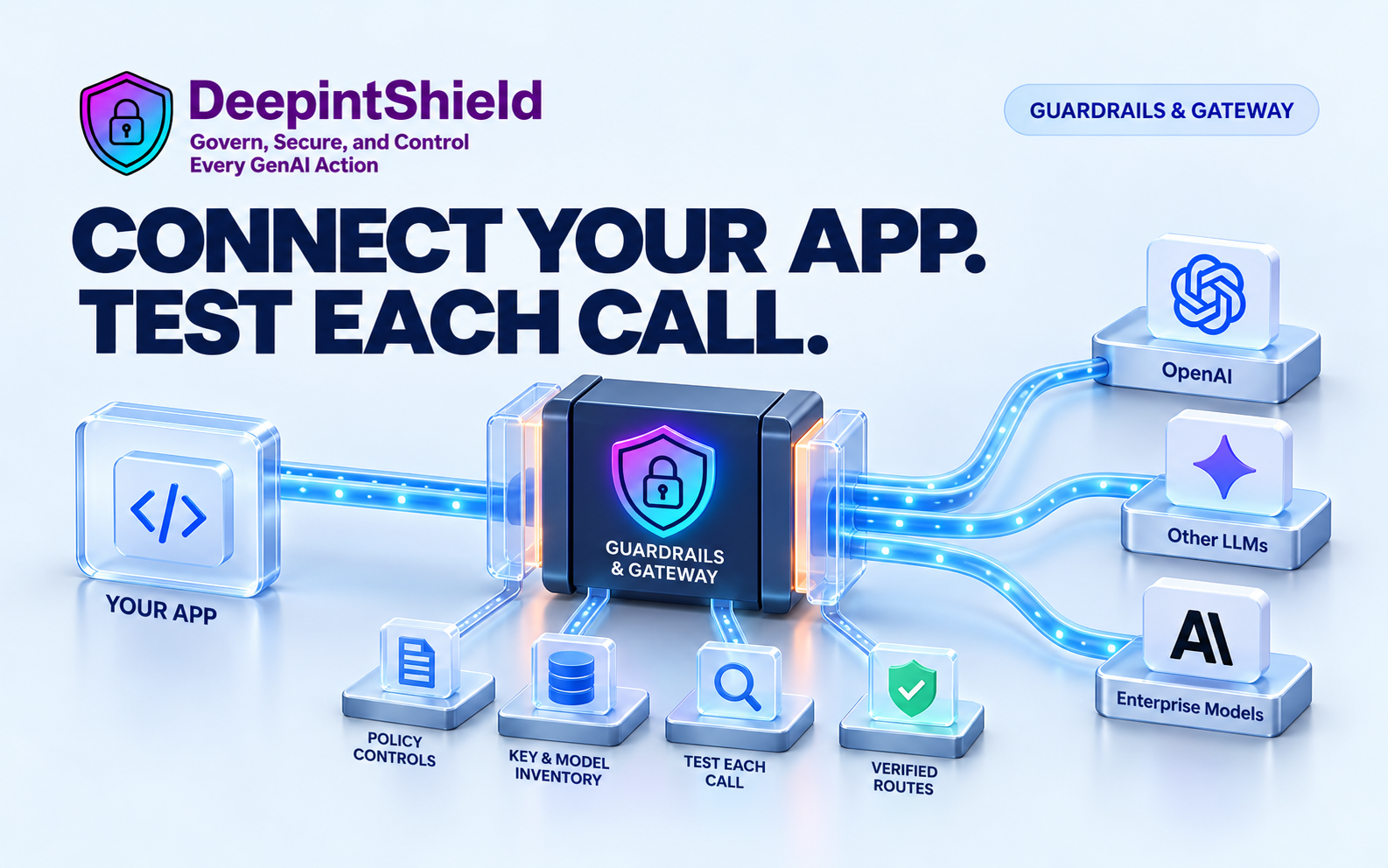
OpenAI Gateway Migration: More Than a Base URL Change Changing a base URL can be the first step in an OpenAI gateway…
DeepintShield team · · 5 min read
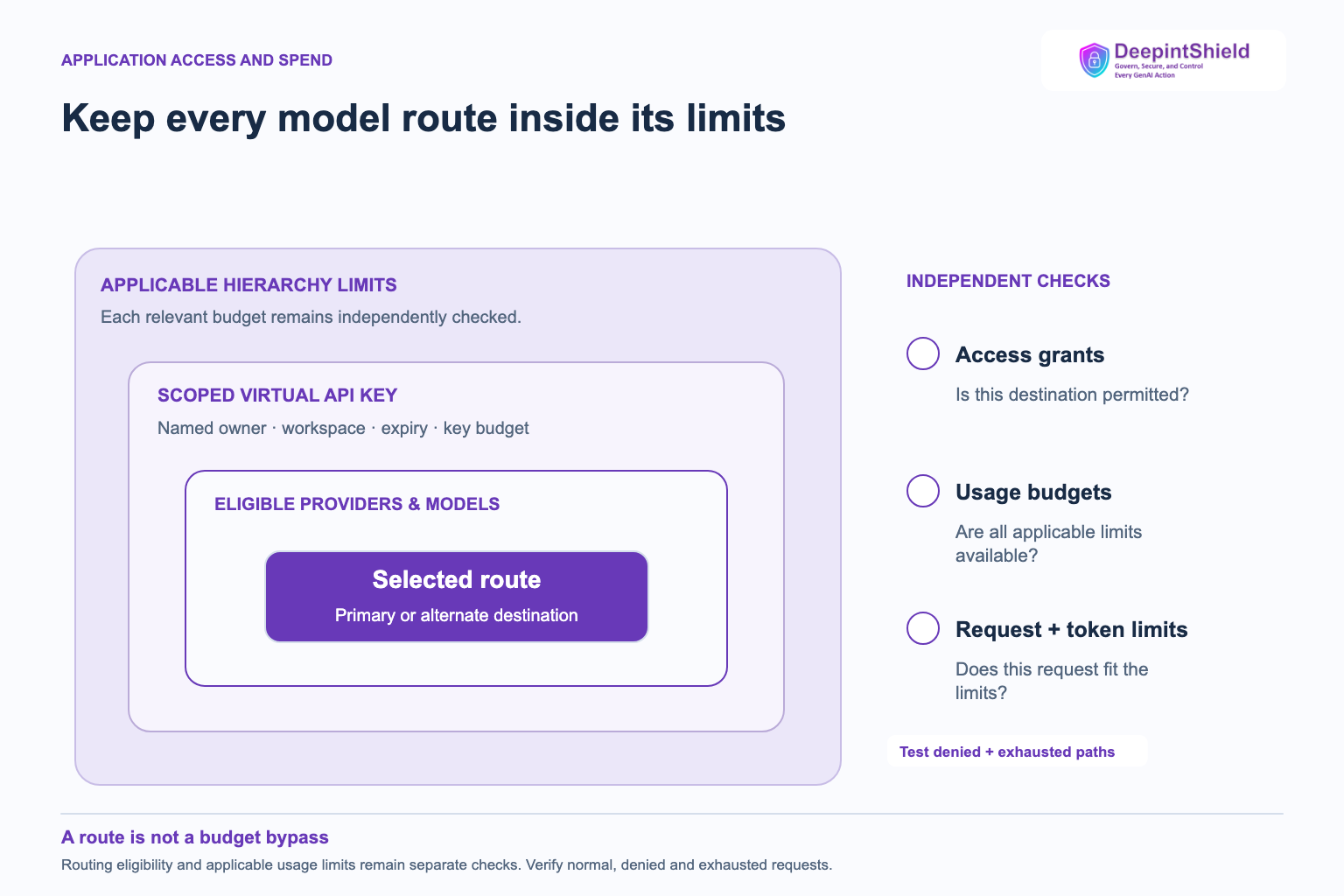
Virtual API Keys: Budgets, Model Access and Routing Boundaries An application credential should express which AI services the application can use and…
DeepintShield team · · 9 min read
Twelve cost techniques, from semantic caching to cascade routing, applied in the same gateway.
Explore Cost Optimization
Virtual keys, budgets, role-based access and SSO over OIDC for every team that uses the gateway.
Explore Governance
Check prompts and responses for injection, jailbreaks, secrets and personal data on the same request path.
Explore Runtime Guardrails
Start free with 50,000 requests a month, or talk to us about running the gateway in your own cloud.