

AI Logs
Five Stages of LLM Guardrails: What Each One Checks
Five Stages of LLM Guardrails: What Each One Checks An AI workflow can receive a question, retrieve a document, call a tool…
Meet DeepintShield at Bengaluru Tech Summit 2026, 17 to 19 November, BIEC Hall 1, booth H1A106. Book 20 minutes
Platform · Runtime Guardrails & PII
LLM guardrails are checks that inspect what goes into and comes out of a model. DeepintShield can apply them at five stages: input, RAG, action, MCP and output. Local patterns and ML detectors catch prompt injection, jailbreaks, secrets and personal data, then your policy passes, redacts, blocks or flags the content.

A filter on the user’s prompt sees one door. Attacks and leaks use the others.
Hidden instructions come through retrieved documents, tool results and MCP responses, not only through the user’s prompt.
Personal data and secrets end up in prompts, model answers, streamed output and request logs.
Sending every prompt to a third-party classifier moves the sensitive content you wanted to protect outside your boundary.
The gateway checks input and output; the SDK and MCP gateway add RAG, action and MCP checks.
Local patterns run without network or model calls; ML detectors add classifiers on Team and above.
Each finding is passed, redacted, blocked or flagged, in sync, async or shadow mode.
Guardrail violations and injection attempts land in the hash-chained audit log for review.
One policy engine covers detection, redaction and rollout, on every plan.
Input, RAG, action, MCP and output checks share one versioned policy, bound to a virtual key.
462 detection patterns in 102 preset families run locally; the ML detector sidecar is on Team and above.
Rewrite emails, card numbers, national IDs, API keys and private keys in prompts, responses and streamed output.
OWASP LLM Top-10 guardrail cards come with every plan, plus OWASP Agentic ASI cards for agent risks.
Run a policy inline, after the response, or in shadow mode to log findings without changing traffic.
On Team and above, add AWS Bedrock Guardrails, Azure AI Content Safety, Google Model Armor or your own webhook.
Pattern counts are configuration entries, not a measure of detection accuracy. Multimodal checks are off by default.
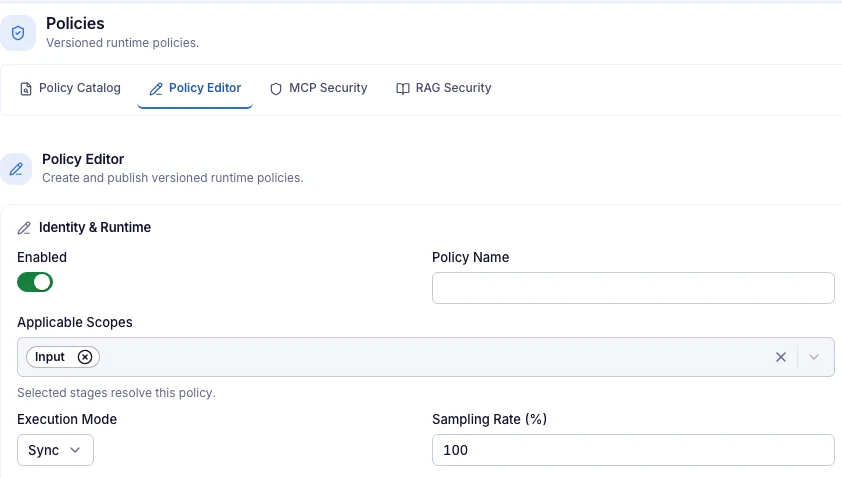
Turn on deterministic guardrails, choose the PII categories to check on input and output, add custom regex rules and pick what happens on a violation. Domain packs cover banking and financial services, healthcare and insurance. The Developer plan includes one guardrail policy; Team and above allow unlimited policies. Compare plans.
Route your client through DeepintShield and the policies bound to its virtual key check input and output on every request. Blocked requests return HTTP 403 guardrail_blocked. For explicit checks in Python, the SDK’s guard() raises an error on a block, evaluate_guardrail() returns a verdict, and guard_turn() checks input, tools and output in order. Tool calls through the MCP gateway can be checked on the MCP stage.
import openai

client = openai.OpenAI(
    base_url="https://app.deepintshield.com/openai",
    api_key="sk-ds-your-virtual-key"
)
Mapped to
Product facts
LLM guardrails are runtime checks on what goes into and comes out of a language model. In DeepintShield they can run at five stages (input, RAG, action, MCP and output), and each finding is passed, redacted, blocked or flagged. See where each stage sits in the request path.
It matches local patterns first, then optional ML detectors. 462 patterns in 102 preset families cover prompt injection, retrieval and memory, credentials, tools and agentic controls, and run without network or model calls; the ML detector sidecar adds classifiers on Team and above. An unmatched request is not proof of safety, so keep tool permissions tight as well. Read the pattern catalogue.
Not by the built-in detectors. Pattern matching runs locally and PII detection runs inside your own deployment. Content goes to an outside service only if you add a safety provider, such as AWS Bedrock Guardrails or Google Model Armor, to a policy.
It depends on your policies and workload, so measure your own. Eligible deterministic guard decisions are reused in about 1.42 µs (local microbenchmark, no I/O), output checks can run as async post-guards, and per-category timeouts cap slow detectors. Read the performance docs.
Yes. Run the policy in shadow mode or with the Monitor only action, and findings are logged while traffic is unchanged. When the results look right, enforce it on one virtual key before you widen it. See the rollout steps.
Five Stages of LLM Guardrails: What Each One Checks An AI workflow can receive a question, retrieve a document, call a tool…
DeepintShield team · · 5 min read
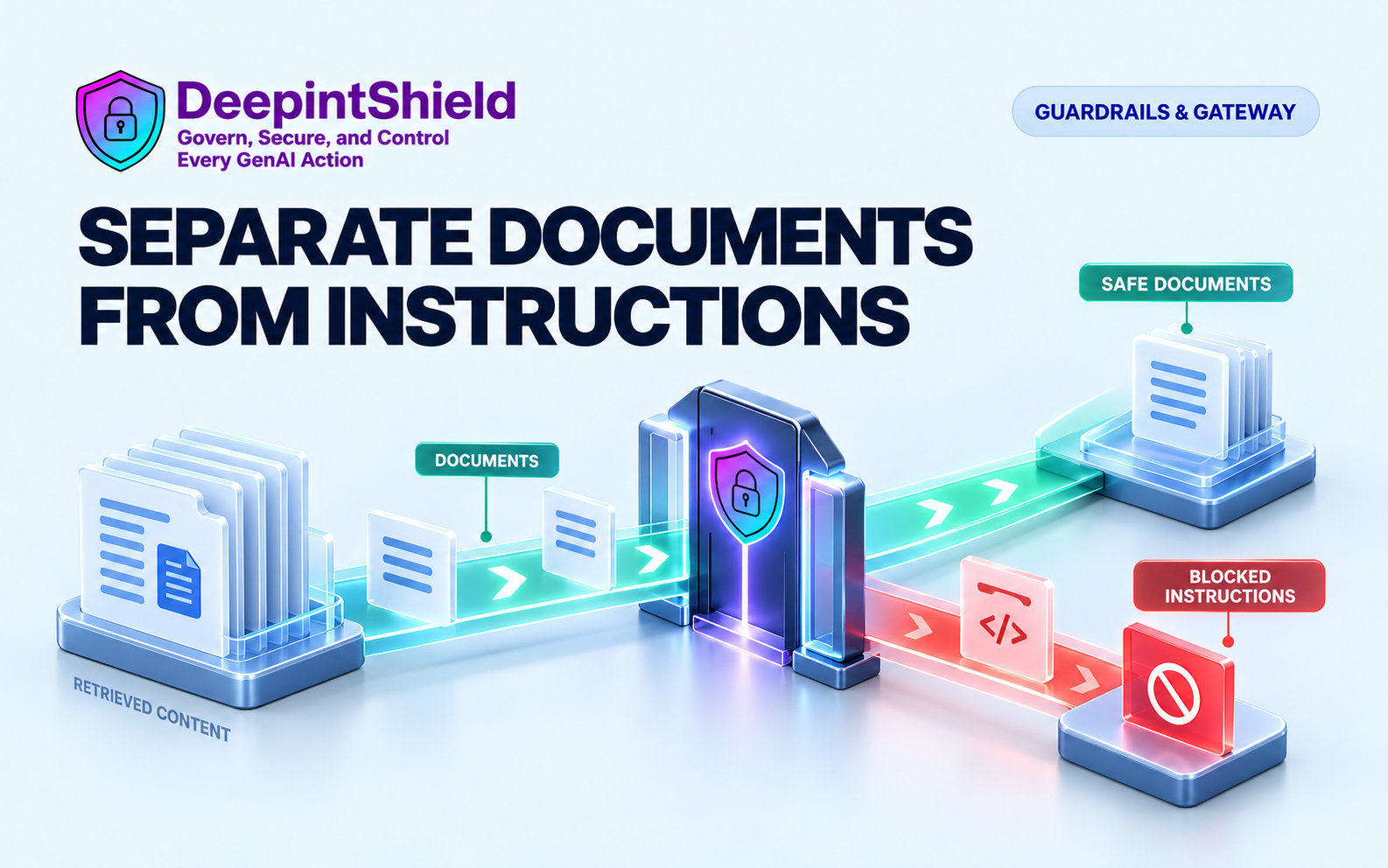
Indirect Prompt Injection: Protect Retrieved Content An assistant may receive a perfectly ordinary request and then read a document containing instructions aimed…
DeepintShield team · · 5 min read
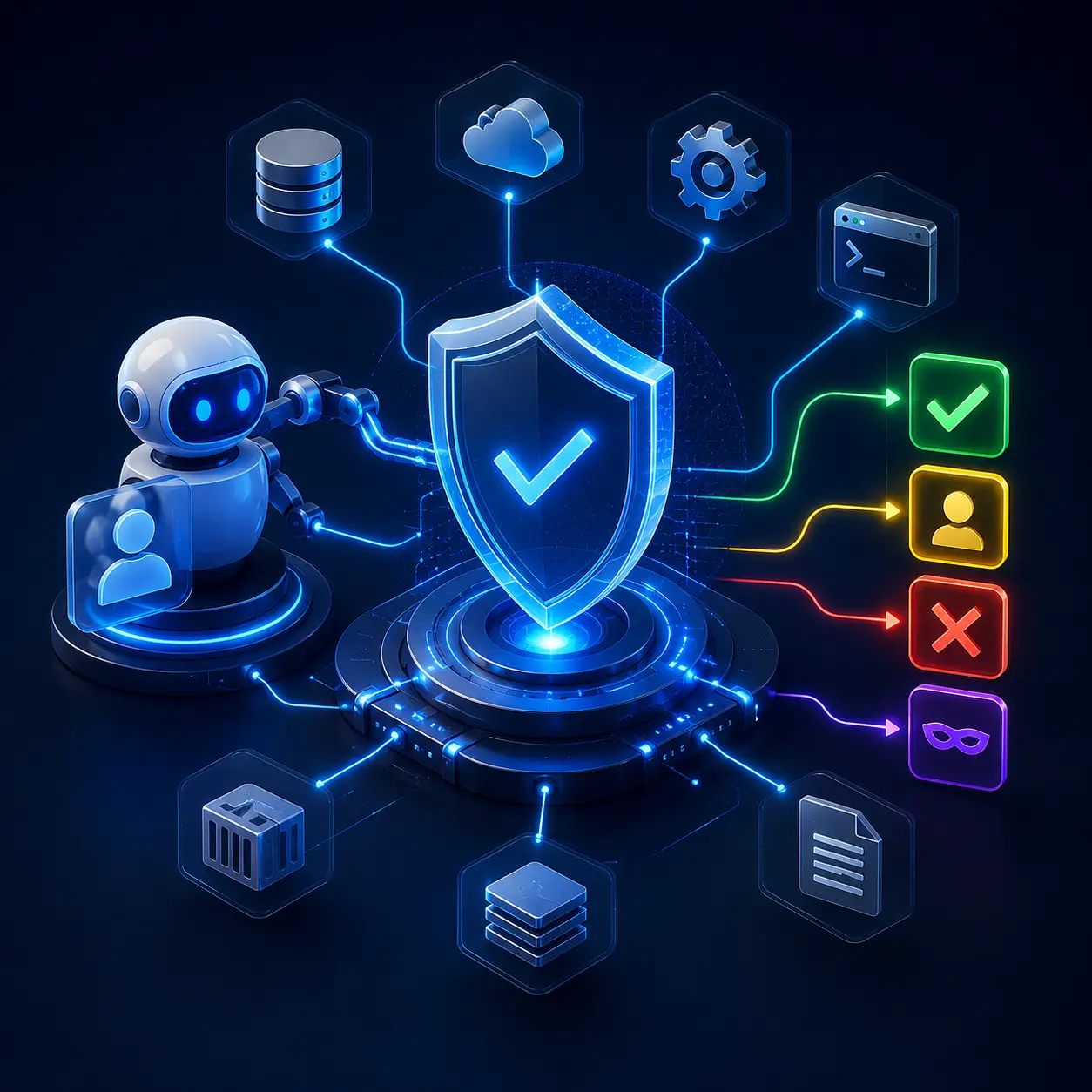
OWASP Agentic ASI Top 10: Risks and Practical Controls The OWASP Agentic ASI Top 10 (2026) is a framework that lists the…
DeepintShield team · · 6 min read
Score every retrieved chunk for injection, poisoning, secrets and source trust before the model reads it.
Explore RAG Security
Give every agent tool call an Allow, Deny or Require approval decision before it runs.
Explore Agentic Security
Turn guardrail findings and audit records into evidence mapped to OWASP, NIST AI RMF and ISO/IEC 42001.
Explore AI Compliance
Start free with one guardrail policy on the Developer plan, or book a demo on your own traffic.