
Platform
AI runtime security for LLM apps, RAG and AI agents
AI runtime security protects AI systems while they run, not only before release. DeepintShield sits between your applications, models and tools. It checks each prompt, retrieved chunk, tool call and response against your policy, decides what happens next and keeps a tamper-evident record of every decision.
- Five enforcement stages
- 29 built-in model providers
- Managed, hybrid or self-hosted
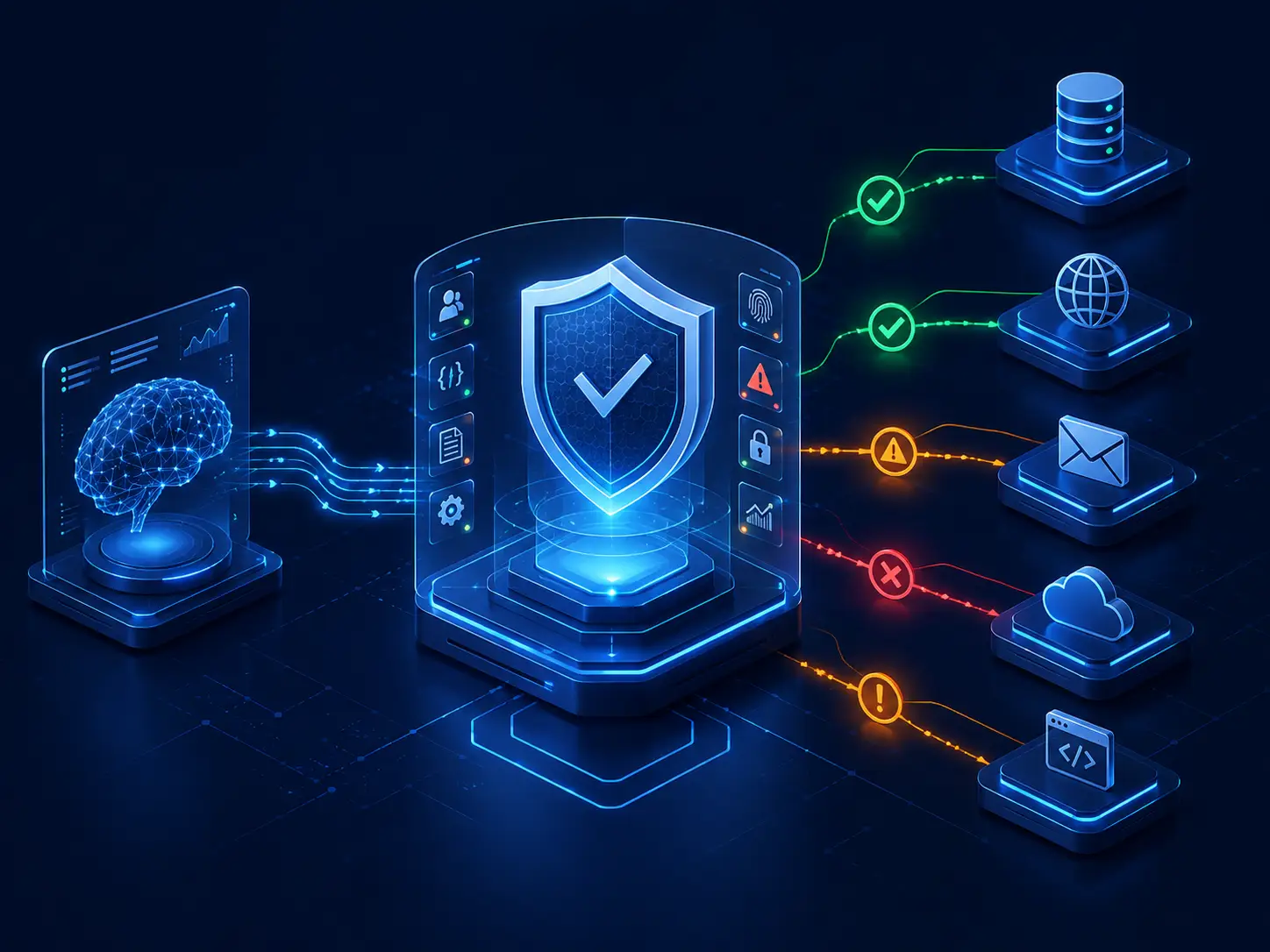
Four AI runtime security risks that firewalls and DLP miss
Prompt injection and jailbreaks
Instructions hidden in prompts, documents or tool results try to override your system prompt.
Personal data and secrets
Customer data, credentials and API keys flow into prompts and come back out in answers.
Unchecked tool and MCP calls
Agents call tools and MCP servers with no policy decision before the action runs.
No record an auditor can verify
Plain logs can be edited, so nobody can prove what an AI system did, or why.
Secure: guardrails for prompts, RAG, agents and MCP
Four capabilities share one policy across five enforcement stages: input, RAG, action, MCP and output.
- Runtime Guardrails & PII checks prompts and responses with 460+ detection patterns and 6 ML detectors (Team and above).
- RAG Security scores every retrieved chunk before the model reads it.
- Agentic Security gives each agent tool call Allow, Deny or Require approval (Business and above).
- MCP Gateway governs MCP servers with pinned tool definitions and OAuth 2.1.
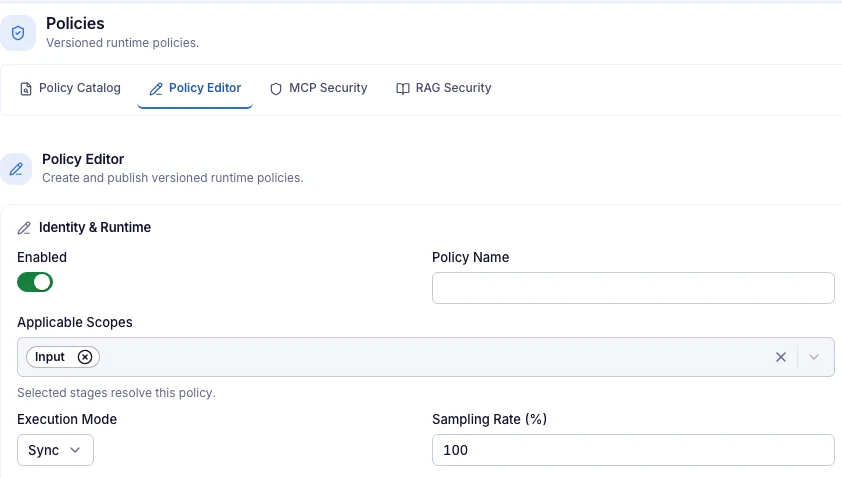
Govern: identity, budgets, audit and answer quality
Three capabilities give security and compliance teams control and proof.
- Governance sets virtual keys, budgets and rate limits per customer, team and key, with SSO over OIDC and role-based access.
- Observability & Audit keeps a hash-chained audit trail you can check with Verify chain, and exports to OpenTelemetry and Prometheus.
- Hallucination Defense scores answers with five detectors plus an overall risk score (Business and above).
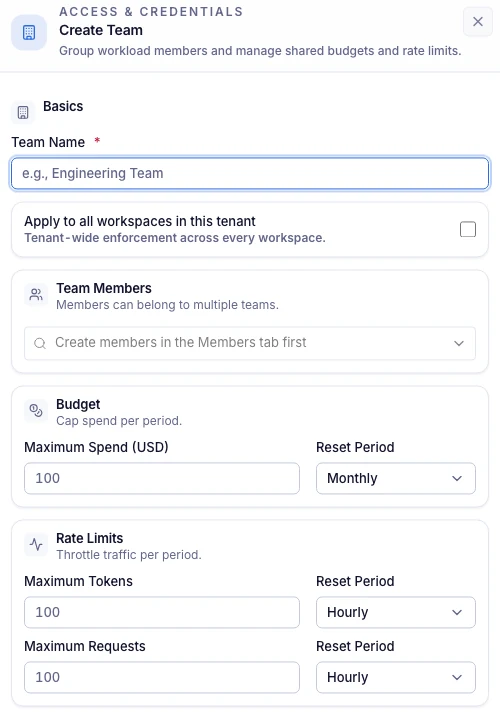
Optimise: one AI gateway that lowers cost
Two capabilities keep model access reliable and spend under control.
- The AI Gateway puts 29 built-in model providers behind one OpenAI-compatible API, with weighted load balancing and fallbacks.
- Cost Optimization offers 12 cost techniques, including semantic caching, provider prompt caching, cascade routing and prompt compression. Semantic caching (Team and above) saves up to 60% on repetitive workloads; your savings depend on the workload.
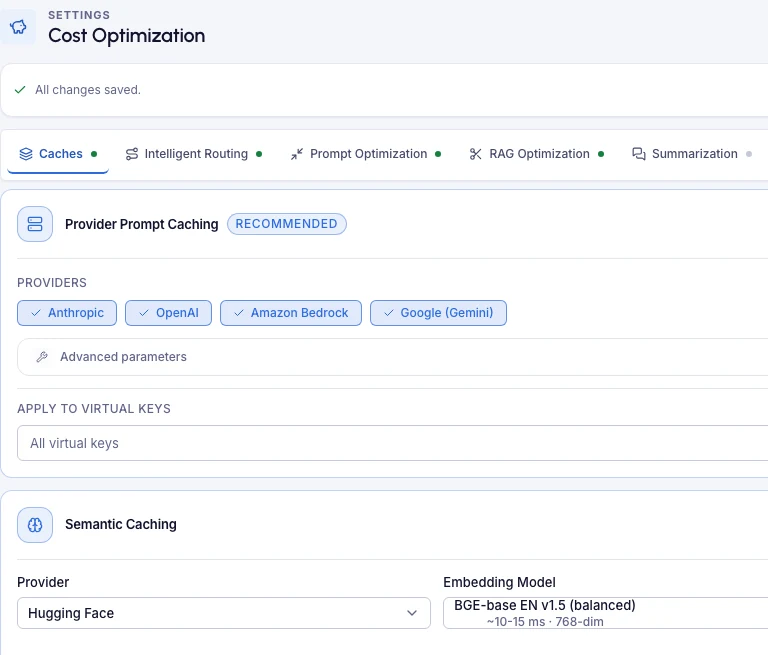
Policy as code, enforced before anything runs
Declare what a tool does and how risky it is in the code that defines it. Before the function body runs, the SDK checks the agent’s registration and asks for a decision. Agent actions get Allow, Deny or Require approval; content findings are passed, redacted, blocked or flagged.
- Versioned guardrail policies bound to virtual keys
- OpenFGA relationship checks, plus optional OPA (Rego) or Cedar context policy
- Agentic Security on Business and above
@shield.agentic.tool(
    "ledger.post",
    action="create_entry",
    action_class="write",
    recovery_cost="high",
)
def post_entry(row: dict) -> dict:
    return ledger.insert(row)
Integrate in three steps
1. Point your app at the gateway
Change the base URL and use a virtual key, or install the Python SDK.
2. Choose a policy
Start from OWASP guardrail cards or write your own, then bind it to a virtual key.
3. Watch the console
Review decisions, cost and audit records as traffic flows through the gateway.
From monitor to enforce in four steps
Roll a policy out without breaking production. Move to the next step when the findings look right on your own traffic. The guardrail docs describe each mode.
1. Monitor
Use the Monitor only action: findings are logged and traffic is unchanged.
2. Shadow
Run policies in shadow mode to see what would be blocked or redacted.
3. Canary
Enforce the policy on one virtual key, app or team before you widen it.
4. Enforce
Block, redact or require approval across all traffic, with every decision recorded.
See it on your own use case
Tell us what you want to see and how you would run it. We reply within one business day to agree a time.
- Pick a capability. Choose one of the nine capabilities, or the whole platform.
- See it live. An engineer runs it on a use case like yours.
- Review the results. Go through the decisions, cost and audit records together.
How DeepintShield compares
Most AI security tools focus on one layer. This table shows each vendor’s main layer and what DeepintShield adds alongside it.
| Vendor | Main layer | Best at | Where DeepintShield differs |
|---|---|---|---|
| Lakera | Prompt and agent guardrails, through an API | Screening prompts, outputs and agent steps for prompt attacks and data leaks; SaaS or self-hosted | A full AI gateway on the request path, with Require approval and OpenFGA record-level checks on every agent tool call |
| Portkey (now Prisma AIRS AI Gateway) | AI gateway | Routing, fallbacks, caching and observability across many providers, with guardrails and an MCP gateway | Allow, Deny or Require approval on every agent tool call, pinned MCP tool definitions and a hash-chained decision ledger |
| LiteLLM | Open-source LLM proxy (MIT licence) | One OpenAI-format API to many providers, with budgets, spend tracking, guardrail integrations and an MCP gateway | Guardrails at five stages built in, tool-call verdicts with human approval, and hash-chained audit evidence |
| CalypsoAI (now F5 AI Guardrails) | AI security | Inference-time guardrails and red-team testing, in the cloud, on-premises or air-gapped | A built-in multi-provider AI gateway with budgets and cost controls, plus agent and MCP governance |
| Protect AI (now part of Prisma AIRS) | Model and AI lifecycle security | Scanning models, securing the ML supply chain and AI red teaming | A runtime AI gateway with guardrails, agent tool-call verdicts and MCP control |
Vendor positioning is summarised at a high level and was last reviewed in November 2026. Check each product’s current features before you decide.
Not sure where you stand? Answer twelve short questions in the AI Runtime Risk Scan.
Put one trust boundary around your AI
Start free with 50,000 requests a month, or book a demo on your own stack.
Plans run from free to Enterprise Self-Hosted. See pricing.