AI Chatbot Reliability: Keep Answers Tied to Policy
A customer asking about a refund needs an answer that fits the actual booking and current policy. A helpful chatbot should make that rule easier to understand, including any facts still needed to apply it. Reliability comes from maintaining the source, checking the answer against it and making a support handoff straightforward when the available information does not settle the question.
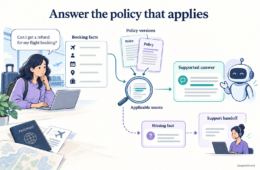
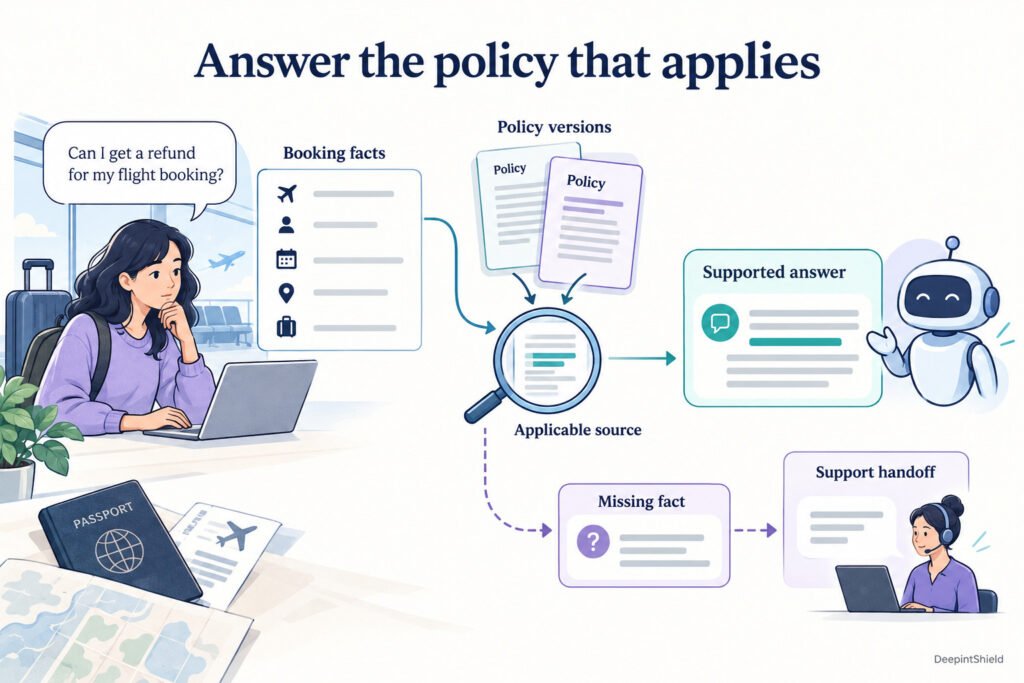
Figure: Booking facts and policy versions feed an applicable-source review before a supported customer answer. Missing facts take a separate path to a human support handoff.
Start with the policy owner
Assign someone to maintain the policy content used by the assistant. Keep the effective version and the conditions that matter, such as the purchase date, product type or booking category. If several documents describe the same process, decide which one is authoritative and how older material is handled.
Consider an illustrative travel assistant asked whether a discount can be claimed after booking. The policy might depend on when the ticket was purchased and which fare was selected. The assistant should ask for the missing fact or provide the relevant conditional explanation, rather than inventing an exception to produce a quick answer.
Check support for the complete answer
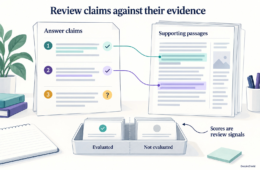
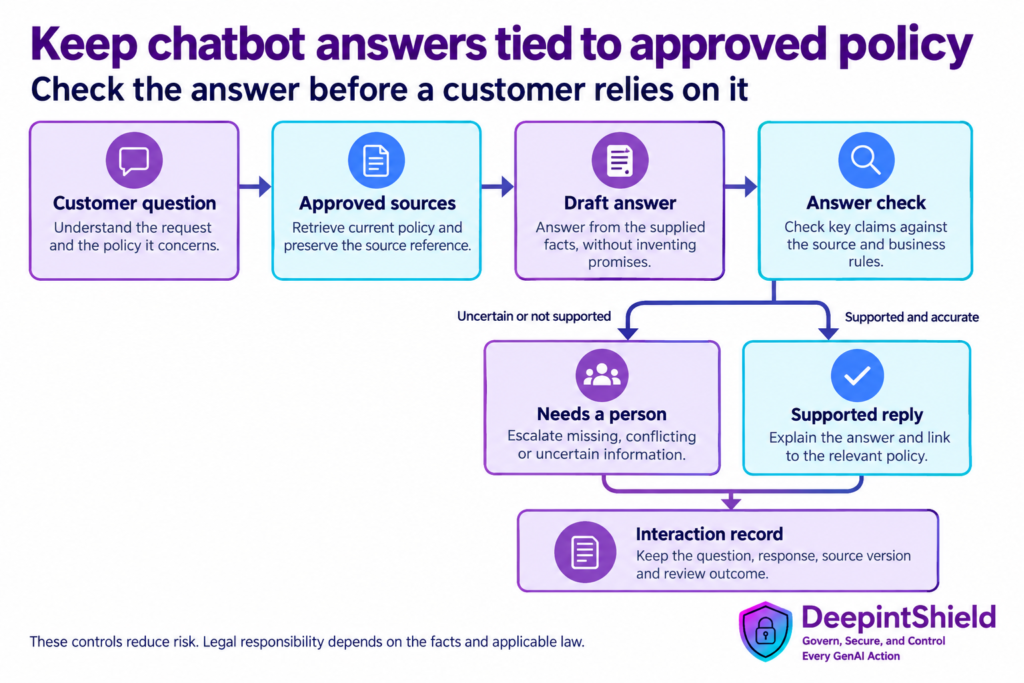
Give the model relevant approved passages and require citations where the workflow needs traceability. Inspect whether the cited passage supports the actual claim, including exceptions and limits. A link to the right document is useful, but it does not show that the assistant interpreted the document correctly.
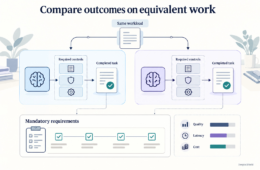
DeepintShield’s RAG controls can review submitted content and source context, while Hallucination Control supports grounding and sampled answer-quality evaluation. Use these as distinct signals. A source-content decision does not establish factual correctness, and a high quality score is not an authorization to change a reservation or issue a refund.
Choose the right response path
Define when the assistant may answer directly, when it should ask a clarifying question and when it should route the customer to a person. Give the receiving colleague the relevant question, policy version and useful context so the customer does not need to repeat the entire conversation.
If an output rule must block or redact content before delivery, use the supported synchronous path and appropriate buffering. Background quality scoring can help improve future responses, but it cannot revise text already seen by the customer. Confirm streaming behavior rather than assuming a final evaluation covers every earlier chunk.
Visual guide: AI Chatbot Reliability: Keep Answers Tied to Policy
Figure: Customer chatbot workflow with approved policies, answer checks, human escalation, a grounded reply and interaction records.
Retest after policy and cache changes
Maintain three simple examples for a policy question: a clearly eligible case, a clearly ineligible case and one missing a required fact. Add variations that change dates, amounts or product categories. These examples test the meaning of the answer instead of only its tone.
After a policy update, verify that the assistant retrieves the new source and that any reused answer follows the intended freshness rules. DeepintShield’s consistency controls depend on context-version signals and eligibility; test the invalidation path and inspect Request Trace. Keep enough interaction evidence for review while respecting the application’s content-logging and retention choices.
Work through a policy answer with missing facts
Consider a customer who bought a flexible ticket before a policy change but requests a refund afterward. The assistant retrieves a current summary and an older document whose effective period may still matter. It should first establish which policy the business applies to that booking, using the approved policy logic and necessary booking facts. If that selection is unresolved, it should explain the uncertainty and route the case for review. Choosing the newest document automatically can be just as misleading as reusing an obsolete answer.
The resulting response should separate the applicable rule, the facts known about the booking and the next action available to the customer. A citation should support the actual condition being described, including any timing or fare-category exception. The Hallucination Defense guide describes grounding and evaluation signals that can help review the answer. Those signals do not supply missing booking facts or determine which commercial policy the organization intends to apply; the policy owner and application must provide that context.
Keep answering and changing a booking distinct
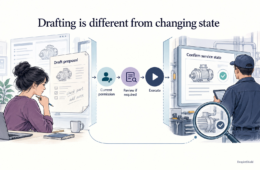
Explain when the assistant is providing information and when it is asking to perform a transaction. A sentence saying that a refund appears available must not become evidence that a refund was issued. If the application offers a refund action, validate it through the relevant service permissions and business rules, and show the actual result. For a handoff, provide the support agent with the question, selected source version and unresolved facts so the customer does not need to reconstruct the entire interaction.
Choose the delivery path based on what must be reviewed before the customer sees it. DeepintShield’s async post-guards guide distinguishes background checks from applicable synchronous output rules. Verify the actual policy attachments and streaming behavior in the deployed integration. An audit finding that arrives after delivery can improve future answers, but it does not retract a promise already displayed. For consequential unresolved cases, design a clear review or clarification step instead of depending on later scoring to correct the experience.
Release policy changes with answer fixtures
When a policy changes, prepare paired questions around its effective boundary and the conditions most likely to be confused. Include a customer who qualifies, one who does not and one whose booking details are incomplete. Have the policy owner approve the expected interpretation, then test retrieval, generated answers and eligible cached responses. The RAG security guide supports reviewing submitted source content, while the application still controls policy applicability and authorized document selection.
After release, inspect a sample of real question types and preserve new failures as regression cases. If an old answer continues to appear, trace whether it came from the source corpus, an application cache, a gateway reuse path or a curated answer. Correct the responsible layer and verify freshness with a controlled marker or changed policy condition. Avoid changing the prompt repeatedly before identifying the source of the stale response. Reliable policy communication depends on maintaining the entire answer path, including the evidence and the person who owns its meaning.
Frequently asked questions
Who should own chatbot policy accuracy?
Assign an operational content owner and a support escalation owner. Technical teams maintain the retrieval and response path, while the relevant business team approves the policy meaning and updates.
Should the assistant always use the latest policy document?
It should use the policy applicable to the customer’s situation. A current document may describe new purchases while an earlier version still matters for an existing booking. The business owner should define that selection logic. If the necessary date or category is missing, ask for it or escalate rather than presenting an unsupported unconditional answer.