AI Gateway Comparison: Eight Questions to Test
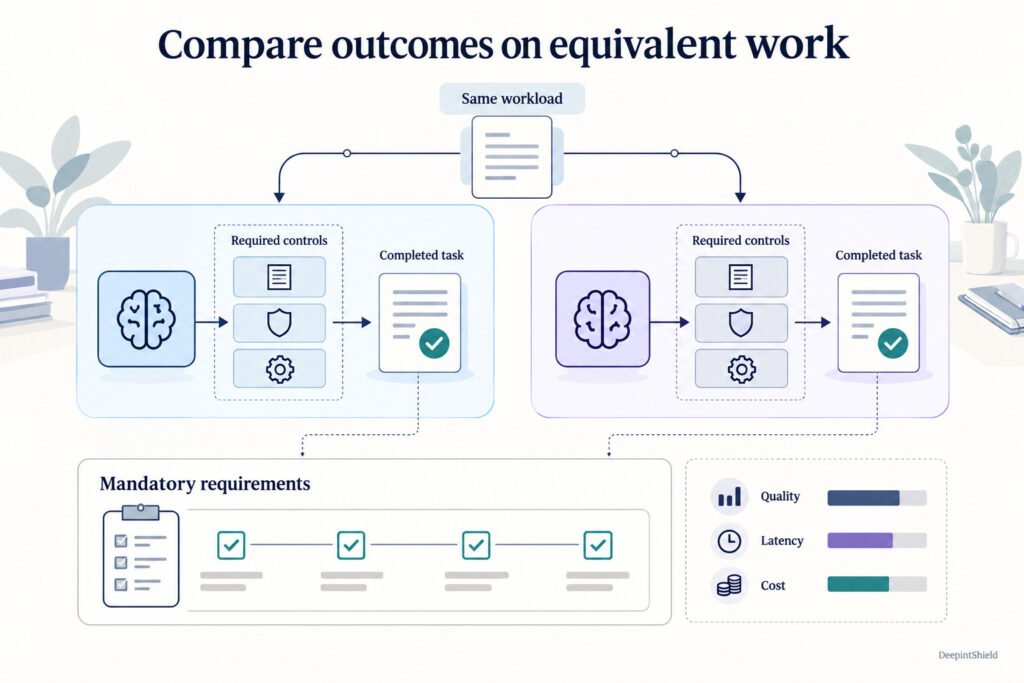
An AI gateway comparison becomes more useful when every feature claim is linked to a request you can test. Two products may use the same label while checking different inputs or acting at different times. Choose the outcomes that matter to your application, weight them before the demonstrations, and keep mandatory requirements visible even when a product scores well elsewhere.
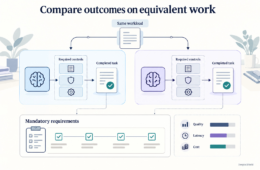
Figure: Two neutral gateway candidates receive equivalent work and required controls. Completed tasks are compared against mandatory requirements and quality, latency and cost measures.
Ask eight questions with observable answers
Use the same examples and expected outcomes for each candidate. The questions below are a starting scorecard; adapt their importance to the workload rather than assuming every team needs the same balance.
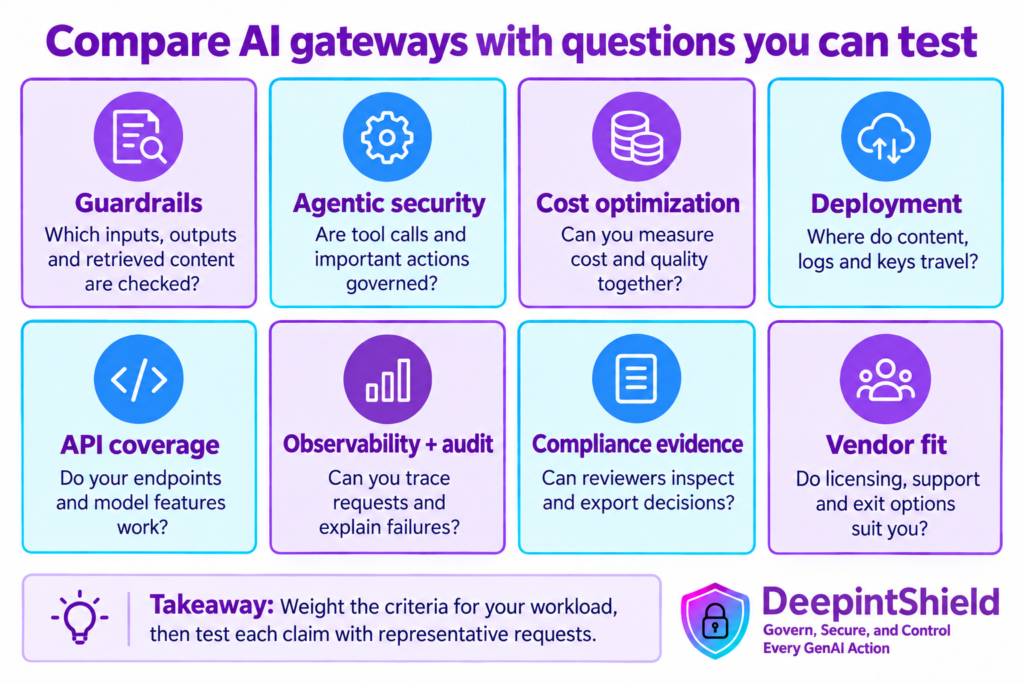
- 1. What content can it inspect? Test the prompt, response, retrieved passages and tool data you actually send, including relevant attachment limits.
- 2. What authorizes an agent action? Demonstrate caller identity, exact resource and tool permission, independent approval, and behavior when authorization is unavailable.
- 3. How does it manage usage? Test model restrictions and budget admission, then measure eligible cache or routing changes against answer quality and total provider usage.
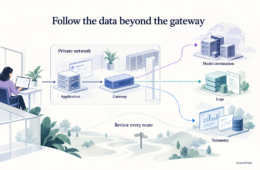
- 4. Where does the data go? Trace the gateway, provider, stores, telemetry and support paths, and assign an operator to each component.
- 5. Which API operations work? Verify the selected models, streaming outcomes, tool continuation and stored-resource lifecycle instead of counting provider logos.
- 6. What can operators observe? Follow one request through useful timing, outcome and usage records, including incomplete data or missing prices.
- 7. Can reviewers verify the evidence? Export a relevant record, inspect its coverage and integrity method, and confirm retention and access controls.
- 8. What does continued operation require? Confirm the necessary plan, dependencies, support terms, upgrade process and practical exit options.
Use a scorecard without hiding hard requirements
For a support agent that changes customer records, permission and approval behavior may carry more weight than a small inference-latency difference. For an offline summarization service, data handling, task quality and throughput may dominate. Mark the conditions that must pass regardless of the weighted total.
Keep demonstrated behavior separate from configuration screenshots. A setting may be available while a plan, provider or integration prevents it from operating on the intended route. Record the version and configuration with each result, and note where an evaluation remains incomplete.
Apply the same tests to DeepintShield
DeepintShield documents gateway controls, Agentic authorization, independent cost switches and several deployment shapes. Evaluate these through the exact routes the application will use. For example, canonical governed MCP calls need an exact Allow, while response-consistency reuse supports a narrower request set than all inference traffic.
Use current feature documentation to form the test, then save the observed result. Review the full request path under ordinary load and relevant dependency conditions. This approach produces a comparison that engineering, operations and procurement can discuss using the same evidence.
Visual guide: AI Gateway Comparison: Eight Questions to Test
Figure: Eight evaluation cards ask about request checks, agent actions, costs, deployment, API coverage, monitoring, review evidence and vendor fit.
Turn the eight questions into a repeatable scorecard
For each question, write one representative request, one boundary case and the evidence needed to judge the result. A gateway may support your chosen model but return an error shape that the application cannot interpret; it may stream text successfully while omitting lifecycle behavior needed by a tool workflow. Record those as distinct findings. Assign weights before testing, and mark any requirement whose failure prevents deployment. Otherwise, a large number of minor conveniences can numerically outweigh a missing control that the application cannot safely operate without.
Keep the same prompt set, model version where controllable, concurrency pattern and response limits across candidates. Document unavoidable differences instead of silently treating them as equivalent. When comparing DeepintShield, use the protocol operations documentation to select the actual endpoints and lifecycle steps under review. Report compatibility for the tested operations and client versions. Avoid generalizing a passing chat request into a claim about every API feature, stored object, provider SDK or future release.
Evaluate performance with the required controls enabled
Consider a support assistant that retrieves context, streams an answer and occasionally proposes a business action. Measure time to first usable output, total completion time and task success under the required inspection and authorization configuration. Keep cached and uncached requests separate, and report cold-start or warm-up conditions. A fast response that skipped a required policy is not a performance improvement for this workload. Likewise, a shorter answer is not automatically equivalent work when the omitted details are needed to resolve the customer’s question.
Introduce an allowed request and a restricted request during load testing, then verify their outcomes at the application and service boundary. The performance overview describes several optimization paths whose applicability differs by request. Test the subset you intend to enable and retain the baseline. Include the cost of retries and fallback calls in usage comparisons, and distinguish measured totals from provider estimates. This avoids choosing a route because its first attempt appears cheap while repeated failures make completed tasks expensive.
Use failure and change tests to break a tie
If two options pass normal traffic, examine what happens when a provider times out, authorization is unavailable or a policy changes between requests. The desired application behavior should be explicit: a retryable inference failure may be handled differently from a denied action. Capture structured errors and confirm that the client does not display a completed action when the downstream system remains unchanged. DeepintShield’s agentic security documentation describes the governed boundary to verify when that capability is enabled.
Also change one meaningful input, such as a tool schema, source version or approved provider route, and observe the review and rollout process. Estimate the effort to diagnose a disagreement and return to a known configuration. Present the final comparison as tested scope, observed outcomes and unresolved conditions, with named owners for follow-up. This form remains useful after a product update because the team can rerun the same cases. A comparison table without reproducible inputs quickly becomes a collection of labels rather than an engineering decision.
Frequently asked questions
Should the gateway with the most features always win?
No. Prefer the candidate that demonstrates the required behavior and fits the operating model. A higher feature count does not resolve an unmet mandatory requirement or an integration limit.
Is the highest weighted score always the best choice?
Only among options that meet the mandatory requirements and acceptable operating conditions. Review measurement uncertainty, incomplete tests and dependencies before comparing totals. A score organizes evidence; it does not replace judgment about a missing control, an unsupported operation or responsibilities the team cannot sustain. Preserve the raw cases so the choice can be revisited.