

AI Logs
Agentic AI Security: How PEP and PDP Protect Tool Calls
Agentic AI Security: How PEP and PDP Protect Tool Calls Agentic AI security checks the actions an AI agent asks to perform,…
Meet DeepintShield at Bengaluru Tech Summit 2026, 17 to 19 November, BIEC Hall 1, booth H1A106. Book 20 minutes
Platform · Agentic Security
Agentic AI security controls what autonomous agents may do, not just what they say. DeepintShield checks every tool call an agent makes against identity, relationships and policy, then returns Allow, Deny or Require approval before anything runs. Each decision is written to a hash-chained ledger, so you can prove what happened.

Agents read untrusted content, hold credentials and act on real systems. Content filters inspect text; they do not decide whether an action should happen.
Hidden instructions in a web page, file or tool result push the agent to call the wrong tool with the wrong arguments.
Agents inherit broad service credentials, so nothing limits them to the records and actions their task needs.
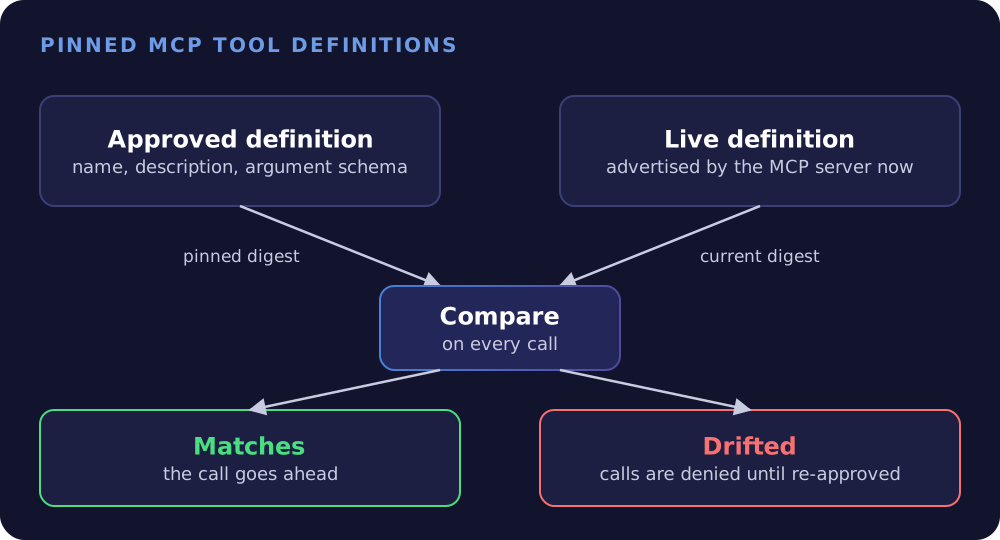
An MCP server can change a tool’s description or schema after review, and the agent keeps calling it.
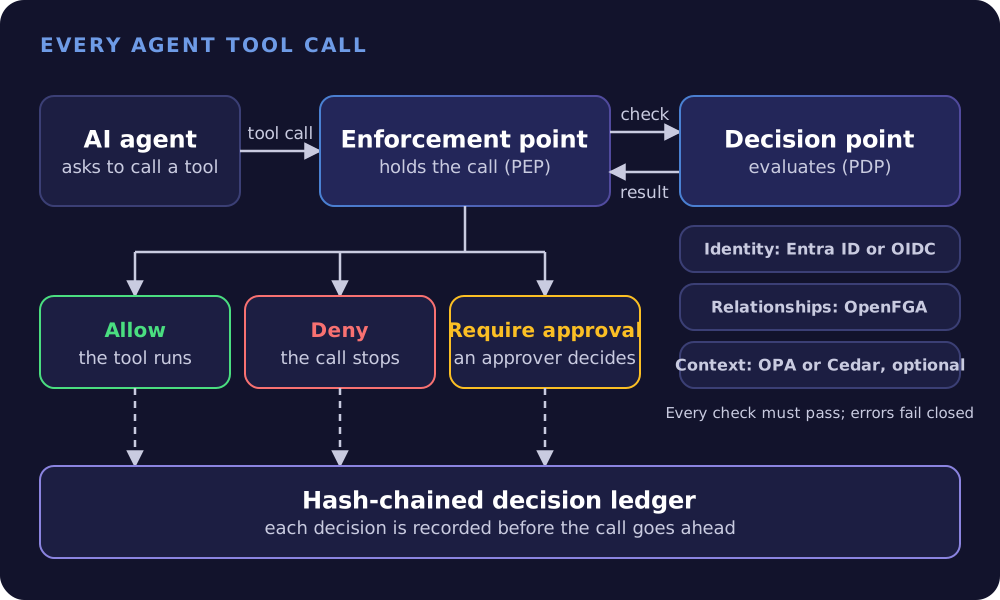
One decision point sits in front of every governed tool call, whether it comes from the SDK, the MCP gateway, Agent Mode or Code Mode. It is part of the wider DeepintShield platform.
A Microsoft Entra Agent ID or OIDC token identifies the agent, not a name it chose itself.
The SDK or the gateway holds the tool call before the function body runs.
Key binding, action class, OpenFGA relationships and optional OPA or Cedar policy must all allow it.
The decision is appended to a hash-chained ledger, then the call runs, stops or waits.
Adding an agent, a tool or an MCP server never grants access by itself. Each governed call needs an exact Allow.
Identity, relationships and policy all agree, so the tool runs and the decision stays on record.
One failed check denies the call. Approvals, auto-execute lists and OAuth grants cannot turn a Deny into execution.
Write-like or unclassified actions wait for a designated approver. The requester and the agent’s owner cannot approve.
Pending approvals expire after five minutes by default, and you can extend that to 24 hours.
Agents prove identity with Microsoft Entra Agent ID or any OIDC issuer, with a one-hour default token-lifetime ceiling.
Enrolment policies register verified agents with an owner, risk tier and namespace. Every call is still authorized.
OpenFGA relationship checks confirm the agent may use this tool, run this action and touch this record.
Approval binds a tool’s name, description and argument schema. Any change denies calls until someone re-approves it.
Agent code gets a mandatory deterministic scan. Incomplete coverage fails closed, and new findings quarantine the agent.
Start in Advisory (shadow) mode to see verdicts, then switch to Enforcing. Advisory never skips required approvals.
Agentic Security, agent enrolment and OpenFGA authorization are available on the Business plan and above, where they are on by default. Developer and Team workflows run without Agentic Security. Compare plans and pricing.
A policy enforcement point (PEP) holds the call; a policy decision point (PDP) evaluates it. The same check covers SDK-governed tools, JSON-RPC tools/call on the MCP gateway, the direct tool-execution endpoint, Agent Mode and every nested Code Mode call.
 Tap to enlarge(opens the full-size image in a new tab)
When you approve a tool, DeepintShield pins a digest of its name, description and argument schema. If the server later advertises a different definition, the console shows both digests and calls stay denied until an operator chooses Approve new definition.
Export AIBOM gives you a JSON inventory of every governed tool contract. It is signed when a signing key is configured; otherwise it is clearly marked unsigned.
 Tap to enlarge(opens the full-size image in a new tab)
The DeepintShield Python SDK 3.2.3 (Python 3.10 or newer) adds a pre-call check to your own functions. Automatic enforcement covers LangGraph, LangChain, LlamaIndex, AutoGen/AG2, PydanticAI, OpenAI Agents SDK, AWS Strands, Google ADK and Temporal.
DEEPINTSHIELD_AGENT_NAME: there is no default@shield.agentic.tool(
"ledger.post",
action="create_entry",
action_class="write",
recovery_cost="high",
)
def post_entry(row: dict) -> dict:
return ledger.insert(row)python -m pip install --upgrade "deepintshield[langgraph]==3.2.3"Mapped to
Agent decisions are tagged against the OWASP Agentic Top 10, with crosswalks to NIST AI RMF, ISO/IEC 42001, the EU AI Act and MITRE ATLAS. Mapping supports your own assessment; it does not replace it.
Agentic AI Security: How PEP and PDP Protect Tool Calls Agentic AI security checks the actions an AI agent asks to perform,…
DeepintShield team · · 7 min read
OWASP Agentic ASI Top 10: Risks and Practical Controls The OWASP Agentic ASI Top 10 (2026) is a framework that lists the…
DeepintShield team · · 6 min read
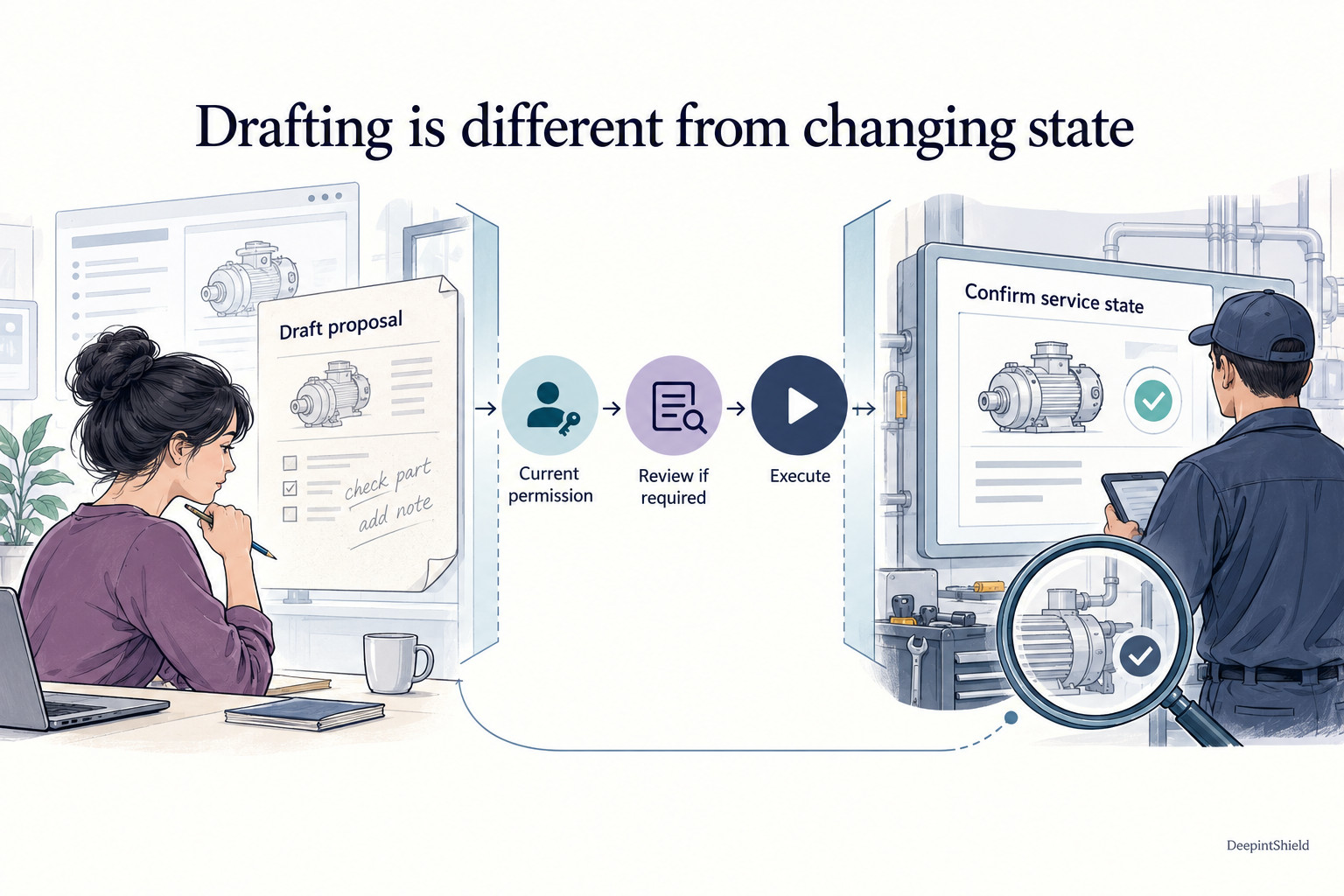
Agentic Security: Why AI Actions Need Clear Controls A sales assistant that reads product details has a different responsibility from one that…
DeepintShield team · · 5 min read
Agentic AI security is the set of controls that decide what an AI agent may do with tools, data and other systems. It goes beyond content filtering: each action is checked against identity, relationships and policy before it runs, and the decision is recorded. See how DeepintShield works.
A policy enforcement point (PEP) is the component that holds a tool call until a policy decision point (PDP) returns a verdict. In DeepintShield, the SDK and the gateway act as enforcement points, and one decision point serves SDK tools, MCP calls, Agent Mode and Code Mode.
A Require approval verdict holds the call until a designated approver accepts or rejects it. The requester and the agent's accountable owner cannot approve, an approval cannot override a hard denial, and the approval is tied to a digest of the call's arguments.
The Python SDK 3.2.3 governs tool calls in LangGraph, LangChain, LlamaIndex, AutoGen/AG2, PydanticAI, OpenAI Agents SDK, AWS Strands, Google ADK and Temporal. CrewAI is not supported. Details are in the Agentic Security docs.
Agentic Security is available on the Business plan and above, where it is on by default. On the Developer and Team plans, agent workflows run without Agentic Security checks. See the plan comparison for details.
Register MCP servers, filter tools per key and send every tool call through the same decision point.
Explore the MCP gateway
Virtual keys, budgets, role-based access and single sign-on decide who can use which model.
Explore governance
Agent runs, decisions and trends in one console, with a ledger you can verify.
Explore observability
Start free on the Developer plan, or book a demo to see Agentic Security on Cloud Business.
Qualified organisations can ask for a complimentary 30-day Cloud Pilot on Cloud Business.