Deployment · Hybrid Cloud
Hybrid AI gateway: managed control plane, your data plane
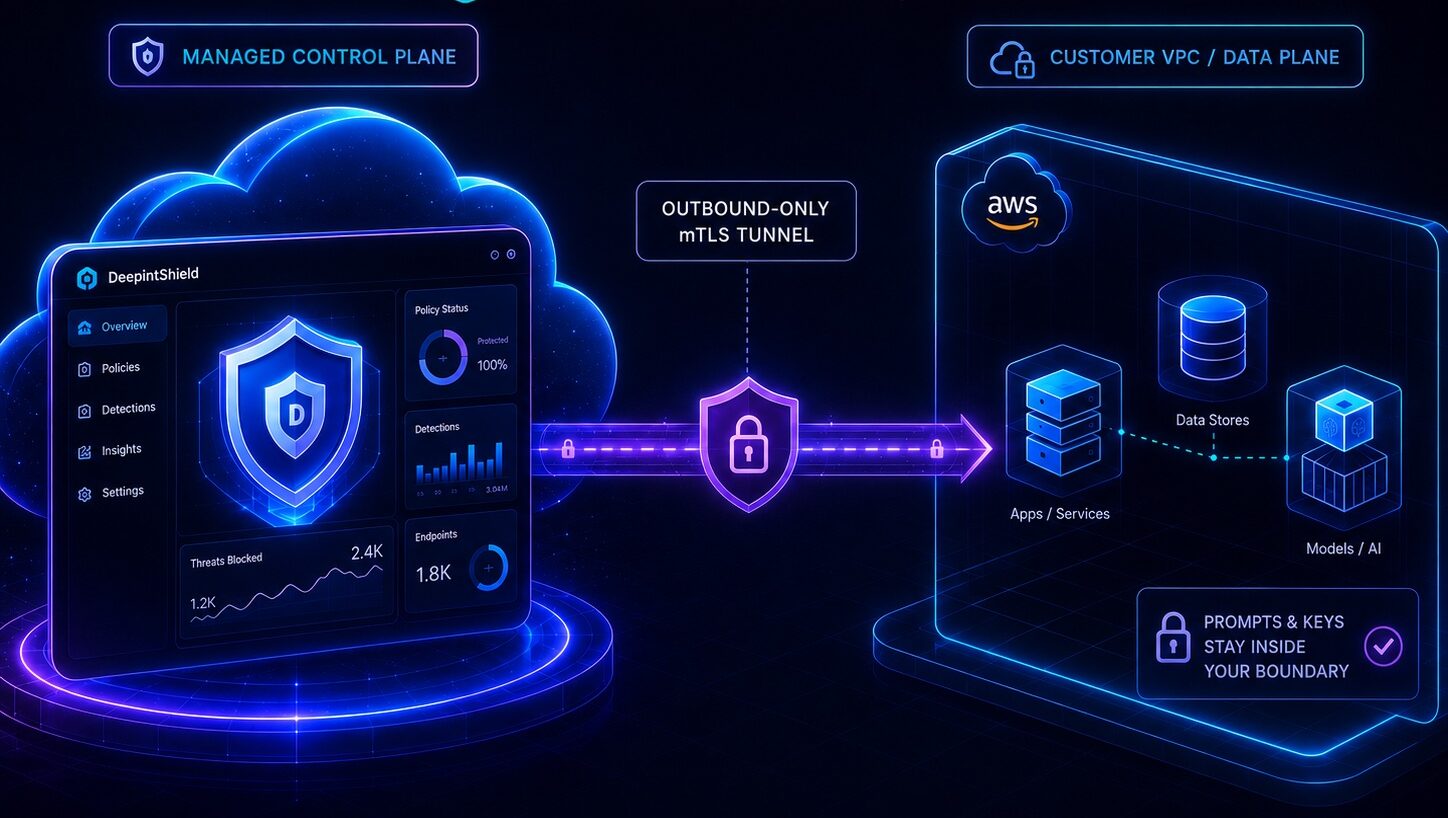
A hybrid AI gateway splits the platform in two: DeepintShield hosts the control plane, and you run the data plane in your own Kubernetes cluster on AWS, Azure or Google Cloud. Prompts, responses, keys and audit data stay in your VPC. The two connect over one outbound-only, certificate-pinned mutual TLS link on port 443.
- No prompt, response, key or audit data leaves your VPC
- Outbound-only link: no inbound port to open
- Keeps enforcing if the control plane is unreachable
Who hybrid is best for
Data residency without the operations
Prompts and keys stay in your cloud while DeepintShield runs the console, configuration and analytics.
A fast route to production
Install one Helm chart in an existing Kubernetes cluster instead of building and running a control plane.
Regulated workloads
Keep prompts, responses, keys and audit data inside your VPC, with keys from your own KMS.
How the hybrid AI gateway works: five steps
You need a Kubernetes cluster with three or more nodes on EKS, AKS or GKE, and outbound access on port 443. The Enterprise VPC guide lists every step.
Get your workspace
Your Enterprise VPC workspace is set up on the hosted control plane.
Install the data plane
Create a namespace, add the tunnel certificate and seed bundle, then run the installer or Helm.
The tunnel connects
The data plane dials out over pinned mutual TLS on port 443; nothing dials in.
Set policies and budgets
Configure guardrails, virtual keys and budgets in the console; signed configuration flows down.
Enforce in your VPC
Point apps at your own host’s /v1 endpoint; every request is checked inside your network.
What runs where
| Part | Who runs it | Details |
|---|---|---|
| Control plane | DeepintShield | Console, configuration, policies and analytics; sends signed configuration to your data plane |
| Data plane | You, in your EKS, AKS or GKE cluster | Gateway, guardrails, policy checks, caching and logs |
| Prompts, responses, keys and audit data | Stay in your VPC | None of them crosses the link to DeepintShield |
| Link between the two | Outbound-only, from your cluster | Pinned mutual TLS on port 443: signed configuration comes down, aggregate counts go up |
| Model calls | Your data plane | Sent to the providers you configure with your own keys; a self-hosted runtime such as vLLM or Ollama keeps them local |
Want both planes in your own account? See self-hosted deployment. Prefer to run nothing? See the fully managed cloud.
Compare the three deployment options
All three options run the same gateway, guardrails and agent controls. They differ in who operates each part and where your data stays.
| Fully Managed Cloud | Hybrid Cloud | Self-Hosted | |
|---|---|---|---|
| Control plane | DeepintShield runs it | DeepintShield runs it | You run it |
| Data plane (gateway, guardrails, policy checks) | DeepintShield runs it | You run it in your cloud | You run it in your cloud |
| Where prompts, responses and keys stay | In DeepintShield Cloud, in a region chosen to meet your requirements; zero retention available | In your VPC: no prompt, response, key or audit data leaves | In your environment: no data leaves and nothing calls home |
| Link to DeepintShield | Your apps call the cloud endpoint | One outbound-only link, pinned mutual TLS on port 443 | None required; air-gapped option |
| Set-up effort | None: sign up and change one base URL | One Helm chart in your Kubernetes cluster | Helm chart and Terraform; you run upgrades, scaling and secrets |
| Who it suits | Fast evaluation and teams without strict data-residency rules | Data residency without running the control plane | Teams that must own the full stack, including sovereign and air-gapped sites |
| Plans | Developer (free), Cloud Team ($49 a month), Cloud Business ($249 a month) | Enterprise VPC, from $12,000 a year | Enterprise Self-Hosted, from $24,000 a year |
Prices are in USD and exclude taxes. See pricing for request limits, seats and add-ons.
Hybrid Cloud at a glance
How we handle data in each mode is set out on the trust and security page.
No data egress
No prompt, response, key or audit data leaves your VPC at any point.
No inbound ports
The data plane opens the connection outbound on port 443; DeepintShield never dials into your network.
Only aggregate counts leave
The control plane receives aggregate counts for analytics, never request content.
Your cloud, your keys
You run the cluster and hold keys in your own KMS; we run the control plane.
Hybrid deployment questions
What crosses the tunnel?
Only signed configuration and aggregate counts cross the tunnel. Configuration comes down from the control plane and aggregate counts go up; no prompt, response, key or audit data leaves your VPC. Details are in the Enterprise VPC guide.
Do we need to open inbound ports?
No, you open no inbound port for DeepintShield. The data plane makes a single outbound connection on port 443, secured with pinned mutual TLS, and your applications reach the gateway inside your VPC as usual.
What happens if the control plane is unreachable?
Your data plane keeps enforcing. It runs on its last-known-good signed configuration, so requests are still checked, and new changes apply once the link returns. Learn how requests are checked.
Which plan includes hybrid deployment?
Hybrid runs on the Enterprise VPC plan, from $12,000 a year. It includes 10 million governed requests a month, 50 console seats, 500 protected identities and one production data plane.
Keep your data, skip the operations
See the hybrid data plane running in a cloud like yours, or start free on the managed cloud while you plan the install.