LLM Cost Optimization: 12 Ways to Reduce Wasted Work
LLM Cost Optimization: 12 Ways to Reduce Wasted Work LLM cost optimization starts by finding wasted work: repeated requests, unnecessary context, unsuitable…
Meet DeepintShield at Bengaluru Tech Summit 2026, 17 to 19 November, BIEC Hall 1, booth H1A106. Book 20 minutes

Platform · Cost Optimization
LLM cost optimization lowers what you pay for model usage while keeping answers fit for purpose. DeepintShield applies 12 techniques on the request path, from provider prompt caching to semantic caching and cascade routing. Semantic caching can cut costs by up to 60% on repetitive workloads; your savings depend on your workload.

Model spend grows from several kinds of waste at once. The AI gateway sees all of it, so that is where the fixes belong.
Repeated questions, long prompts, growing histories and oversized models each need a different control.
A cheaper model or a shorter prompt can lower answer quality if nobody measures the result.
Without figures per key, team and customer, finance cannot see where model spend goes.
Each technique targets one kind of waste. See how a request moves through DeepintShield.
Exact and semantic caches, provider prompt caching and request coalescing avoid repeated work.
Cascade routing tries a cheaper model first; reasoning-effort controls stop unneeded reasoning.
Prompt compression, RAG optimization and conversation summarization cut tokens before the call.
Prometheus metrics and the console show cost, cache hits and savings by key and team.
Five techniques run on every plan. Seven more, including semantic caching, need the Team plan or above. A request served from cache skips the later steps, so measure the combined bill rather than adding up percentages.
| Technique | What it reduces |
|---|---|
| Every plan, including Developer | |
| Provider prompt-cache hints | Repeated prompt prefixes, billed at the provider's cached-input rate |
| Request coalescing | Identical concurrent requests, which share one upstream call |
| TTFT prefix ordering | Prompt changes that stop a provider cache from matching |
| Guardrail evaluation cache | Repeated deterministic guard checks, reused in about 1.42 µs (local microbenchmark, no I/O) |
| Parallel-tool safety | Serial waits for independent tool calls |
| Team plan and above | |
| Semantic caching | Repeated or similar requests, answered from an exact or vector cache |
| Cascade routing | Use of a stronger model when a cheaper one is good enough |
| Reasoning-effort throttling | Reasoning beyond what the task needs |
| Prompt compression | Redundant input text |
| RAG optimization | Irrelevant retrieved passages in the context |
| Conversation summarization | Long histories sent again on every turn |
| Batch eligibility analysis | Non-urgent work that could run as a batch; it reports eligibility and does not submit batches |
Team and above can also opt in to MCP tool-result caching. Budgets and rate limits per key and team are part of Governance.
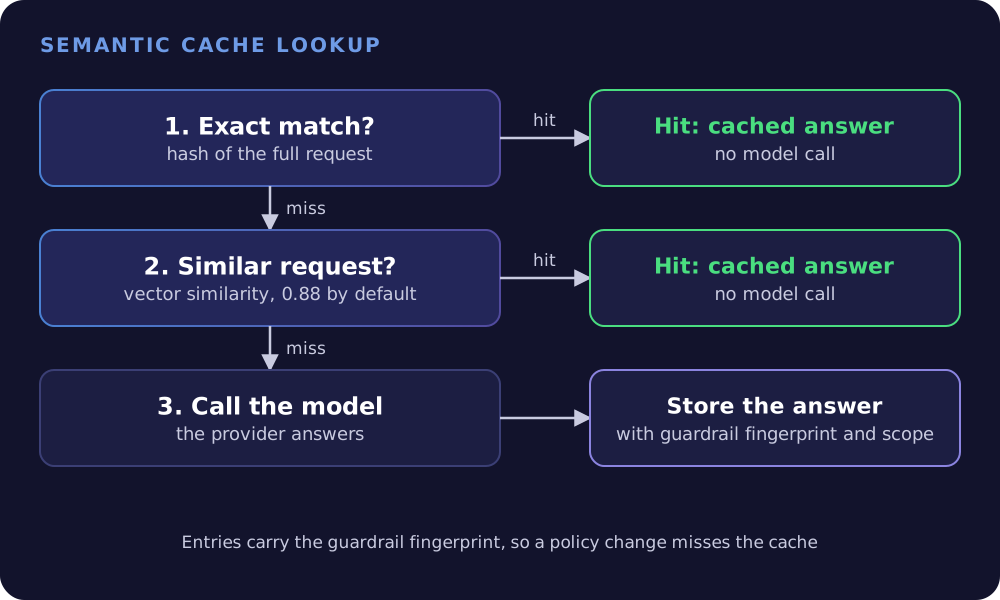
An exact hash lookup runs first, then vector similarity with a default threshold of 0.88. Entries carry the guardrail fingerprint and full request scope, so a policy change misses the cache. Works with Weaviate, Redis or Valkey, Qdrant and Pinecone.
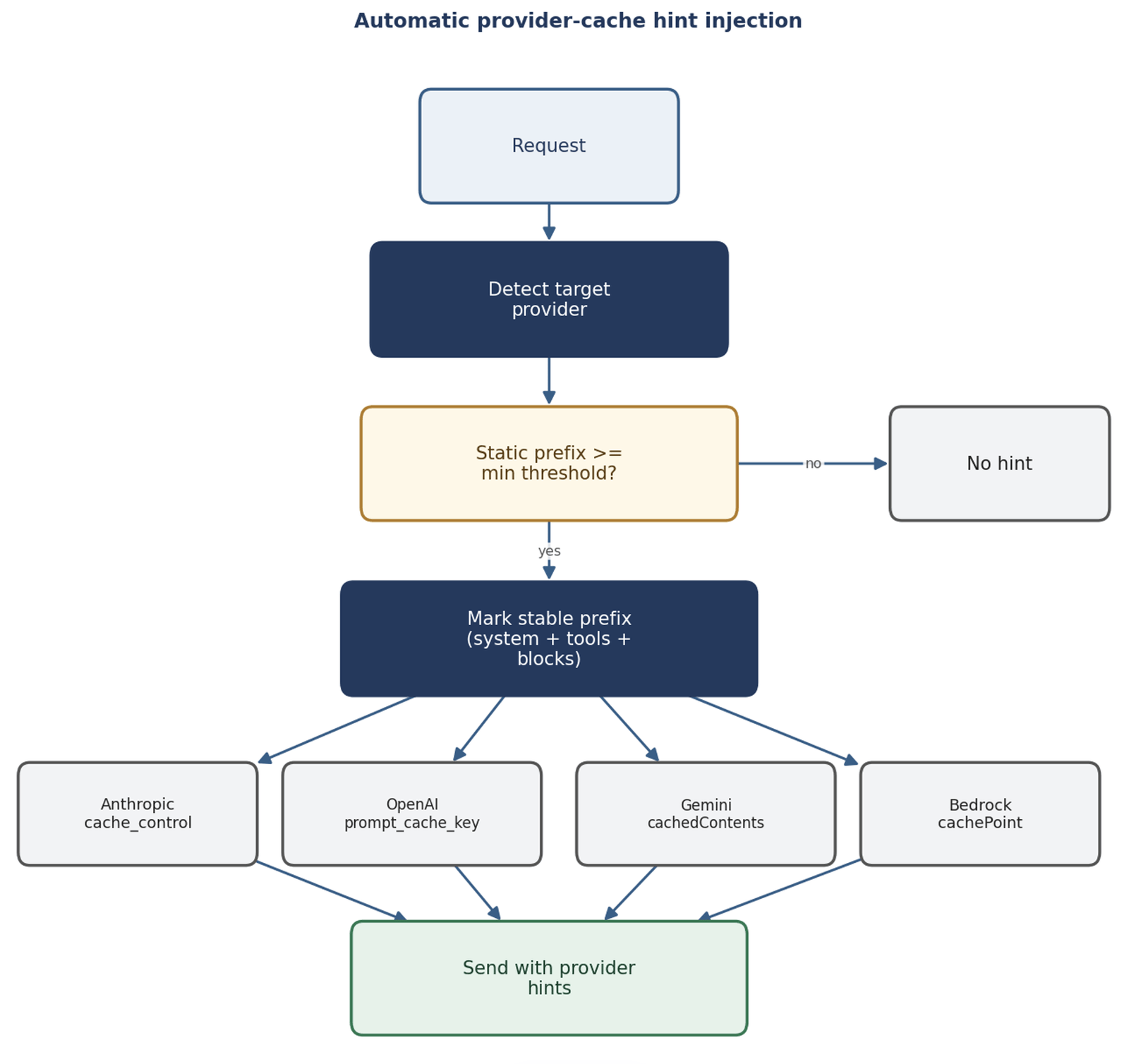
On by default for Anthropic, OpenAI and Bedrock, and you can add Gemini. The gateway marks stable prompt prefixes and forwards cache hints, with no application change. Provider pricing gives roughly 90% off cached input on Anthropic, 50% on OpenAI and 75% on Gemini.
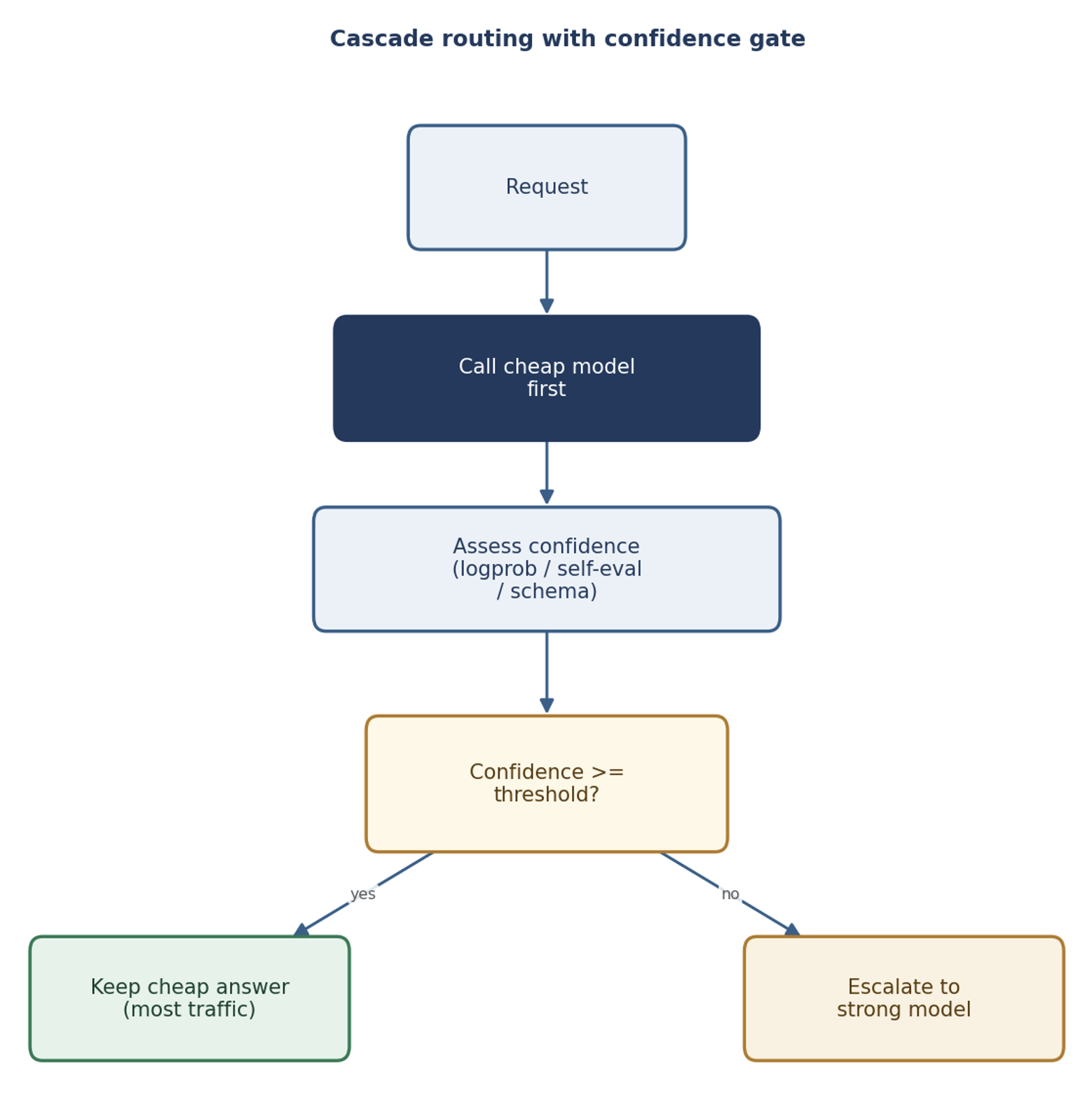
Tap to enlarge(opens the full-size image in a new tab)A cheaper model answers first, and the request escalates to a stronger model when confidence is low. The cascade checks the key's model policy before it substitutes a tier.
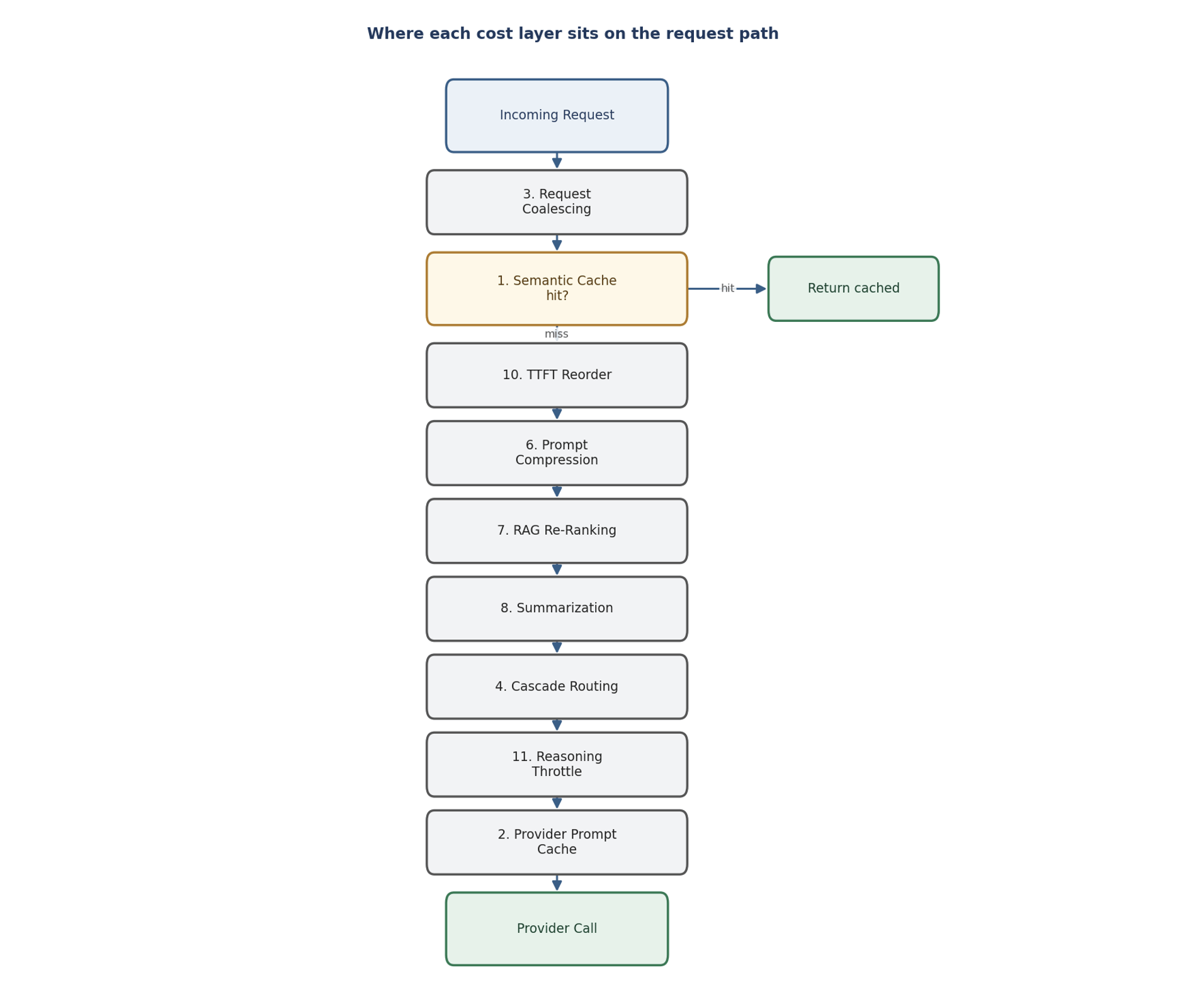
Tap to enlarge(opens the full-size image in a new tab)Each technique sits at a fixed point on the request path, so a request served from cache never reaches compression or routing.
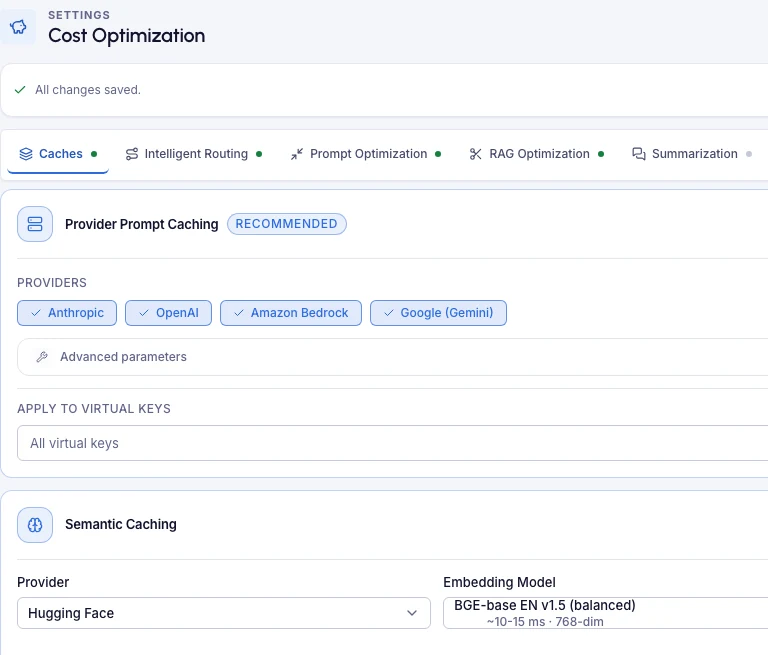
Tap to enlarge(opens the full-size image in a new tab)Switch provider prompt caching and semantic caching on and tune them in one place, then follow cost, cache hits and savings on the analytics overview. Prometheus exposes deepintshield_cost_total and deepintshield_cache_hits_total for your own dashboards.
Tap to enlarge(opens the full-size image in a new tab)Point your existing client at the gateway and the caching techniques apply to its traffic. When one request needs different cache behaviour, set it with a header.
import openai
client = openai.OpenAI(
base_url="https://app.deepintshield.com/openai", # Point to DeepintShield
api_key="sk-ds-your-virtual-key"
)x-deepintshield-cache-ttl
x-deepintshield-cache-threshold
x-deepintshield-cache-type
x-deepintshield-cache-no-store
x-deepintshield-cache-keyWorks with
Semantic caching needs the Team plan or above, a vector store and embeddings configured.

LLM Cost Optimization: 12 Ways to Reduce Wasted Work LLM cost optimization starts by finding wasted work: repeated requests, unnecessary context, unsuitable…
DeepintShield team · · 4 min read

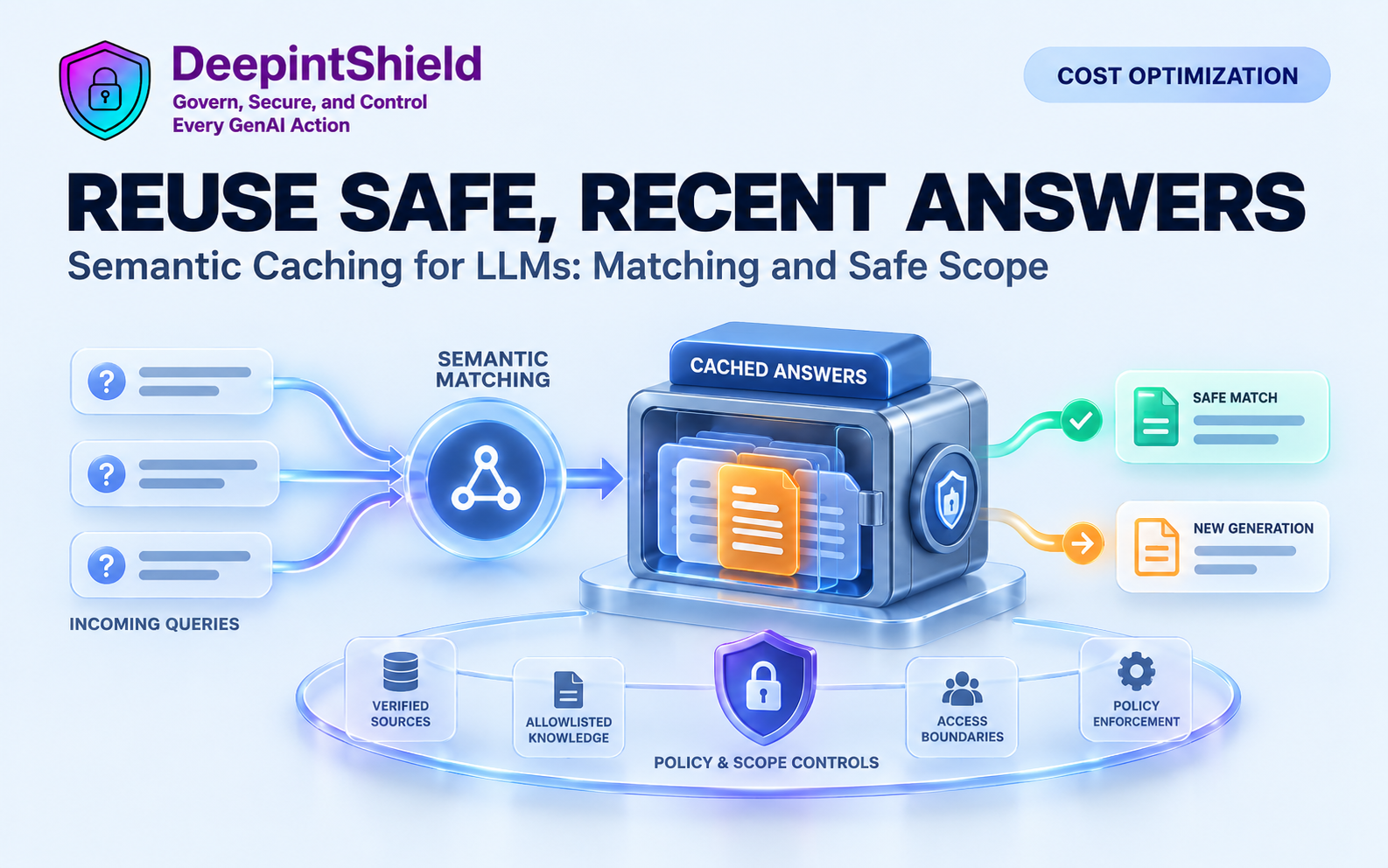
Semantic Caching for LLMs: Matching and Safe Scope Two people may ask the same question in different words and still need the…
DeepintShield team · · 5 min read

Cascade Routing for LLMs: Balance Cost and Quality A mixed AI workload does not always need the same model for every request.…
DeepintShield team · · 5 min read
It depends on your workload. Semantic caching can cut costs by up to 60% on repetitive workloads such as FAQ assistants, while long-form RAG or streaming code generation sees much less. The semantic caching docs explain what drives the hit rate.
It can, which is why cache scope is strict. Entries carry the guardrail fingerprint and the full request scope, structured, multimodal and tool requests are exact-match only, and semantic hits still pass output checks.
Semantic caching returns a stored answer when a new request means the same as an earlier one. DeepintShield checks an exact hash first, then vector similarity at a default threshold of 0.88, and keeps entries separate for each virtual key.
Cascade routing sends a request to a cheaper model first and escalates to a stronger one only when needed. It is available on Team and above, and it never substitutes a model that the key's model policy forbids.
No. You bring your own provider keys, model usage stays on your own accounts, and there is no token markup or logging surcharge. See pricing.
One OpenAI-compatible API for 29 built-in model providers, with routing, load balancing and fallbacks.
Explore the AI gateway
Score sampled answers with five detectors so cheaper routes do not quietly lower quality.
Explore hallucination defense
Cost, cache-hit and latency metrics through OpenTelemetry and Prometheus, plus a verifiable audit trail.
Explore observability
Start with five techniques on the free Developer plan, then add semantic caching and cascade routing on Cloud Team.