FAQ
AI security FAQ: questions, answered
This AI security FAQ gives short, plain answers about DeepintShield: where your data goes, how much latency guardrails add, which models and agent frameworks work, how agents and MCP servers are controlled, what each plan costs and how partners work with us. Each answer links to the page or docs with the detail.
AI security FAQ: general questions
What is DeepintShield?
DeepintShield is an AI security platform that checks every prompt, retrieved document, tool call and response before it runs. It combines an AI gateway, runtime guardrails, agent and MCP control, observability and cost control, and runs fully managed, hybrid or self-hosted. See the platform overview.
How is this different from a prompt filter?
A prompt filter checks one message, while DeepintShield checks five stages: input, RAG, action, MCP and output. Agent tool calls get a decision before they run, and each decision is written to a hash-chained ledger. Read how it works.
Do I need to change my application code?
Usually you change only the base URL and the API key. Point your OpenAI-compatible client at the gateway with a virtual key; the Anthropic, Google GenAI and AWS Bedrock SDKs have their own routes. The quick start shows the code.
Who is DeepintShield for?
It is for security, platform engineering and compliance teams that run LLM apps and AI agents in production. Security teams set policies, platform teams get one API for 29 built-in model providers, and compliance teams get exportable evidence. Browse the use cases.
Is DeepintShield open source?
Yes, the core is open source under the Apache License 2.0. The code is on GitHub, so you can inspect it and run it yourself. See open source and benchmarks.
Deployment and data
Does any data leave my environment?
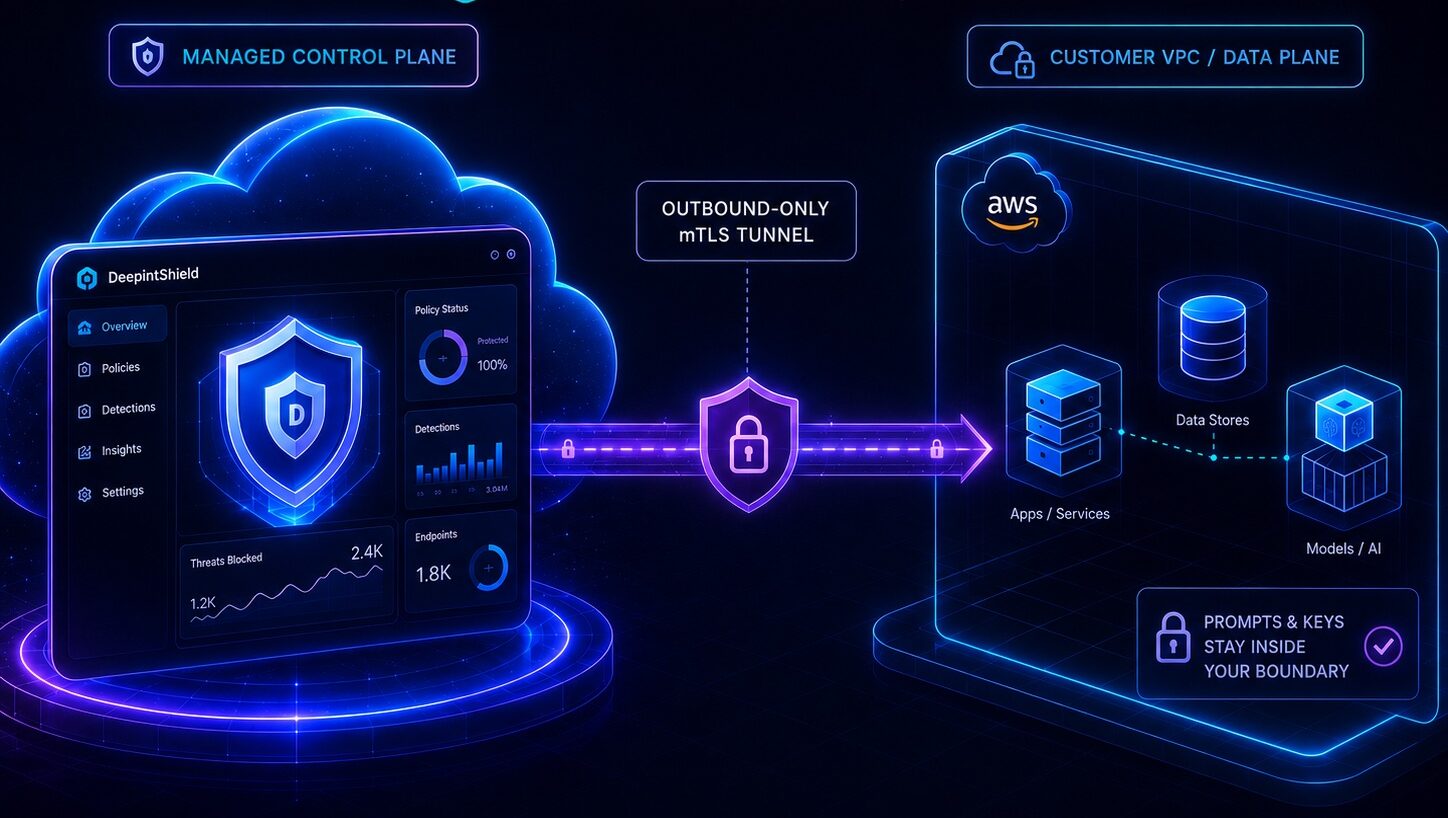
In hybrid and self-hosted modes, no data leaves your environment. In hybrid, only signed configuration comes down and aggregate counts go up over an outbound-only link; in self-hosted mode nothing calls home. Model calls still go to the providers you choose. Compare the deployment options.
Where is the managed cloud hosted?
It is hosted in a region chosen to meet your requirements. DeepintShield Cloud is multi-region, content logging can be switched off and zero retention is available. See the fully managed cloud.
Can DeepintShield run air-gapped?
Yes, on Enterprise Self-Hosted. Both planes run in your environment, and air-gapped delivery is an add-on at $6,000 a year. See self-hosted deployment.
What happens if the hybrid control plane is unreachable?
Your data plane keeps enforcing on its last-known-good signed configuration. Requests are still checked inside your VPC, and new changes apply when the link returns. Read about hybrid deployment.
Can we keep prompts out of logs?
Yes, switch off content logging. Usage data such as tokens, cost and latency is still recorded for each request. Details are in the observability docs.
Do you use our data to train models?
No, we do not use customer prompts, responses or files to train models. In hybrid and self-hosted modes we never receive them. Read more on the trust and security page.
Guardrails
What do the guardrails check?
They check prompts, retrieved chunks, tool calls, MCP traffic and responses at five enforcement stages: input, RAG, action, MCP and output. Built-in checks cover prompt injection, jailbreaks, personal data, secrets and toxicity. See Runtime Guardrails & PII.
How many detection patterns are there?
There are 462 detection patterns in 102 preset families, plus 6 ML detectors on Team and above. The counts are configuration entries, not a measure of detection accuracy. See the pattern catalog.
How much latency do guardrails add?
It depends on your policies, models and deployment, so we publish no end-to-end figure. Eligible deterministic decisions are reused in about 1.42 µs (local microbenchmark, no I/O), speculative dispatch makes allow-path latency max(guards, model) instead of guards + model, and output checks can run as async post-guards. See published benchmarks.
What happens when a guardrail finds something?
The finding is passed, redacted, blocked or flagged, depending on your policy. A blocked request returns HTTP 403 with guardrail_blocked, and safety providers can also sandbox a request. Each finding is logged with the stage that caught it; see Observability & Audit.
Can we test a policy before enforcing it?
Yes, run it in shadow or async mode first. Findings are recorded without blocking traffic, so you can tune the policy before you enforce it. See guardrails in the docs.
Can we use AWS Bedrock Guardrails, Azure AI Content Safety or Google Model Armor?
Yes, as safety providers linked through a policy, on Team and above. You can also connect your own webhook and run several providers in parallel on one policy. See integrations.
Agents and MCP
How does DeepintShield control what an agent can do?
Every agent tool call gets a decision before it runs: Allow, Deny or Require approval. The check covers the agent's identity, the tool, the action and its relationships in OpenFGA, and errors fail closed. Agentic Security is on Business and above; see Agentic Security.
What is an MCP gateway?
An MCP gateway puts every MCP server and tool behind one governed entry point. DeepintShield adds a registry, tool filtering per virtual key, OAuth 2.1 with PKCE, delegated authentication, Agent Mode and Code Mode. See the MCP Gateway.
What happens if an MCP server changes a tool?
Calls to that tool are blocked until someone re-approves it. Approval pins a digest of the tool's name, description and argument schema, so any change shows up as drift. Read about tool execution in the docs.
Can a person approve risky actions?
Yes, Require approval holds the action for a designated approver. The requester and the agent's accountable owner cannot approve it, and pending approvals expire after five minutes by default. See Agentic Security in the docs.
Which agent frameworks are supported?
The Python SDK 3.2.3 has binders for LangGraph and LangChain, OpenAI Agents SDK, LlamaIndex, AutoGen/AG2, PydanticAI, AWS Strands and Google ADK. CrewAI is not supported; it was removed in release 2.8.3. See integrations.
How many MCP servers can we connect?
It depends on the plan: 1 on Developer, 25 on Team, 50 on Business and unlimited on Enterprise. The MCP registry, Agent Mode and Code Mode are on every plan. Compare plans and features.
Gateway and cost
Which models are supported?
DeepintShield supports 29 built-in model providers, plus custom OpenAI-compatible endpoints, behind one OpenAI-compatible API. They include OpenAI, Anthropic, Azure, AWS Bedrock, Vertex AI, Gemini, Mistral and self-hosted runtimes such as vLLM and Ollama. See the AI Gateway.
Can I bring my own keys?
Yes, every plan uses your own provider keys. Model usage is billed on your own accounts with 0% markup. See pricing.
What happens if a model provider fails?
The gateway tries the fallback providers and models you list, in your order. Load balancing spreads traffic across keys, and a circuit breaker takes failing keys out until they recover. See fallbacks in the docs.
How much can we save on LLM costs?
You can save up to 60% on repetitive workloads with semantic caching, but savings depend on your workload. The platform offers 12 cost techniques, from semantic and provider prompt caching to cascade routing and prompt compression. See Cost Optimization.
Can we set budgets for each team?
Yes, budgets and rate limits apply at customer, team, virtual-key and provider level. Every level must pass, and teams and customers need the Team plan or above. See Governance.
Pricing
Is there a free plan?
Yes, the Developer plan is free with 50,000 requests a month and 2 seats. It has a hard cap, and you bring your own model keys. See pricing.
What happens when we pass our request limit?
On Developer, requests stop at the cap with HTTP 429; on paid plans the service never stops. Extra requests cost $9 per 100,000 on Cloud Team and $6 per 100,000 on Cloud Business, and Enterprise plans pay $5, then $3, then $2 per 100,000 as volume grows. Compare plan limits.
How much do the paid plans cost?
Cloud Team is $49 a month and Cloud Business is $249 a month; Enterprise VPC starts at $12,000 a year and Enterprise Self-Hosted at $24,000 a year. Yearly billing on Cloud plans costs ten times the monthly price, in USD and excluding taxes. For an Enterprise quote, talk to sales.
Do you charge a token markup or a logging surcharge?
No, there is 0% markup on model usage and no logging surcharge. You pay model providers directly with your own keys. See billing in the docs.
Can we run a pilot first?
Yes, there are several pilots: a complimentary 30-day Cloud Pilot for qualified organisations, a $2,500 Production-Readiness Pilot in your cloud, a $5,000 VPC or sovereign validation and a $1,000 Agent Risk Assessment. Paid pilot fees are credited in full against an order signed within 60 days of the read-out. Book a demo to plan one.
Partners
Does DeepintShield have a partner program?
Yes, for MSSPs, resellers and distributors, technology partners, system integrators and referral partners. Partners can offer DeepintShield managed, hybrid or self-hosted, which keeps data-residency deals open. See the partner program.
Can an MSSP serve several customers from one platform?
Yes, that is what the MSSP program is for. The platform models customers, teams and virtual keys, each with its own budgets and rate limits, and roles control what your analysts can see and change. See the MSSP program.
How do we register a deal?
Fill in the deal registration form with the end customer, expected size and close date. You get a registration number by e-mail, and the partner team confirms deal protection within two business days. Register a deal.
How long does a partner application take?
The partner team reviews each application and replies within three business days. Technology vendors, integrators and referral partners can start from the technology, SI and referral page.
Where your data goes, at a glance
Whether data leaves your environment depends on the deployment mode. In hybrid mode, the gateway, guardrails and policy checks run in your VPC, and only signed configuration and aggregate counts cross the outbound-only link to the managed control plane.
Still have a question?
Ask our team directly, or search the documentation for the technical detail.