
Compare
AI security platforms compared: where DeepintShield fits
AI security platforms compared by the layer each one covers. AI security has moved from filtering prompts to governing what agents do, and most tools cover one layer well. This page shows the layers, five well-known vendors and where DeepintShield fits as one runtime control point across them.
- Self-hosted or hybrid
- Agent and MCP control
- Audit evidence you can verify
Most AI security tools solve one layer
Buyers often compare tools that do different jobs. Sorting them by layer makes the comparison fair.
Prompt and content protection
Screens prompts and responses for injection, jailbreaks, unsafe content and data leaks, usually through an API call.
Gateways, proxies and observability
Route traffic across model providers, track spend and log requests. Some add guardrail checks or plug-ins.
Model lifecycle security
Scans models and ML pipelines for unsafe files, vulnerabilities and supply-chain risk before deployment.
Red teaming and testing
Attacks your AI apps before release to find weaknesses, then reports what to fix.
One runtime control point across the layers
DeepintShield sits on the request path at runtime. One gateway gives you an OpenAI-compatible API for 29 built-in model providers, runs guardrails at five stages (input, RAG, action, MCP and output), gives every agent tool call Allow, Deny or Require approval, and writes each decision to a hash-chained ledger. Follow one request through every stage.
It does not scan model files or run red-team campaigns. If you need those, keep a lifecycle or testing tool alongside it.
- Prompt and content protection at five stages
- A multi-provider gateway with cost controls
- Agent, tool and MCP governance
- Record-level authorization with OpenFGA (Business and above)
- Hash-chained audit evidence
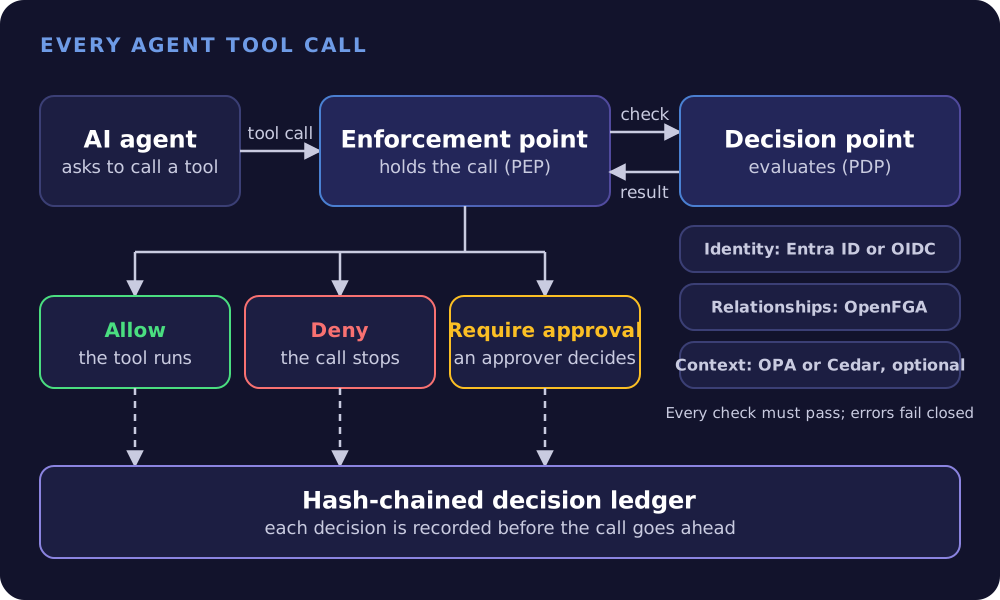
AI security platforms compared, vendor by vendor
A short summary of each vendor’s main layer, checked against each vendor’s own product pages and documentation on 15 November 2026. Products change often, so check each vendor’s documentation before you decide.
| Vendor | Main layer | Best at | Where DeepintShield differs |
|---|---|---|---|
| Lakera | Prompt and agent guardrails, through an API | Screening prompts, outputs and agent steps for prompt attacks and data leaks; SaaS or self-hosted | A full AI gateway on the request path, with Require approval and OpenFGA record-level checks on every agent tool call |
| Portkey (now Prisma AIRS AI Gateway) | AI gateway | Routing, fallbacks, caching and observability across many providers, with guardrails and an MCP gateway | Allow, Deny or Require approval on every agent tool call, pinned MCP tool definitions and a hash-chained decision ledger |
| LiteLLM | Open-source LLM proxy (MIT licence) | One OpenAI-format API to many providers, with budgets, spend tracking, guardrail integrations and an MCP gateway | Guardrails at five stages built in, tool-call verdicts with human approval, and hash-chained audit evidence |
| CalypsoAI (now F5 AI Guardrails) | AI security | Inference-time guardrails and red-team testing, in the cloud, on-premises or air-gapped | A built-in multi-provider AI gateway with budgets and cost controls, plus agent and MCP governance |
| Protect AI (now part of Prisma AIRS) | Model and AI lifecycle security | Scanning models, securing the ML supply chain and AI red teaming | A runtime AI gateway with guardrails, agent tool-call verdicts and MCP control |
Last reviewed: 15 November 2026. Product names are trademarks of their owners. Each summary describes the vendor’s main layer only.
Why teams choose DeepintShield
Runs in your environment
Enterprise VPC or fully self-hosted, with an air-gapped option. In hybrid and self-hosted modes, no data leaves your environment.
Governs tool calls, not only text
Every agent action gets Allow, Deny or Require approval, checked against OpenFGA relationships down to the record.
Gateway and security in one
One OpenAI-compatible API for 29 built-in providers, with guardrails, budgets and 12 cost techniques on the same path.
Evidence your auditor can check
Decisions go to an append-only, hash-chained ledger you check with Verify chain, and export to your SIEM.
Agentic Security and OpenFGA authorization need the Business plan or above.
Open a detailed comparison
DeepintShield vs Lakera
An API for prompt and agent guardrails compared with a gateway that checks every stage of a request.
Read the comparison
DeepintShield vs Portkey
Two AI gateways compared on guardrails, agent and MCP control, and audit evidence.
Read the comparison
DeepintShield vs LiteLLM
An open-source LLM proxy compared with a gateway built around agent policy and audit evidence.
Read the comparison
DeepintShield vs CalypsoAI
Two AI security platforms, compared on deployment options and the built-in gateway.
Read the comparison
DeepintShield vs Protect AI
Model and supply-chain security compared with a runtime AI gateway.
Read the comparison
Comparing another tool?
Tell us what you run today and an engineer will map it against DeepintShield on a call.
Book a Demo
Comparison questions
Can DeepintShield replace my AI gateway?
Often, yes, because DeepintShield is itself an AI gateway. It gives you one OpenAI-compatible API for 29 built-in model providers, with fallbacks, load balancing, budgets and semantic caching (Team plan and above). Most apps switch by changing the base URL and key, but test the exact endpoints you use first. See the AI Gateway.
Can I use DeepintShield with another guardrail tool?
Yes. DeepintShield can call AWS Bedrock Guardrails, Azure AI Content Safety, Google Model Armor or your own webhook as safety providers inside a policy, and run several in parallel. Safety providers need the Team plan or above. Read the safety provider docs.
What makes self-hosted different?
The gateway, guardrails and audit store run in your own cloud or data centre, so in hybrid and self-hosted modes no data leaves your environment. With Enterprise VPC, only signed configuration comes in and aggregate counts go out, over one outbound mutual-TLS connection. See Self-Hosted deployment.
Does DeepintShield do red teaming or model scanning?
No. DeepintShield enforces policy at runtime, on live prompts, retrieved documents, tool calls and responses. If you need attacks before release or checks on model files, pair it with a testing or model-scanning tool.
How were these comparisons made?
From each vendor’s own product pages and documentation, checked on 15 November 2026, and from our own documentation. We describe each vendor’s main layer and write “check vendor docs” wherever we could not confirm a detail. Several vendors have recently been acquired or renamed. If something is out of date, tell us and we will correct it.
About these comparisons. The product names on this page are trademarks of their respective owners. DeepintShield is not affiliated with, endorsed by or sponsored by them. We compiled these comparisons in good faith from each vendor’s public product pages and documentation, checked on 15 November 2026. Products change often, so check each vendor’s current documentation before you decide. If anything here is out of date or inaccurate, tell us and we will correct it promptly.
Compare on your own use case
Bring one app or agent to an architecture review and see how each layer applies to it.