
Compare · DeepintShield vs Protect AI
DeepintShield vs Protect AI: a Protect AI alternative built on an AI gateway
Looking for a Protect AI alternative, or a runtime partner for it? Protect AI is best known for model lifecycle security: scanning models and securing the ML supply chain before deployment. DeepintShield works later, at runtime: it checks prompts, retrieval, tool calls and responses in production and gives every agent action Allow, Deny or Require approval.
- Runtime control in production
- Agent and MCP governance
- Self-hosted or hybrid
Two tools, two different layers
Protect AI is best known for checks before deployment, DeepintShield for runtime control, so they often complement each other. See every vendor on the AI security comparison page.
Protect AI: model lifecycle security
Scans models and secures the ML supply chain, so unsafe or tampered models are caught before deployment. Its products are now part of Prisma AIRS.
DeepintShield: runtime control
Controls what apps and agents do in production: prompts, retrieval, tool calls, MCP servers and responses, with evidence for each decision.
DeepintShield vs Protect AI, capability by capability
The DeepintShield column lists documented capabilities. The Protect AI column stays high level and describes its main layer, model lifecycle security.
| Capability | DeepintShield | Protect AI |
|---|---|---|
| Prompt injection and jailbreak defence | Yes: 462 detection patterns in 102 preset families, plus ML detectors (Team and above), at five stages | Check vendor docs |
| PII and secrets masking | Yes: detects and redacts personal data and secrets in prompts, responses, MCP tool data and RAG chunks, inside your deployment | Check vendor docs |
| RAG security | Yes: each retrieved chunk is allowed, redacted, rejected, quarantined or flagged (Team and above) | Check vendor docs |
| Tool-call governance | Yes: every agent tool call gets Allow, Deny or Require approval before it runs (Business and above) | Check vendor docs |
| MCP gateway | Yes: MCP registry, per-key tool filtering, pinned tool definitions and OAuth 2.1 with PKCE | Check vendor docs |
| Record-level authorization | Yes: OpenFGA relationship checks down to the record (Business and above) | Check vendor docs |
| Human approval | Yes: designated approvers with separation of duties; the requester and the agent’s owner cannot approve (Business and above) | Check vendor docs |
| Self-hosted with no data egress | Yes: Enterprise VPC or Self-Hosted, with an air-gapped option; in hybrid and self-hosted modes, no data leaves your environment | Check vendor docs for deployment options |
| Multi-provider gateway and cost control | Yes: 29 built-in providers behind one OpenAI-compatible API, budgets per customer, team and key, and 12 cost techniques | Not its main layer; check vendor docs |
| Audit evidence | Yes: append-only, hash-chained ledger checked with Verify chain, plus OpenTelemetry, Prometheus and log exports | Check vendor docs |
| Model scanning and ML supply chain | Not covered: DeepintShield works at runtime and does not scan model files | Main focus: scanning models and securing the ML supply chain |
| Red teaming and pre-release testing | Not offered: DeepintShield enforces policy at runtime | Yes: automated AI red teaming |
Last reviewed: 15 November 2026. Product names are trademarks of their owners. The Protect AI column describes its main layer from public information; “Check vendor docs” means we could not confirm the detail.
Three differences that matter in a Protect AI alternative
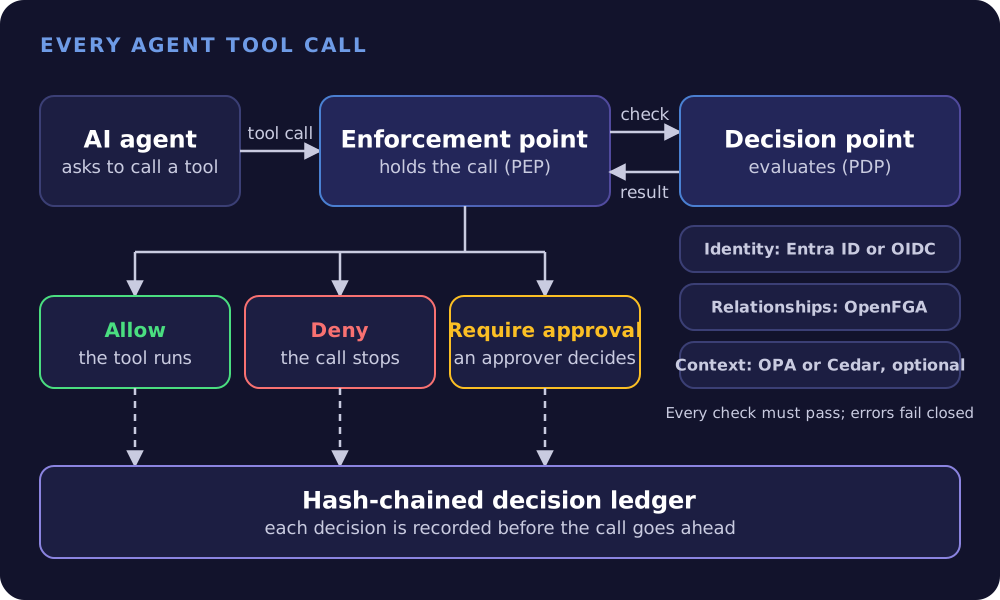
Control at runtime
Every agent tool call gets Allow, Deny or Require approval in production, checked against OpenFGA relationships (Business and above).
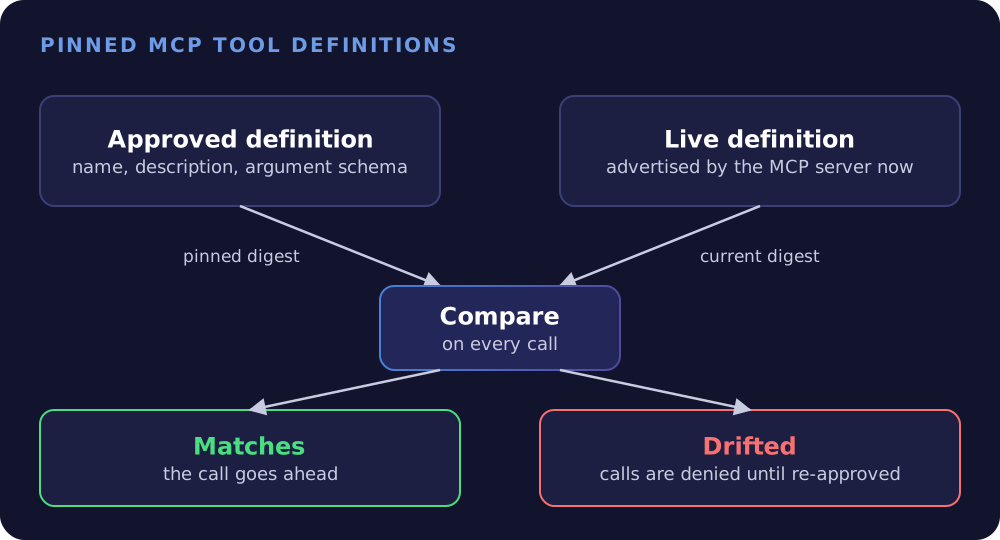
MCP tool integrity
Pinned tool definitions: a digest of name, description and argument schema. Any change blocks calls until re-approved.
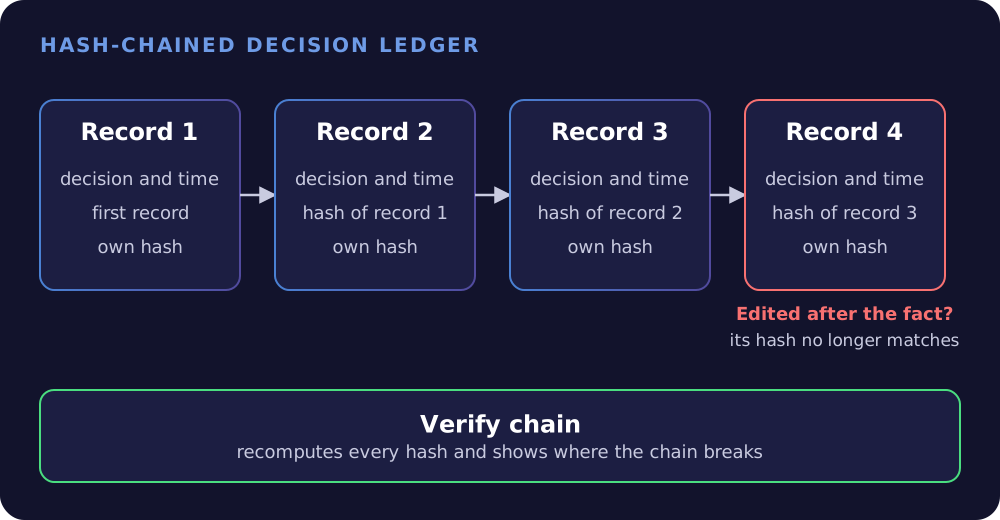
Evidence for every decision
An append-only, hash-chained ledger records each agent decision before the call proceeds, and Verify chain checks it.
When to choose which
These are different layers, so the honest answer is often both. Here is where each one leads.
Choose Protect AI if
- Your main risk is the models themselves: unsafe model files, vulnerable ML dependencies or a weak supply chain.
- You build and train models in-house and need checks before deployment.
- Your security work centres on ML pipelines rather than live agent traffic.
Choose DeepintShield if
- Your risk is what apps and agents do in production with the models you use (see Agentic Security).
- Agents call tools or MCP servers and need a verdict before each action (see MCP Gateway).
- Prompts and responses need injection checks and PII redaction at runtime.
- You want one gateway for 29 built-in providers that runs in your own environment.
The two fit together: check the model before release with a lifecycle tool, then control how it is used at runtime with DeepintShield.
How to test DeepintShield next to Protect AI
The two cover different stages of the AI lifecycle, so test them as a pair rather than head to head.
Map your AI lifecycle
List the models you build or buy, and the apps and agents that use them in production.
Check models before release
Use a lifecycle tool to scan model files and dependencies before they reach production.
Control use at runtime
Route one app through DeepintShield in shadow mode, then enforce guardrails and agent controls.
Keep the evidence together
Store scan reports next to the hash-chained decision ledger, so auditors see both stages.
DeepintShield vs Protect AI questions
Is DeepintShield a Protect AI alternative?
For runtime control, yes; for model scanning, no. DeepintShield governs prompts, retrieval, tool calls and responses in production, but it does not scan model files or ML pipelines. Teams that build their own models may want both layers. See Runtime Guardrails & PII.
Can I use both together?
Yes, and the layers fit well. Use a lifecycle tool to check models before deployment, and DeepintShield to control how apps and agents use them in production. The two do not need to integrate to work side by side.
How do I add DeepintShield next to Protect AI?
Start with one app. Point its model calls at the DeepintShield OpenAI-compatible endpoint, run guardrails in shadow mode, then enforce. For agents, the Python SDK 3.2.3 binds to frameworks such as LangGraph, the OpenAI Agents SDK and PydanticAI. Read the SDK docs.
Does DeepintShield produce an AIBOM?
Yes, for governed tools. Export AIBOM produces a JSON inventory of governed tool contracts, signed when a signing key is configured (Business plan and above). It does not inventory model files.
Is there a free plan?
Yes. The Developer plan is free, with 50,000 requests a month and 2 seats, and Cloud Team costs $49 a month. Agent controls start on Cloud Business at $249 a month. See pricing and plans.
About this comparison. Protect AI and the other product names on this page are trademarks of their respective owners. DeepintShield is not affiliated with, endorsed by or sponsored by them. We compiled this page in good faith from each vendor’s public product pages and documentation, checked on 15 November 2026. Products change often, so check the vendor’s current documentation before you decide. If anything here is out of date or inaccurate, tell us and we will correct it promptly.
Try DeepintShield on your own stack
Start free with 50,000 requests a month, or see how every vendor compares on one page.