

AI Logs
What Is an MCP Gateway? Tool Access and Policy Checks
What Is an MCP Gateway? Tool Access and Policy Checks An MCP gateway gives an application a common route to connected Model…
Meet DeepintShield at Bengaluru Tech Summit 2026, 17 to 19 November, BIEC Hall 1, booth H1A106. Book 20 minutes
Platform · MCP Gateway
An MCP gateway sits between AI agents and Model Context Protocol servers and decides which tools each caller can see and run. DeepintShield acts as both MCP client and MCP server: it registers your servers, filters tools per virtual key, brokers OAuth and checks every tool call before it executes.

The Model Context Protocol defines how clients discover and call tools. Who may call which tool, with which credentials, is left to you.
Every team connects its own MCP servers, so nobody can list which tools your agents can reach.
API tokens are copied into agent configs and scripts, with no central place to scope or revoke them.
A server can change a tool’s description or schema after review, and clients keep calling it.
The MCP gateway shares one policy engine with the rest of the DeepintShield platform. See how a request flows from caller to tool.
Add servers over HTTP, SSE or STDIO; the gateway health-checks them and lists their tools.
Each virtual key sees only the tools its MCP configuration allows. An empty configuration means no tools.
On Business and above, every tool call also needs an exact Allow from Agentic Security.
Tool calls land in the logs, and agentic decisions go to the hash-chained ledger.
With Agentic Security on, the direct tool-execution endpoint returns one of three outcomes. JSON-RPC callers get the same verdict as an error result.
The key binding, the tool filter and the authorization check all allow the call, so the gateway executes it.
Returns 403 mcp_tool_authorization_denied. Auto-execute lists and OAuth grants cannot override it.
Returns 202 mcp_tool_approval_required. Write-like actions need a live approval tied to the argument digest.
Register HTTP, SSE and STDIO servers, with health checks every 10 seconds. STDIO is off in production by default.
Client config, virtual key binding and authorization intersect. Request headers can narrow the tool list but never expand it.
Strict OAuth 2.1 (MCP 2026-07-28) with PKCE S256, issuer binding and encrypted tokens bound to the workspace.
RFC 8693 token exchange. The caller’s token is never forwarded to the MCP server and never stored.
Agent Mode runs tool loops for you; Code Mode calls tools from one sandboxed Starlark script, checking every nested call.
Server URLs are validated before the gateway connects, and cloud metadata endpoints are refused unconditionally.
MCP servers per plan: Developer 1, Team 25, Business 50, Enterprise unlimited. The registry, Agent Mode and Code Mode are on every plan; per-call agentic authorization is on Business and above. See pricing.
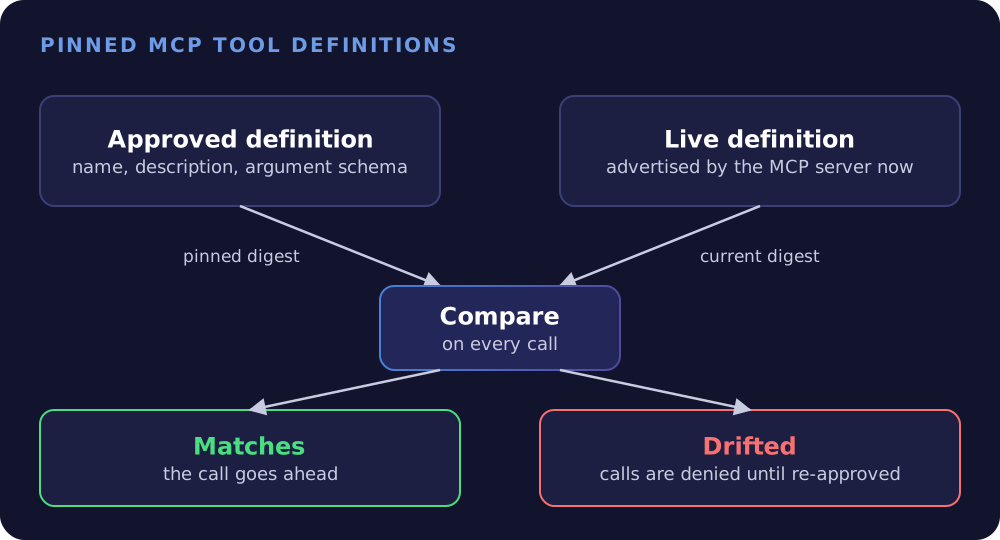
A tool approval covers the tool’s name, description and argument schema. If an upstream MCP server changes any of them, the tool moves to Drifted and calls are denied. The console shows the approved and advertised digests, and an operator chooses Approve new definition to re-pin the tool.
 Tap to enlarge(opens the full-size image in a new tab)
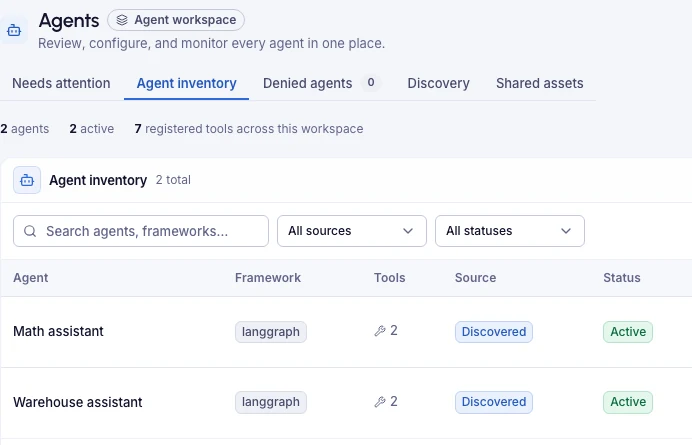
Export AIBOM produces a JSON inventory of governed tool contracts, so security and audit teams can see which tools agents may use and which definitions were approved. On Business and above, the export is signed when a signing key is configured; otherwise it is clearly marked unsigned. Read how agentic AI security uses the same contracts.
 Tap to enlarge(opens the full-size image in a new tab)
Agents and frameworks reach MCP tools through the gateway with a virtual key; anonymous access is refused, and each key gets its own filtered catalogue. The /mcp gateway URL accepts JSON-RPC 2.0 and SSE and needs gateway version v1.4.0-prerelease1 or later.
# Governed MCP entry points
/mcp                        # JSON-RPC 2.0 and SSE
POST /v1/mcp/tool/execute   # direct tool execution

# Responses from the authorization check
403 mcp_tool_authorization_denied
202 mcp_tool_approval_required
503 mcp_tool_authorization_unavailable
Mapped to
Mapping supports your own assessment; it does not replace it.
What Is an MCP Gateway? Tool Access and Policy Checks An MCP gateway gives an application a common route to connected Model…
DeepintShield team · · 5 min read

Tool Fingerprint Drift: Review Changes Before Use Tool fingerprint drift means the recorded tool definition differs from its approved baseline. It is…
DeepintShield team · · 4 min read

AIBOM Explained: Inventory and Verify AI Agent Tools An AI Bill of Materials (AIBOM) is a structured inventory of the AI components…
DeepintShield team · · 4 min read
An MCP gateway is a single control point between AI clients and Model Context Protocol servers. It handles discovery, authentication and policy for every tool call, so tools are not wired directly into each agent. Read the MCP overview in the docs.
No. The protocol describes how to discover and call tools, but access control and credential handling are up to you. DeepintShield adds per-key tool filtering, OAuth 2.1 and, on Business and above, an authorization check on every call.
Credentials stay on the gateway, not in your agents. OAuth tokens are encrypted and bound to the workspace, and delegated sign-in never forwards the caller's token to the MCP server. Set DEEPINTSHIELD_ENCRYPTION_KEY so that stored server secrets are encrypted.
STDIO, HTTP and SSE are supported. STDIO servers are off in production by default, and outbound URLs are validated before the gateway connects.
It depends on your plan: Developer 1, Team 25, Business 50 and Enterprise unlimited, counted across your organisation. See the plan comparison.
Allow, Deny or Require approval for every agent action, with OpenFGA authorization down to the record.
Explore agentic security
Virtual keys set which MCP tools, models and budgets each team or application may use.
Explore governance
Check MCP tool inputs and outputs for prompt injection, secrets and personal data.
Explore guardrails
Connect your first MCP server on the free Developer plan, or book a demo to see per-call authorization.