What Is an MCP Gateway? Tool Access and Policy Checks
An MCP gateway gives an application a common route to connected Model Context Protocol servers. It can centralize tool discovery, authentication and configured governance, making integrations easier to operate. To understand its security value, follow a real call from the client to the tool and ask what authorizes execution, what content is inspected and what evidence remains afterward.
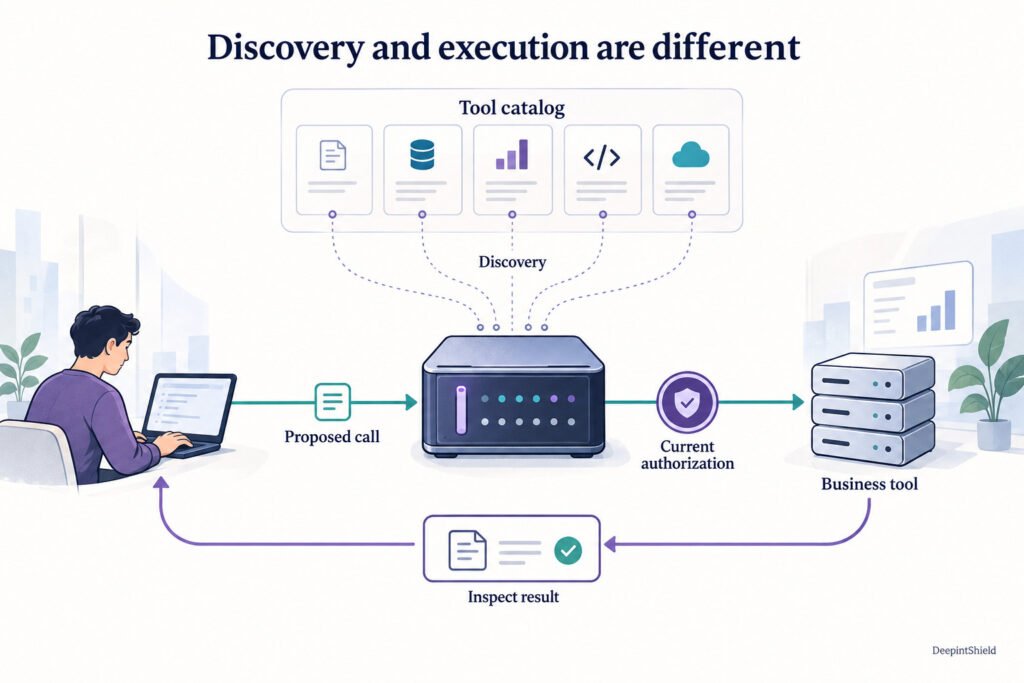
Figure: An MCP switchboard separates tool discovery from an authorized execution path. One proposed call reaches the selected business tool and returns a result for inspection.
Discovery tells the client what is available
MCP clients use the protocol to discover tools and invoke them with structured arguments. DeepintShield scopes its MCP catalog through connection, request and Virtual Key configuration. A tool visible in a listing is available for consideration; its visibility is not the final decision that a particular action may run.
For a support assistant, the same server may expose both order search and order update. The application can offer a common integration while retaining different permissions for those operations. Confirm tool names, schemas, transport and authentication using the actual client-server combination rather than relying only on general protocol compatibility.
Governed execution has its own boundary
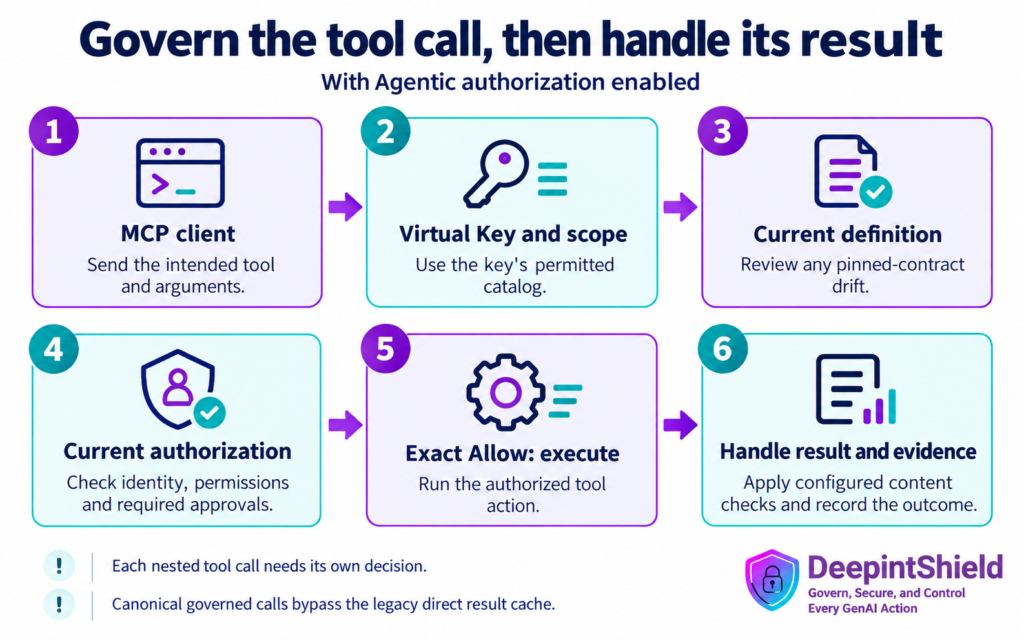
When Agentic authorization is enabled, DeepintShield’s server-owned MCP paths converge on a canonical decision before invoking the tool. That includes JSON-RPC tools/call, the direct tool-execution endpoint, Agent Mode and nested Code Mode calls. An auto-execution list expresses eligibility, while every attempted governed call still needs an exact Allow.
The decision rechecks the current Virtual Key and agent binding, registered action, exact-workspace relationships, optional context policy and approval state. Deny, pending approval and unavailable authorization do not execute the call. In Code Mode, both the outer code call and the inner tool calls receive their own authorization checks.
Inspect contracts and returned content deliberately
The current MCP contract pin compares the tool name, description and argument schema with its approved definition. A changed definition becomes pending and calls are denied until an operator reviews and re-approves it. This checks the advertised surface, while implementation review and service controls address what happens behind that surface.
Configured content checks can complement authorization on supported arguments and results. Treat tool output as returned data, including when it contains instructions or sensitive values. With the SDK’s official MCP session helper, check the resulting DeepintShield error behavior before placing a result into model context. External adapters should perform the documented result validation at their own boundary.
Visual guide: What Is an MCP Gateway? Tool Access and Policy Checks
Figure: With Agentic authorization enabled, an MCP client uses its Virtual Key and scoped catalog, checks the current tool definition and authorization, executes only on an exact Allow, and handles the result and evidence. Each nested call gets a separate decision; canonical governed calls bypass the legacy direct result cache.
Evaluate the route you intend to deploy
The canonical governed path bypasses the legacy direct MCP result cache because that older key does not bind the complete authorization context. Avoid drawing a cache stage into this path as if prior execution automatically permits reuse for the next caller.
Test a permitted read, a restricted update, a pending approval, a changed tool definition and an unavailable upstream service. Inspect the resulting decision and run evidence. Confirm plan availability and the workspace setting as part of the test record. This gives the team a practical description of the gateway’s coverage and its expected behavior.
Treat discovery and execution as separate integration tests
A client can list an inventory tool successfully while lacking permission to update stock. Test those operations separately using an isolated warehouse fixture. Capture the tools visible to the credential, then submit an allowed lookup and a prohibited adjustment. Observe whether the adjustment handler runs at all. A client-side hidden button or a filtered catalogue is useful usability behavior, but it does not replace an execution decision for a request submitted directly to the gateway.
DeepintShield converges its governed MCP execution surfaces on the canonical decision boundary. That boundary rechecks the current Virtual Key binding, resolved tool action and workspace authorization context. Outbound MCP OAuth serves a different role: it authenticates the upstream connection or delegated caller and does not turn a denied Agentic decision into permission. Keep both credentials and both decisions visible in the architecture review. Canonical MCP execution
Build a correct result-handling loop
When the model proposes a function call, parse and validate the arguments before submitting the call through the supported session. Inspect the returned MCP result for its actual outcome before adding it to model context. A protocol-level success can carry an error result; treating every returned object as valid tool data can make the assistant explain a failure as though it were an inventory observation. Keep the tool-call identifier with the result so the next model turn can correlate it correctly.
Use a synthetic timeout and a disconnected upstream server to exercise recovery. Distinguish a request that was never authorized from a request whose downstream result is unknown. For read-only operations, a retry may be acceptable under the application’s rules; for stock adjustments, check a durable operation record before another attempt. The gateway’s authorization check does not make the upstream service transactional or remove its own duplicate-write and reconciliation requirements.
Review every path that can reach the service
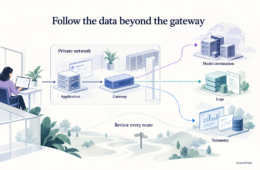
Inventory direct SDK connections, framework tool wrappers, gateway calls and administrative scripts. A protected gateway route is only meaningful for traffic that actually uses it. If a framework can invoke the underlying service directly, enforce suitable resource authorization at that service and remove unnecessary direct credentials from the application. Cooperative local instrumentation can improve normal workflow behavior, but should not be described as an unbreakable boundary against code controlling the same process.
For the approved route, retain a compact compatibility test covering connection initialization, listing, an allowed call, a denied call, pending approval and a tool-result error. Re-run it when the MCP server, SDK or gateway changes. Keep remote tool definitions and consuming-client expectations aligned during release. A tool that remains discoverable after a schema update may still require integrity review or application changes before its new contract can be used safely.
Record the inventory tool’s service-side outcome independently of the MCP response envelope. This helps distinguish a completed read from a tool-reported error and reveals calls made through an unexpected route. A passing discovery test only proves that a tool can be listed; retain execution and negative-permission tests as separate evidence.
Frequently asked questions
Does MCP OAuth grant permission to run a tool?
OAuth can authenticate an upstream connection or delegated caller. It does not replace the separate Agentic authorization required for governed MCP execution.
Does connecting an MCP server authorize all its tools?
No. Connection, discovery, tool filtering and governed execution are different concerns. Register the intended tools and exact actions, grant only the required relationships and test a prohibited call directly. A valid upstream connection or OAuth grant does not replace the permission decision at the execution boundary.
Documentation and further reading
Related guide: Agentic AI Security: How PEP and PDP Protect Tool Calls