OpenAI Gateway Migration: More Than a Base URL Change
Changing a base URL can be the first step in an OpenAI gateway migration, especially for a small text application. A production migration also needs a clear contract for the requests the application actually uses. Confirm the endpoint, credentials, model route, response shape and failure handling before moving more traffic. A successful greeting proves one useful path, not every operation.
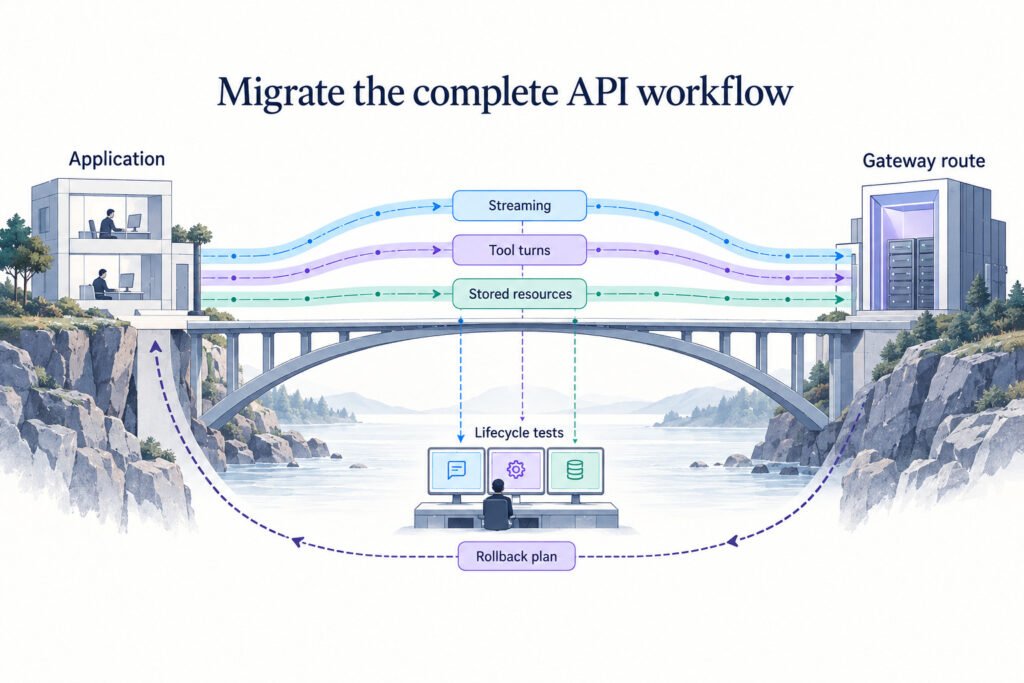
Figure: A migration bridge carries streaming, tool turns and stored-resource operations between an application and a gateway route. Lifecycle tests and a rollback path support the transition.
Begin with the application’s feature list
List the API operations in use: Chat Completions or Responses, streaming, structured output, function calls, file inputs and stored resources. Keep examples of representative requests and expected outcomes. This gives the team a focused compatibility review instead of a broad question about whether a gateway supports a provider.
DeepintShield supports native OpenAI clients through its documented integration and API roots. Applications use a gateway Virtual Key, while provider credentials remain in the gateway configuration. Select the intended provider-qualified model and preserve deployment identifiers or nested model paths where the chosen adapter requires them.
Treat the API method as part of the route
A model name alone does not select the correct client method. Chat Completions and Responses have different request and response structures. Responses uses typed output items, including messages, function calls and reasoning state, rather than only a single text field. Match the endpoint and fields to the selected model’s supported operation.
For continuation after a function call, keep the complete required output items and attach the tool result to the original call identifier. Reconstructing a turn from visible text alone can omit protocol state. Preserve opaque reasoning items with the compatible provider and model when the workflow requires them.
Verify streams and stored resources separately
A streaming client should distinguish completed, incomplete and failed outcomes, and treat a connection that closes without a terminal event as interrupted. Test function-argument events as well as visible text. This is particularly important when the interface updates while generation is still in progress.
Creating a Responses result through a translated provider adapter does not establish support for retrieving, cancelling, deleting or compacting stored responses. Check DeepintShield’s operation-specific coverage. Resource calls may need a provider selector and the same configured key used at creation; a response identifier is not a portable routing token across providers.
Visual guide: OpenAI Gateway Migration: More Than a Base URL Change
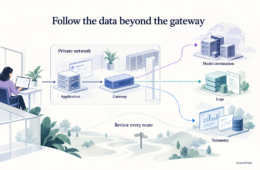
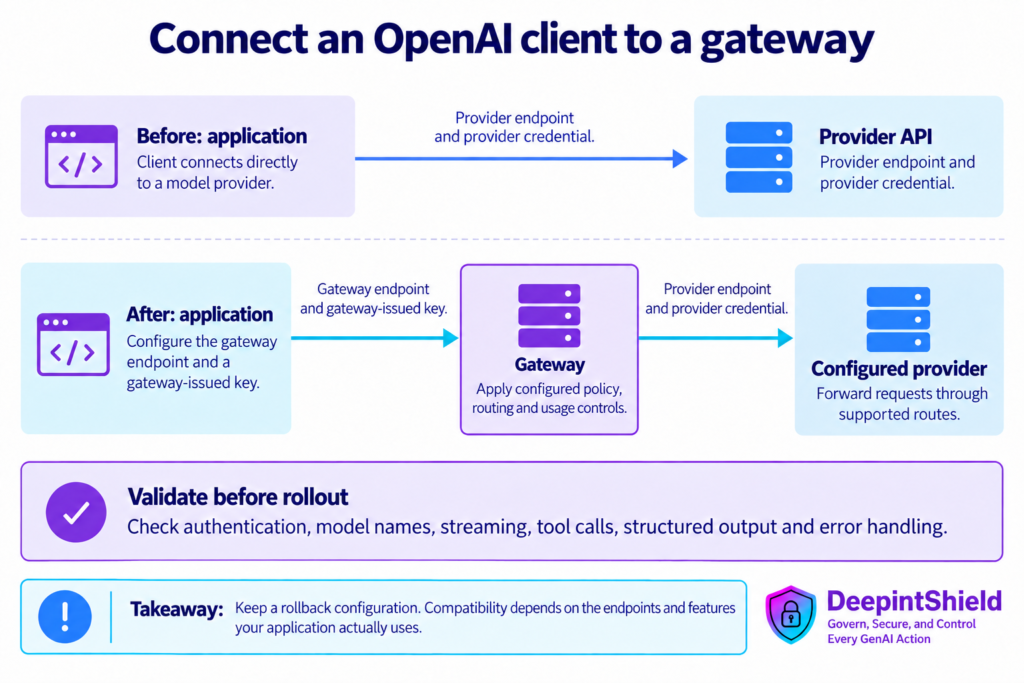
Figure: Before-and-after API connection paths show an application calling a provider directly, then calling a gateway with a gateway-issued key; a validation checklist checks supported features and rollback.
Roll out with current versions and clear rollback
The current Python SDK release is 3.0.0, with Server 2.8.3 identified as its compatibility reference. These versions are independent. Installing a client package does not deploy gateway features, so record both sides of the integration and the enabled workspace policies.
Replay a normal answer, a tool turn, a structured response, a stream and an expected policy rejection. Compare response handling, latency and usage with the current application. Keep client configuration reversible during the rollout. If the application also performs Agentic actions, verify their authorization path separately from model inference.
Inventory the application contract before changing configuration
List each API operation the application uses: a simple text completion, a streamed response, function calling, embeddings, files or stored-response retrieval. Record the installed client version, model identifier and response fields consumed by the application. For each operation, prepare a small request that represents real usage and a clear expected result. This prevents a successful text-only demo from being treated as proof that the application’s more complex lifecycle is compatible.
Separate gateway origin, integration root and API method in the configuration review. A native client’s constructor may override environment defaults, and a model identifier does not select Chat Completions versus Responses for you. DeepintShield documents the native-client integration and provider-specific operation coverage; inspect the route used by the running process, not only a deployment variable that might be ignored. Native client setup
Test errors and stateful operations through the new route
Exercise an unavailable model, a denied request, an incomplete stream and a tool handoff. Confirm the application presents the correct operational state rather than treating every exception as a provider outage. Native client exceptions own their HTTP decoding, so capture the structured gateway error where the client exposes it and preserve a stable correlation identifier. Avoid parsing a complete diagnostic message for business logic when a supported status or code is available.
For stateful operations, create and retrieve the resource using the intended provider and workspace. Test a credential from a different workspace and a provider change before assuming resource identifiers are portable. For tool continuation, retain the complete output items and call identifiers required by the chosen protocol. A response that printed text before failing has not necessarily completed, and a tool result alone may not reconstruct the preceding model turn. Protocol operation contracts
Use a bounded cutover with an observable rollback
Move a small application-owned traffic slice through the gateway after the fixtures pass. Compare task outcomes, error categories, latency and usage with the previous route using the same time window and workload classes. Confirm that credentials remain server-side and that the selected Virtual Key has the intended model and provider access. A connection test should not require granting the application broad administrative access or exposing a provider secret in a browser configuration.
Keep the prior supported configuration available for recovery, while respecting any stateful resources created on the new route. If a rollback changes provider context, decide how in-progress tool turns, stored responses and file identifiers will be handled instead of silently replaying them elsewhere. Record the SDK and gateway versions independently; upgrading a client package does not install server features. The cutover is complete when the operations the application actually relies on have passed, including their failure and cleanup paths.
For stateful operations, keep the originating route and resource context available during cutover. A new gateway setting does not necessarily make an existing upstream object accessible through a different provider or credential. Test retrieval and cancellation of objects created before the change, and document the supported handling for operations still in progress when rollback begins.
Frequently asked questions
Does OpenAI-compatible mean every provider feature is supported?
It means the gateway supports documented interface behavior for specific operations. Confirm the exact model, endpoint, optional fields and resource lifecycle used by the application.
Is changing the base URL enough for every OpenAI-style application?
It may cover a simple supported inference call, but it is not a full migration test. API methods, model capabilities, streams, tools and resource lifecycles have their own contracts. Inventory those operations, exercise their success and failure paths and verify the effective client configuration before moving the complete workload.