LLM Hallucination Checks: Grounding and Answer Quality
A useful AI answer should address the question and show where its factual claims come from. LLM hallucination checks help a team examine that relationship, but they work best alongside better source material and clear generation instructions. Treat the scores as signals for review and improvement, with a clear understanding of which answers were evaluated and what evidence the evaluator received.
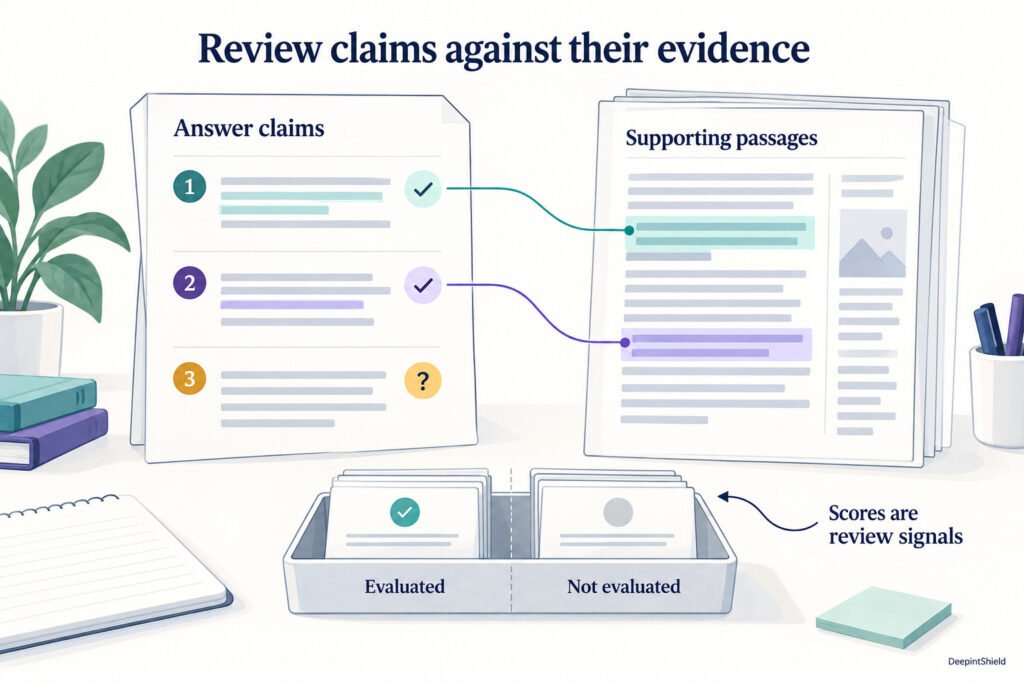
Figure: Claims in an answer are connected to supporting passages in a source document. Missing support and unevaluated answers remain visible alongside completed evaluations.
Give the model a fair starting point
Provide relevant, current context and tell the assistant how to respond when the evidence does not answer the question. DeepintShield’s Hallucination Control includes grounding, anti-fabrication, citation and uncertainty directives, along with supported generation-setting controls. Their effect should be evaluated on the application’s own questions.
For a product-policy assistant, the reference set should contain the current rule and any applicable exception. A model cannot reliably cite a passage the application never retrieved. Improving source coverage or separating an outdated document can make a larger difference than changing the wording of a grounding instruction.
Read each metric as a different question
Faithfulness considers how the answer follows the supplied context. Answer relevance considers whether it addresses the user’s question. Coherence looks at internal consistency, while helpfulness depends on the configured rubric or judge. Citation precision asks whether reference material supports the associated claims.
These signals should not be collapsed into a blanket statement that an answer is true. A coherent answer can rely on an outdated source, and a relevant answer can omit an important condition. Review examples around the chosen thresholds so the team understands what a strong or weak result actually means.
Prepare the references and evaluation coverage
DeepintShield’s Ground Truth records support citation-precision evaluation and can be scoped to a Virtual Key or the workspace-wide wildcard. Supply reference answers and sources for the scope you intend to evaluate. Keep those records current when the underlying product or policy changes.
The helpfulness detector can use a selected judge model and authorized Virtual Key. Sampling, worker capacity and timeout settings affect how much scoring completes. Track evaluated answers, timeouts and skipped work alongside scores; an empty score is not evidence that an answer passed evaluation.
Visual guide: LLM Hallucination Checks: Grounding and Answer Quality
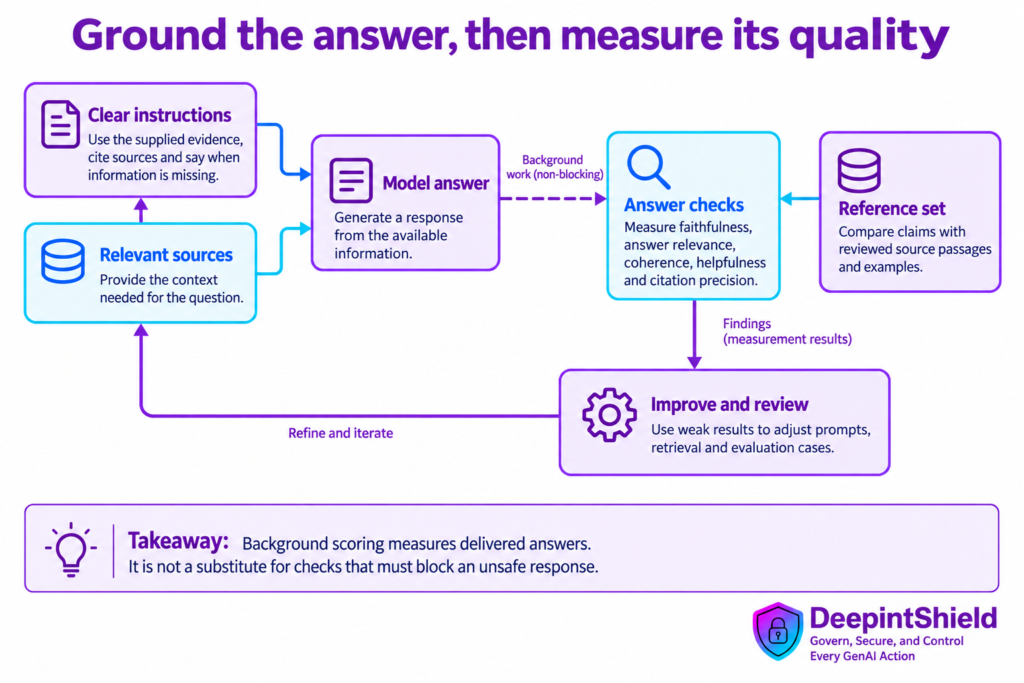
Figure: Grounding instructions and source context feed a model answer; a separate background scoring path compares it with reference material and feeds findings into prompt improvements.
Use background findings to improve the next answer
The documented scoring process runs after the client response according to sampling configuration. It can inform retrieval changes, prompt revisions and source maintenance, but it cannot prevent an answer already delivered. Checks that must block or redact delivery belong on the appropriate synchronous policy path.
Keep Ground Truth separate from the Golden Registry. Ground Truth supplies evaluation references; the Golden Registry supplies curated answer text for eligible response-consistency matches. A score does not activate a canonical answer or approve an action. Use the appropriate trace to understand whether a response came from generation or reuse before assessing the result.
Build a claim-level review for a benefits assistant
Consider an employee asking whether a particular course qualifies for reimbursement. The source says eligible courses require advance approval and excludes examination fees. An answer that mentions the reimbursement amount but omits both conditions can sound helpful while causing a poor decision. Break the response into consequential claims: eligibility, amount, approval timing and exclusions. Match each claim to a supporting passage, and mark what the source does not resolve. This review method makes missing conditions visible instead of rewarding a fluent paragraph as a whole.
Create examples covering an eligible course, an excluded fee, an outdated policy and a question the corpus cannot answer. Have the policy owner review the expected interpretation before using these examples to assess a model or detector. The Hallucination Defense guide describes several distinct metrics and reference mechanisms. Use the metric relevant to the failure being investigated; an internally consistent answer may still omit an exception, and an answer closely following obsolete context may still be unsuitable for today’s question.
Measure evaluation coverage as well as scores
Keep counts for eligible responses, sampled responses, completed evaluations, failures and timeouts. Suppose most short answers receive scores but long answers often time out: the visible average now describes a different population from the application’s full traffic. Review that gap before interpreting an improvement. Also separate answers produced by the model from eligible reused answers, because changes in reuse frequency can change the score distribution without improving the underlying generation behavior. Request traces help identify which path produced a specific response.
Calibrate a proposed threshold against reviewed examples, including cases near its boundary. Inspect false reassurance as well as unnecessary flags, and segment results by source set, question type and model configuration when those differences matter. The evaluator can make mistakes, so retain human review of consequential examples and disagreements. These are evaluation practices rather than an automatic product guarantee. Record the judge, rubric, references and sampling settings with each comparison so a later team can understand whether two result sets are meaningfully comparable.
Turn a finding into a specific repair
When an answer invents an eligibility condition, first inspect the retrieved context. If the authoritative passage was missing, fix retrieval or source coverage; if the passage was present but ignored, adjust generation instructions and rerun the affected examples. If the source itself is ambiguous, ask the content owner to clarify it instead of trying to force certainty through a higher score threshold. Keep the original failure as a regression case and check that the repair also preserves useful answers to neighboring questions.
Choose the delivery consequence separately from background measurement. DeepintShield’s documented sampled scoring occurs after the response, so it is suitable for identifying patterns and improving subsequent behavior. A workflow requiring review before an employee acts needs an explicit pre-delivery or approval step designed for that purpose. The guardrails guide describes policy enforcement paths, but a generic content verdict does not certify benefits-policy accuracy. Make the assistant’s uncertainty and escalation route understandable even when no quality score is available.
Frequently asked questions
Does a high grounding score guarantee factual accuracy?
No. Its meaning depends on the context, references, detector and coverage. Inspect representative answers and maintain authoritative sources, especially when the information changes over time.
How many test questions are enough?
There is no universal count. Cover the decisions and exceptions that matter, then add observed failures, unsupported questions and changes in the source corpus. A small reviewed set can reveal a concrete defect, but it cannot establish accuracy for every future question. Report its scope and evaluation coverage alongside any aggregate result.