
Prompt Compression with LLMLingua-2: Practical Limits
A long prompt often contains useful facts mixed with repeated explanation. Prompt compression tries to keep the information the answering model needs in less text. LLMLingua-2 approaches this through token classification: it selects parts of the input to retain. The practical question is not simply how short the prompt becomes, but whether the resulting answer still serves the task.
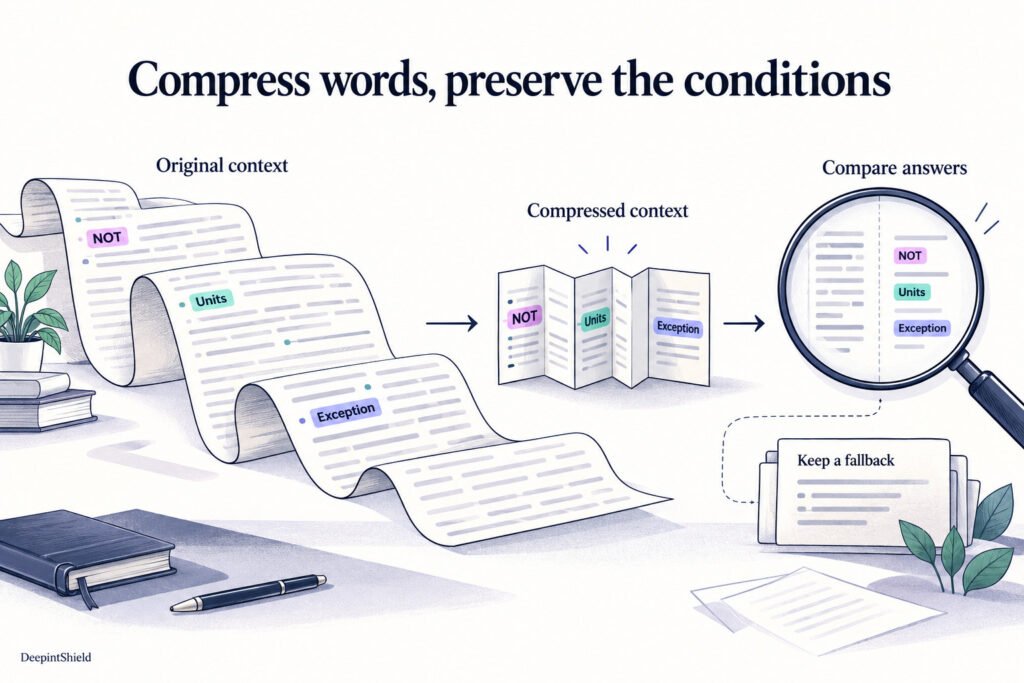
Figure: A long instruction ribbon folds into compact context while retaining negations, units and exceptions. Answer comparison and a fallback preserve the connection to the original material.
Choose a suitable compression candidate
A background passage with repeated wording can be a useful place to experiment. Exact quotations, account identifiers, calculations and carefully constrained instructions need closer treatment. In a document assistant, the definition of a term may be brief while the surrounding explanation is long. A compressor must retain the definition if the user’s question depends on it.
Start with an application path where the team can inspect both original and shortened context. Keep the user’s question and the expected evidence visible during review. It is easier to evaluate one type of document well than to assume a single compression setting fits every kind of content.
Preserve structure and meaning explicitly
Tool arguments, JSON, code, attachment references and opaque reasoning state carry structure as well as text. Do not flatten them into prose or remove tokens merely because they resemble ordinary language. DeepintShield’s current documentation says text optimizations preserve structured messages, including attachments and tool or reasoning state.
For precise material, maintain an explicit bypass route. Heuristic structure detection can help an implementation choose candidates, but it should not be described as a guarantee that every important value survives. An application that must reproduce an exact clause should retain that clause verbatim and use its authoritative source.
Test the complete answer, not just the token count
Use questions that depend on names, dates, qualifying conditions and relationships between passages. Compare answers produced from the original and compressed contexts. Review whether citations still support the claims and whether a shortened passage changes the meaning of a restriction or exception.
Include the compression model’s processing cost and latency. A smaller input to the main model can still require extra work elsewhere. If the deployed optimizer supports a fallback to the original prompt when compression is unavailable, test that behavior separately. The fallback preserves the request path; it does not guarantee the downstream provider will complete it.
Visual guide: Prompt Compression with LLMLingua-2: Practical Limits
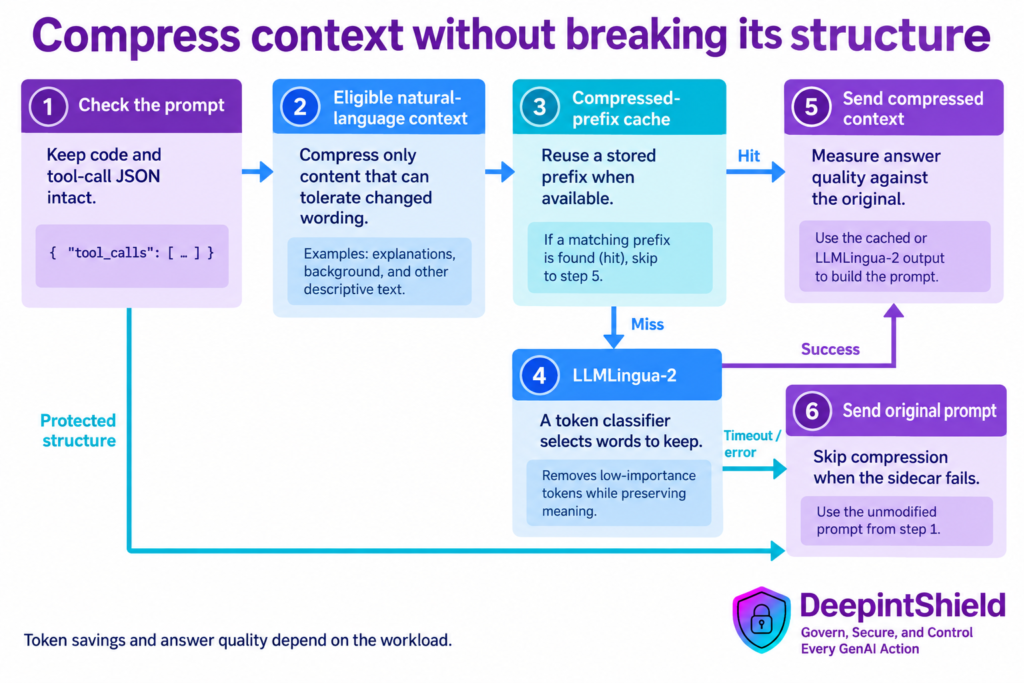
Figure: Illustrative optimization workflow: Prompt compression flow: protect code and tool-call JSON, reuse a cached compressed prefix or run LLMLingua-2, and send the original prompt on a timeout. Available controls depend on the configured implementation.
Apply the workspace setting with a clear scope
DeepintShield lists prompt compression among the Team-and-above cost controls. It has its own workspace setting, separate from semantic response caching. Supporting classifier calls use the selected authorized workspace Virtual Key, so check its provider and model permissions and include those calls in usage review.
Keep a representative set of original requests for future comparisons. Re-evaluate when the compression model, answering model or document format changes. The right setting is the one that preserves the task’s required evidence while producing a measured improvement, rather than the most aggressive shortening ratio.
Build a compression fixture around facts that matter
Take a long maintenance instruction containing a machine identifier, an exception for one model and a warning that a step must not be performed while power is connected. Mark these facts in a review sheet before compressing the text. Ask the downstream model questions that depend on each fact. The useful comparison is whether the compressed context supports the same correct answers, especially the exception and negation, rather than whether its sentences resemble the original document.
Include numbers, units, dates and references that look repetitive but carry meaning. Two procedures may differ by one threshold or by the equipment revision to which they apply. Removing one such distinction can create a plausible but unsuitable answer. LLMLingua-2 is a learned prompt-compression approach; its published examples are evidence about that method under their conditions, not a guarantee for your maintenance corpus. Microsoft project
Decide which request components may change
Separate system instructions, the employee’s question, retrieved evidence, structured tool schemas and conversation state. Specify the portions eligible for compression and the portions the application must preserve exactly. An identifier or JSON field may need exact serialization even when surrounding explanatory prose can be shortened. If the integration cannot reliably preserve a required structured component, keep that component out of the compression path rather than relying on an informal instruction to retain important information.
Run the complete request through a local or staging fixture and inspect what is actually sent to the selected provider. Compare the original and compressed token counts using a consistent measurement, then include compression time in the end-to-end latency. In DeepintShield, confirm the relevant optimization setting and eligible request path from the current documentation. Do not infer from an enabled card that every endpoint, attachment type or provider received the same transformation. Optimization controls
Use a review gate for aggressive compression
Start with a moderate reduction and review difficult cases before increasing it. Have a subject-matter reviewer score whether the answer preserves obligations, exceptions and source attribution. Keep a separate label for unsupported answers that happen to be correct by outside knowledge; the task is to answer from the supplied evidence. A model can conceal lost context by filling gaps fluently, which is why output review must inspect the relationship between the answer and the retained facts.
When a failure appears, retain the original passage, compressed passage, question and observed answer as a regression fixture. Reduce compression for that request class or bypass it until the cause is understood. Re-run the fixture after changing the compressor or downstream model, since the pair determines the result. Maintain access-controlled originals for diagnosis without logging entire sensitive documents by default. A shorter prompt is a useful optimization only when its quality and operating cost remain acceptable.
Keep the uncompressed maintenance instruction available in controlled evaluation records. When a technician-facing answer changes, compare the removed text with the failed condition, including units and exceptions. This provides a concrete reason to adjust the compression setting instead of relying on subjective judgments that the shorter prompt still looks similar.
Frequently asked questions
Does LLMLingua-2 preserve every important fact?
Compression is a selection process, so evaluate it on the actual workload. Keep exact and structured content intact, inspect complete answers, and provide a bypass when the original wording matters.
Can a fixed compression ratio be applied to every document?
It is usually a poor starting assumption. Repetitive prose, short legal exceptions, tabular values and structured tool definitions have different tolerance for removal. Evaluate representative classes separately, preserve exact data where required and keep an uncompressed route for requests whose necessary meaning cannot be retained reliably.
Documentation and further reading
Related guide: LLM Cost Optimization: 12 Ways to Improve AI Efficiency
Related guide: RAG Re-Ranking: Choose Useful Context for Your LLM