Semantic Caching for LLMs: Matching and Safe Scope
Two people may ask the same question in different words and still need the same answer. Semantic caching can reuse a suitable stored response in that situation. The important word is suitable: similarity alone does not establish permission, freshness or relevance to the current caller. Good cache design combines matching with a clear definition of where an answer may be reused.
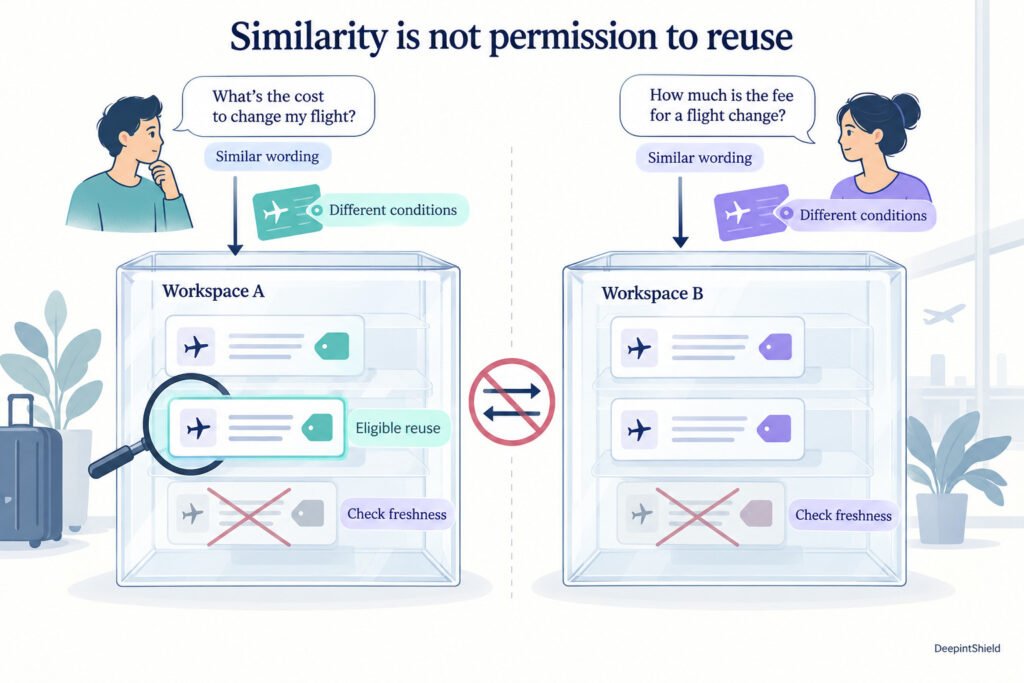
Figure: Similar flight-change questions enter separate workspace cache compartments. Different conditions and freshness checks determine eligible reuse within each scope.
Distinguish exact matches from similar meaning
An exact-response cache compares the complete request identity used by the implementation. Semantic matching uses embeddings to find requests close in meaning. This can help a documentation assistant answer recurring questions, while a changing account balance or a highly personalized recommendation may be a poor reuse candidate.
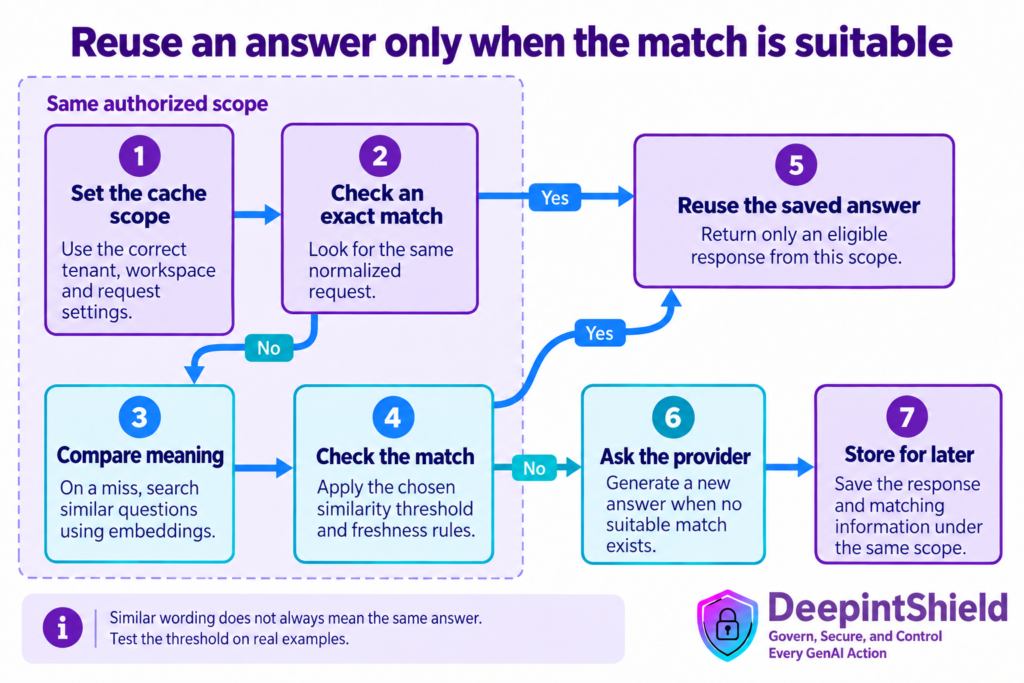
DeepintShield supports direct and semantic response reuse with configured storage and controls. Exact lookup happens before request coalescing. A semantic lookup follows the current input guard, and a reused answer crosses the applicable output-policy barrier. An established exact entry must match the current guardrail fingerprint and request scope.
Define caller scope before tuning similarity
Suppose several support agents share one application key. Their users can all ask, ‘What is my order status?’ The text matches, but the answers depend on a particular customer and order. A key shared by those callers is not by itself a sufficient boundary for that response.
Use the documented user, session or custom-metadata scope appropriate to the application, and keep unscoped semantic reuse disabled when answers must remain separate. Include the relevant instruction, model and provider context in your design. A similarity threshold decides whether requests are close; it is not a substitute for authorization or an answer-validity check.
Keep structured requests intact
Current DeepintShield guidance treats image or file inputs, tool-call and tool-result history, reasoning state and other structured message metadata as exact-only cache inputs. Their complete structured identity contributes to matching, and semantic embedding lookup and storage are skipped. This preserves distinctions that would disappear if an attachment or continuation state were flattened into plain text.
The same documentation states that text optimizations preserve structured messages. Test this with the kinds of payloads your application sends. A plain-text conversation that advertises tools is different from a conversation containing actual tool results; inspect the request rather than inferring its type from the application’s name.
Visual guide: Semantic Caching for LLMs: Matching and Safe Scope
Figure: Within one authorized cache scope, requests pass through exact and meaning checks, then either reuse an eligible answer or call the provider and store the response.
Evaluate useful hits, not just hit rate
Build a review set with paraphrases, near matches, changed instructions, fresh records and separate callers. A cancellation question and a refund question may be close in wording while needing different guidance. Choose the threshold and retention period using those examples, then inspect both accepted and bypassed matches.
Track provider usage together with embedding and storage work. Confirm invalidation behavior across replicas when updates must take effect immediately; a process-local cache can have a documented staleness window. Measure the deployed path instead of treating a lookup microbenchmark as the response time every user will experience.
Use look-alike requests to expose unsafe reuse
Create two synthetic customers whose questions have similar wording but whose entitlements differ. Ask whether each can access a particular service, then reverse the request order. An answer reused across the wrong scope may look fluent and relevant while disclosing a benefit or record the second caller should not receive. Repeat with the same customer after its entitlement changes. These cases test authorization and freshness boundaries that a generic paraphrase benchmark would not reveal.
Build another pair around a meaningful qualifier: a refundable ticket versus a non-refundable ticket, or a policy effective before and after a named date. The semantic representation may place the questions close together even when the correct answers differ. Set acceptance criteria around the returned facts and scope, not merely a numerical similarity threshold. The documented cache path applies request scope and current policy fingerprints, but the application still needs an evaluation set that exposes plausible semantic false matches. Reuse boundaries
Choose an invalidation policy that fits the answer
For a stable public explanation, a moderate refresh interval may be acceptable. For a changing account balance, reuse may be inappropriate altogether. Record the source version or policy revision that makes an answer valid, and identify what event should make it ineligible. If an application cannot connect a sensitive answer to a reliable freshness boundary, exclude that request class until the team can explain when reuse is permitted and how it ends.
Test deletion and policy changes across the deployment shape you operate, including more than one replica where applicable. The documentation describes a bounded local exact-response cache and notes that remote invalidation visibility can depend on its configured lifetime. Measure the observed interval rather than calling every delete instantaneous. After an invalidation, distinguish an answer freshly regenerated from a source that remains stale from an answer incorrectly retained by the cache; the remedies are different.
Review cache economics together with answer errors
Report eligible-request share, useful hit share and reviewed false-match cases separately. A high hit rate is unhelpful if it comes from broadening scope or accepting answers with the wrong date, account or qualification. Compare gateway lookup, embedding and validation work with the avoided provider call. Include misses in the same measurement period so the total reflects an operating workload, rather than only the fast portion selected for demonstration.
When a wrong reuse is found, preserve a sanitized pair of requests, their relevant scope and the source state. Disable the affected reuse class or correct its scope while investigating. Add that pair to regression checks and verify that ordinary authorized repeats still work afterward. Avoid resolving one false match by returning no answers at all without reporting the loss of useful coverage. The operating goal is a known, justified set of reusable answers with understandable exceptions.
For the travel example, review wrong-answer cost alongside hit rate: a cached refundable-fare answer reused for a restricted fare can require customer correction even if it saves a model call. Define those consequential mismatches in the evaluation set so an attractive reuse percentage cannot hide them.
Frequently asked questions
Can semantic caching be used for every request?
No. Eligibility depends on content, scope and configuration. Structured requests use exact-only matching, while personalized or rapidly changing answers may be best handled without response reuse.
Can lowering the similarity threshold improve the cache safely?
It may increase candidate matches, but safety and usefulness depend on the distinctions in your workload. Test look-alike requests with different dates, identities and entitlements before changing the threshold. Keep authorization and policy scope independent of similarity, and use reviewed false-match examples to judge whether the additional hits are acceptable.
Documentation and further reading
Related guide: LLM Cost Optimization: 12 Ways to Improve AI Efficiency