Cascade Routing for LLMs: Balance Cost and Quality
A mixed AI workload does not always need the same model for every request. Cascade routing starts with a suitable candidate model and escalates when the result needs another level of capability. The approach can improve efficiency, but its value depends on the acceptance check as much as the model pair. A confident answer is not automatically a correct one.
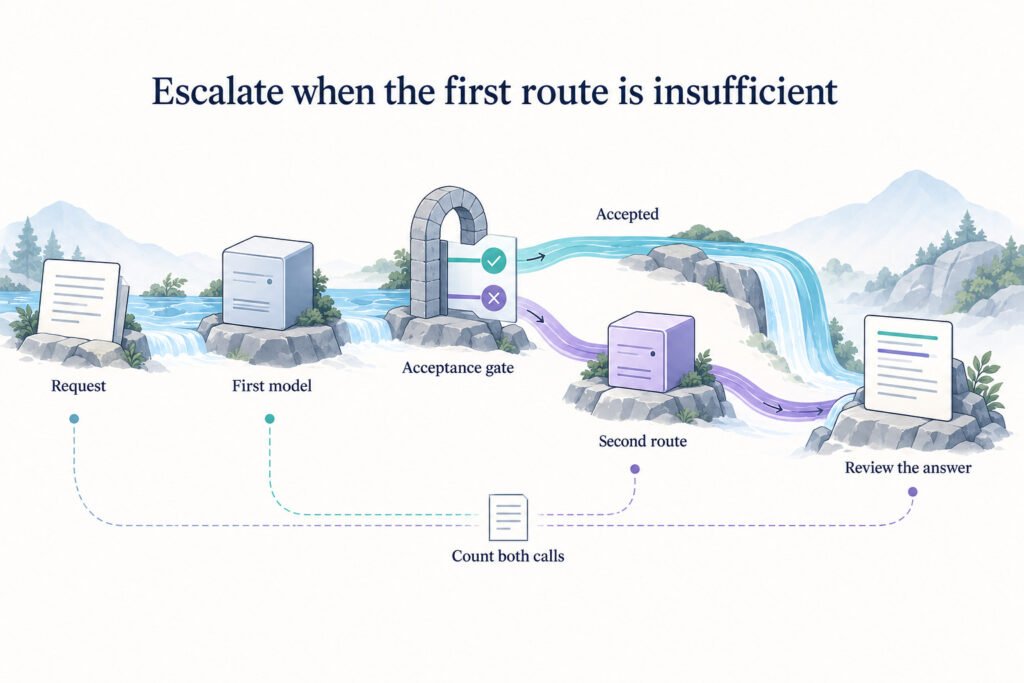
Figure: A river-shaped routing cascade sends accepted first-model work toward an answer and insufficient work through a second route. Both calls remain part of the accounting and answer review.
Define what an acceptable answer looks like
For structured extraction, an acceptance check can validate required fields and compare selected values with the source. For a support answer, it may need to check evidence, completeness and the required escalation language. A parseable response shows that the output has the expected shape; it does not prove the contents are accurate.
Use a review set containing answers that should be accepted and answers that should escalate. Include subtle cases, such as a valid-looking date taken from the wrong section of a document. If the gate accepts those results, adjusting model cost alone will not make the cascade suitable.
Count every call in the path
A sequential cascade waits for the candidate before deciding whether to make another call. Escalated requests therefore include the candidate, the check and the next model’s work. A parallel design can reduce the wait for another answer by starting multiple calls, but each can consume resources even when its response is not selected.
Compare the configured design with a single-model baseline using the same requests. Track accepted-answer quality, escalation frequency, total provider usage and end-to-end response time. Include the cost of any model used to judge candidates. A lower price for the first model alone is not the total price of the workflow.
Keep routing within approved model access
DeepintShield lists cascade routing as a Team-and-above cost control with its own workspace setting. Supporting cascade calls use an authorized workspace Virtual Key and check provider and model grants and expiry. Review those permissions before choosing the candidate and escalation route.
Also check whether the two models support the endpoint, tool schemas and response format the application needs. A provider switch can require different continuation handling, particularly when reasoning or tool-call state is present. Routing should preserve the task contract and security controls, not only change the model name.
Visual guide: Cascade Routing for LLMs: Balance Cost and Quality
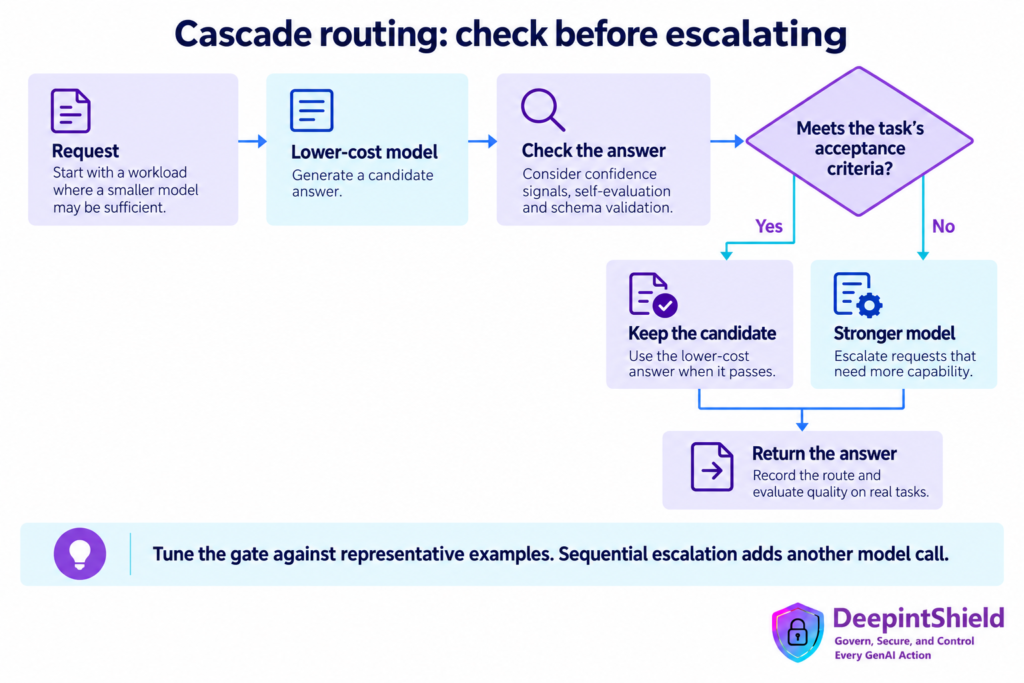
Figure: Illustrative optimization workflow: Cascade routing flow from request to a lower-cost model, answer checks and an acceptance gate, branching to keep the candidate or escalate before returning an answer. Available controls depend on the configured implementation.
Roll out by task, then monitor changes
Start with a bounded task such as classifying incoming tickets into a maintained set of categories. Review ambiguous examples and decide when the workflow should request more capability or a human decision. Keep a sample of requests evaluated against the reference path so the team can detect changes in accepted-answer quality.
Revisit the gate when categories, source documents or models change. Keep the acceptance criteria written in business terms that the application owner can review. A good cascade is understandable: it explains why the first answer was sufficient, why another call was made, and what the combined path achieved.
Define the gate with independently labeled examples
Consider an assistant that classifies support requests into a small set of queues. A first model may handle ordinary requests economically, while ambiguous cases need a more capable route or human review. Build examples with a known queue, overlapping topics and deliberately insufficient information. Label the expected outcome before examining candidate outputs. The acceptance gate should evaluate the task’s requirements, not simply trust the first model’s self-reported confidence.
For a drafting task, the gate may need to check cited support, required fields and prohibited content rather than a single classification label. Decide which failures require a second model and which require clarification from the requester. These are application design choices; the availability of routing does not imply that the gateway automatically implements your domain-specific acceptance test. Check the documented routing controls and distinguish them from the additional application logic. Routing reference
Account for escalation as a full second path
Measure the first-model call, gate evaluation and any escalation together. If the second model starts after a rejected answer, the user waits for both stages. Include requests that exceed the first stage’s timeout and requests that both models fail. Compare this cascade with sending the same workload directly to the approved higher-capability model; a cascade with frequent escalation can cost more or take longer than the simpler route it was intended to improve.
Keep the evidence passed between stages deliberate. A rejected draft can bias the second model, while discarding all prior context can force it to repeat retrieval. Test both approaches on your labeled cases and record what information crosses the boundary. Preserve source permissions and the destination’s data-handling requirements. A successful first-stage authorization does not automatically authorize a different provider, and provider-specific continuation state should not be treated as portable conversation text.
Operate the cascade without hiding hard cases
Report acceptance at the first stage, escalation frequency, final quality and abandonment separately. Break those measures down by language, topic and input length where the sample supports it. A gate that accepts almost everything may be weak rather than efficient; a gate that escalates almost everything may add overhead without useful selection. Inspect false acceptance and unnecessary escalation examples to improve the gate instead of tuning only for a headline first-stage percentage.
Choose a clear response when the escalated route is unavailable. The application may queue eligible work, explain the interruption or request human help, but should not silently return the previously rejected answer as if it passed. Maintain a route that can be restored quickly after a poor model update and keep the labeled evaluation set versioned. Re-test after changes to either model, the gate or the prompt because each can alter which cases move through the cascade.
Review escalated and non-escalated support questions together. If the fallback route repeatedly corrects one class of first-pass answer, update the routing rule or first-pass task scope and retest that class. Do not hide a weak first pass by reporting only the final answer quality without its extra latency and cost.
Frequently asked questions
Is cascade routing the same as reasoning-effort tuning?
No. A cascade decides whether to use another model or route. Reasoning controls adjust a supported model’s deliberation settings. They can interact, so evaluate the combined workflow rather than assuming independent savings.
Is provider fallback the same as a quality cascade?
No. A fallback often handles availability or request failure, whereas a quality cascade deliberately evaluates an answer and may escalate an otherwise successful response. Their triggers, latency and evidence differ. Document both paths if the application uses both, and avoid counting a retried unavailable request as a successful quality decision.
Documentation and further reading
Related guide: Reasoning-Effort Controls: Match the Model to the Task
Related guide: LLM Cost Optimization: 12 Ways to Improve AI Efficiency