Provider Prompt Caching: APIs, Prefixes and Limits
A support application may send the same instructions and tool descriptions with thousands of different questions. Provider prompt caching can reuse eligible processing for that shared prefix while the provider generates each new answer. It is useful to understand this as reuse of input work: the application still makes a provider call and receives a newly generated response.
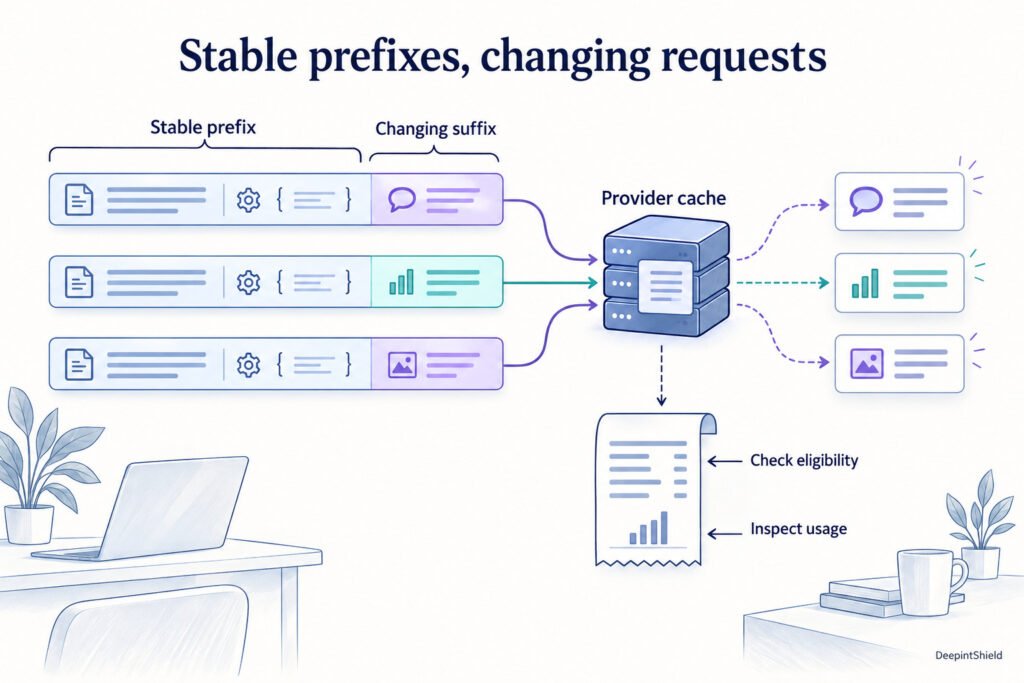
Figure: Three requests share a stable prefix while their suffixes change. The provider-cache illustration pairs that repeated structure with eligibility checks and usage evidence.
Separate prefix reuse from response reuse
A gateway response cache can return a stored answer when the current request is eligible for reuse. Provider prompt caching works inside the upstream provider’s supported mechanism. The changing user question still needs processing, and the answer still needs generation. These two caches therefore have different eligibility rules and cost signals.
For example, a stable product-support guide may be part of every request, while the customer’s issue changes. Prefix caching may help the stable portion. A semantic response cache should only reuse an earlier complete answer when the new question and caller context make that answer appropriate.
Keep the stable part genuinely stable
Place repeated instructions and other suitable context consistently, following the provider’s supported request structure. Avoid changing an otherwise stable prefix with unnecessary timestamps or unrelated request identifiers. Keep dynamic customer context where the provider and application expect it, and preserve the intended instruction order.
This is an application design decision as well as a cache setting. If a tool schema or policy instruction changes, the request should reflect that change even if reuse decreases. Cache efficiency should follow the current task definition, rather than encouraging the application to keep an obsolete prompt.
Review each provider’s supported controls
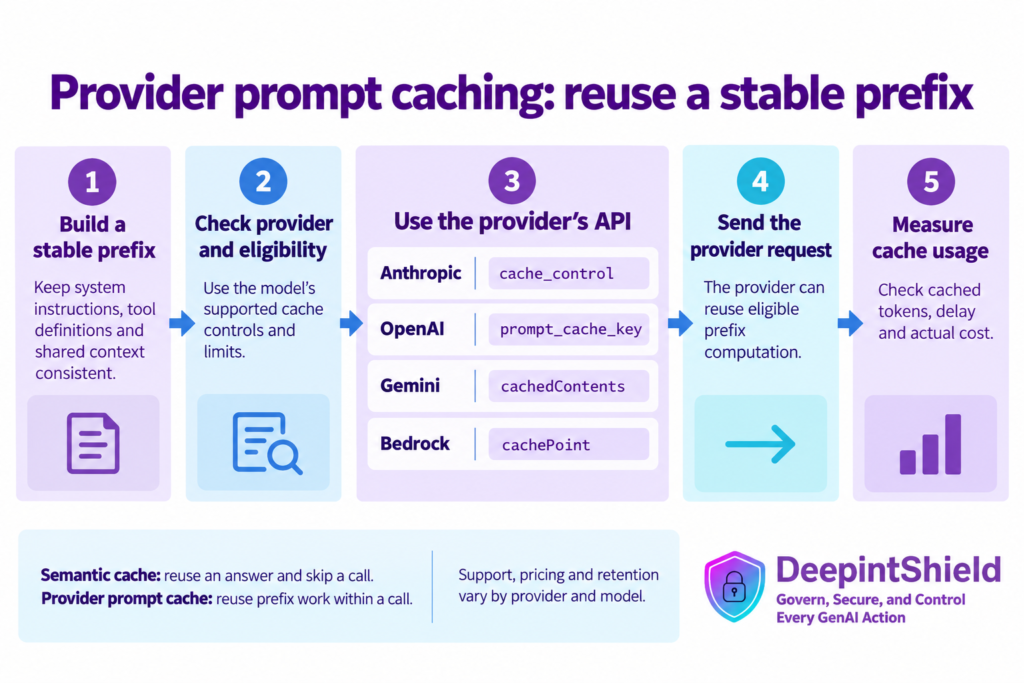
DeepintShield manages provider cache hints, provider selection and supported duration settings from the workspace cost configuration. The meaning of those controls depends on the provider and model. Minimum prefix sizes, retention behavior, creation charges and reported cached usage should be checked for the actual route.
Do not carry a fixed discount or duration from one provider into a forecast for another. The gateway’s allow-list and Virtual Key scope also matter. Confirm that the configured route supports the intended hints, then inspect returned usage rather than assuming a saved toggle proves that every request became cacheable.
Visual guide: Provider Prompt Caching: APIs, Prefixes and Limits
Figure: Provider caching diagram showing stable prefixes, provider detection, API-specific cache fields, the provider call and measured cache usage.
Measure reuse over the real traffic pattern
A prefix used repeatedly within the provider’s retention window behaves differently from one used only occasionally. Test a realistic sequence that includes the first request, subsequent eligible requests and a changed prefix. Account for the provider’s creation and read behavior alongside ordinary input and output usage.
DeepintShield’s observability surfaces can help connect request usage and available cost information. Keep unknown price coverage visible when reviewing totals, and compare the actual billed provider usage where available. Report the workload, route and observation window with the result so the next team can judge whether the same configuration fits its traffic.
Design a stable prefix without freezing changing facts
An internal assistant may send the same general instructions and tool definitions with many employee questions. Place genuinely stable material consistently, while keeping current account details, dates and retrieved evidence in their correct dynamic positions. Do not move a changing entitlement into a long-lived static block merely to create more cache hits. A reused prefix is a computation optimization; it is not permission to reuse an old business fact or bypass the current request’s authorization.
Compare the serialized requests, not just the prompt template displayed in an editor. Generated timestamps, random identifiers and unstable tool ordering can change an otherwise identical prefix. Identify which differences the application controls and which are provider-required. OpenAI’s current guide describes matching prefixes and provider-specific cache behavior; use the actual selected model’s documentation and observed usage fields rather than assuming the same controls across every provider. Provider caching guide
Measure cold writes and later reuse separately
Run one eligible request from a cold state, then repeat it with only the intended dynamic suffix changed. Inspect the provider’s returned cache accounting fields where available and correlate them with gateway usage records. Record the complete input size and whether the static portion meets the provider’s eligibility requirements. A faster second request is suggestive, but it does not by itself prove prefix reuse; connection warming and ordinary latency variation can produce a similar observation.
Next introduce an intentional prefix change and confirm the expected accounting behavior. Vary the interval between repeats to reflect real usage rather than an unrealistically tight loop. Include any cache-write, storage or other provider charges in the comparison when they apply. Avoid copying a discount percentage from a different model or an old pricing page. The economic question is the aggregate cost of the actual cold-and-warm request mix over the intended operating period.
Keep provider settings and data handling explicit
Document which providers the gateway is permitted to send cache hints to and which request classes are eligible. In DeepintShield, the cache configuration distinguishes provider hints from semantic response reuse and offers provider-specific controls. Verify how the deployed adapter handles a hint it cannot support: a common request shape does not mean every destination implements identical retention or duration semantics. Inspect the provider-bound behavior with a safe fixture before applying the setting to sensitive workloads. Gateway configuration
Treat data-retention questions independently from cost questions. Ask where the provider processes and retains cached material under the applicable account configuration and terms. Avoid placing unnecessary secrets or personal records in a cacheable prefix. If a policy or tool definition changes, update the request deliberately and check that new calls use the intended version. A warmed older prefix should never become a reason to delay a required correction to the assistant’s instructions.
Track prefix changes as part of prompt releases. Reordering stable instructions or adding a variable value near the beginning can change reuse behavior even when the final answer quality stays similar. Compare usage evidence before and after the release, and avoid attributing every cost change to the provider’s cache configuration.
Frequently asked questions
Does prefix caching skip output guardrails?
No. Prefix reuse concerns upstream input processing. The generated response still follows the applicable output handling and policy path configured for the request.
Is a prompt-cache hit the same as receiving an old answer?
No. Prefix caching reuses eligible processing of input material at the provider while the model still handles the request and generates an output. Semantic response reuse serves an existing answer through a different path. Measure and govern them separately, including freshness, scope, pricing and the evidence that identifies which optimization occurred.
Documentation and further reading
Related guide: LLM Cost Optimization: 12 Ways to Improve AI Efficiency
Related guide: Semantic Caching for LLMs: Matching and Safe Scope