
OWASP LLM Top 10 checklist (2025)
A practical review of the 2025 OWASP Top 10 for LLM applications: one question to check per risk and the DeepintShield control that helps.
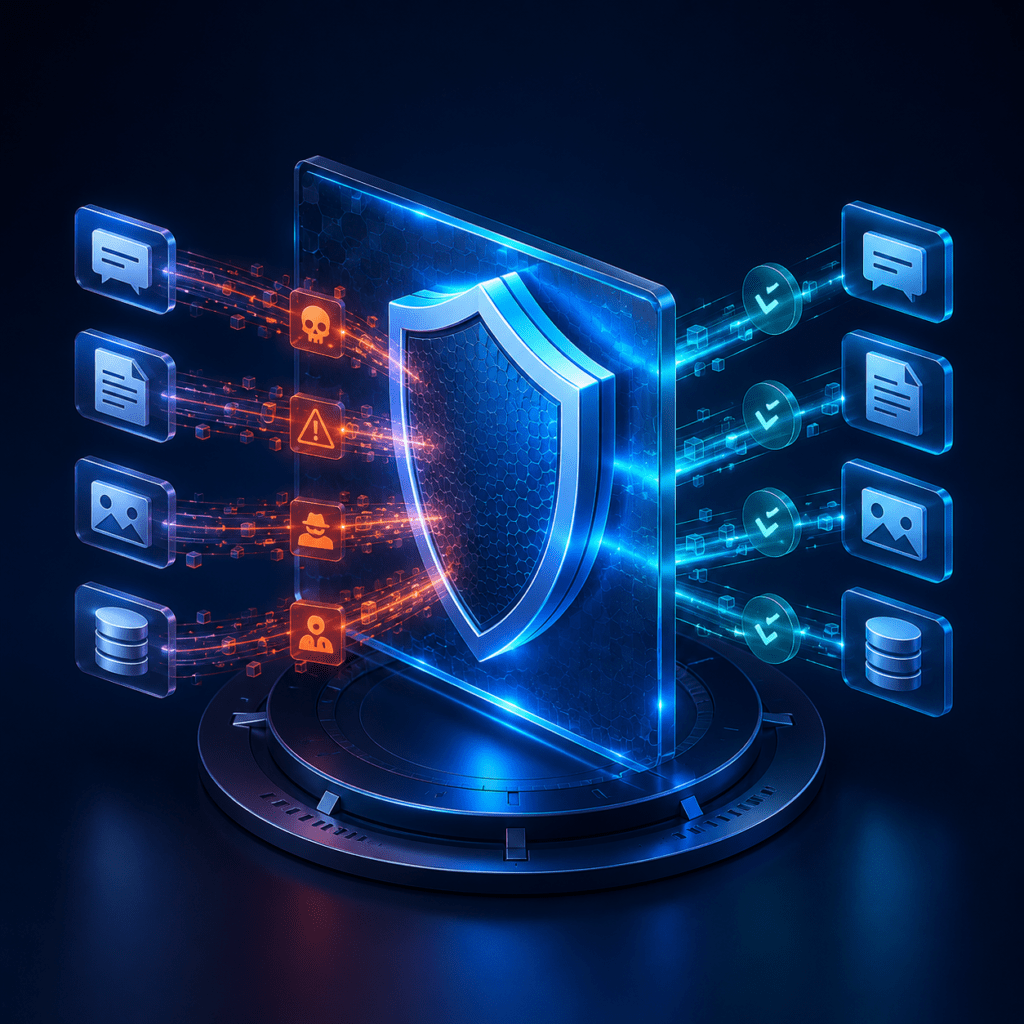
The OWASP Top 10 for Large Language Model Applications (2025 edition) lists the ten risks that matter most when you build on language models, from prompt injection to unbounded consumption. This OWASP LLM Top 10 checklist turns each risk into one question your team can answer in a design review or a security assessment, and names the runtime control in DeepintShield that helps close the gap.
Use it in three passes. First, answer each question for one real application, not for “our AI” in general. Second, mark each answer as covered, partly covered or open, and write down the evidence: a configuration, a test result or a log record. Third, assign an owner and a date to every open item. Repeat the review when the application gains new data sources, tools or users.
Two cautions. A control mapped to a risk helps you meet it. OWASP publishes a community guide, not a standard you are audited against, so treat this as a review aid. And no detector catches everything: pair content checks with limits on what the application is allowed to do. DeepintShield ships OWASP LLM Top-10 guardrail cards on every plan, so you can start from the same structure in the product.
The checklist
LLM01:2025 Prompt Injection
Check: Are untrusted inputs, including retrieved documents and tool results, checked before they reach the model, and could an injected instruction still trigger an action?
Control that helps: Input-stage guardrails with the prompt-injection presets of the pattern catalogue (462 entries in 102 preset families, matched locally), ML prompt-injection and jailbreak classifiers on Team and above, RAG chunk scoring, and an exact Allow for every governed agent action.
LLM02:2025 Sensitive Information Disclosure
Check: Can personal data, credentials or confidential text reach the model or come back in an answer, including in streaming output and logs?
Control that helps: PII and secrets redaction at Input, Output, RAG, MCP and Action, including streaming output; “Disable Content Logging”; and, in hybrid and self-hosted modes, no data leaves your environment.
LLM03:2025 Supply Chain
Check: Do you know which models, providers and tools each application can use, and would you notice if a tool definition changed?
Control that helps: Model access per Virtual Key with unknown models rejected, pinned MCP tool definitions that deny calls after a change until re-approval, and an AIBOM export of governed tool contracts.
LLM04:2025 Data and Model Poisoning
Check: Are documents checked when they are ingested into your knowledge base, and again when they are retrieved?
Control that helps: RAG Security with guard_embedder() at ingestion and guard_retriever() at retrieval, trust and injection scores, and quarantine for suspect sources.
LLM05:2025 Improper Output Handling
Check: Is model output checked before your application renders it, stores it or passes it to another system?
Control that helps: Output-stage guardrails that redact or block, and an explicit authorisation step before output becomes a tool call. Your application should still validate and encode output for its own context.
LLM06:2025 Excessive Agency
Check: Does each agent have only the tools and actions its task needs, and are consequential actions held for a person?
Control that helps: Agentic Security (Business plan and above): OpenFGA checks on the exact object, tool and action, Require approval with separation of duties, and MCP tool filtering per Virtual Key.
LLM07:2025 System Prompt Leakage
Check: Does your system prompt contain secrets, and would you notice if an answer repeated it?
Control that helps: Keep provider keys on the gateway behind Virtual Keys rather than in prompts, and add a custom secret pattern for a marker string from your system prompt to the output checks.
LLM08:2025 Vector and Embedding Weaknesses
Check: Could retrieval return content from an untrusted source, or content the current user should not see?
Control that helps: Per-chunk trust and injection scoring with Allow, Redact, Reject, Quarantine or Warn decisions. Document permissions stay in your retriever, because chunk scoring is not access control. Semantic cache entries are scoped per Virtual Key.
LLM09:2025 Misinformation
Check: Do answers on policy, pricing or eligibility stay grounded in sources, and can you show how often they drift?
Control that helps: Hallucination Defense (Business plan and above): grounding directives such as “Require sources”, five detectors combined into an overall risk score, and Response Consistency with a Golden Registry of approved answers.
LLM10:2025 Unbounded Consumption
Check: Could one user, agent loop or retry storm run up unlimited requests or tokens?
Control that helps: Budgets and rate limits at customer, team, Virtual Key and provider level, with request and token limits, and default Agent Mode limits on loop depth and tool timeouts.
After the checklist
Most teams find the same pattern: content checks are partly in place, but action limits and evidence are missing. Close those first, because they reduce what a missed detection can cause. Then test each control with a real request: an injection attempt in a retrieved document, a prompt with a test card number, an agent asking for a write action it should not have.
- See how the checks work at each point in the five stages of LLM guardrails.
- Compare the agent-specific risks in the OWASP Agentic Top 10 checklist.
- Read about the controls on Runtime Guardrails & PII and AI Compliance.
- Check the guardrail options in the guardrails docs.