
OWASP Agentic Top 10 checklist
Ten checks for AI agents, from goal hijack to rogue agents, each with the identity, authorisation or evidence control that helps.
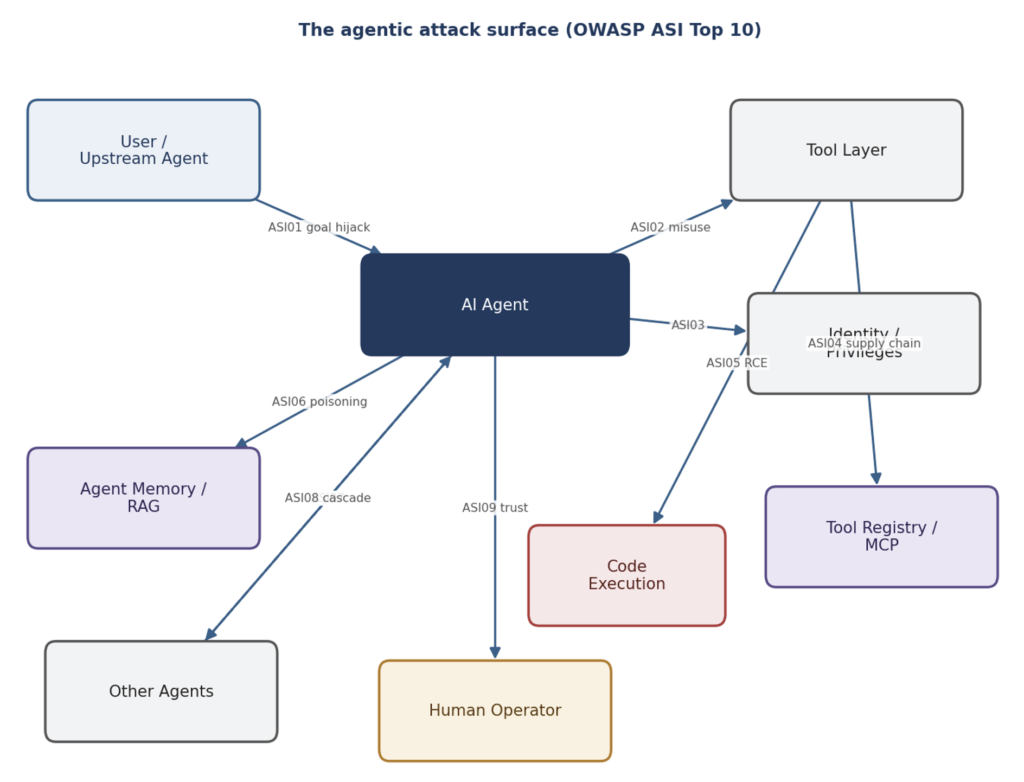
The OWASP Agentic Security Initiative Top 10 (ASI, 2026) covers the risks that appear when language models get tools, memory and the freedom to act. It overlaps with the OWASP LLM Top 10, but it follows the whole action path: who the agent is, what it may call, what it remembers, who it talks to and who checks it. This OWASP Agentic Top 10 checklist gives one check per risk and the DeepintShield control that helps.
Run the checklist against one agent workflow at a time, such as “support agent that can issue refunds”. For each item, record whether the control is in place, the evidence, and which part of the execution path it covers. The categories are not a ranking of how often incidents happen, and they rarely occur alone: a supply-chain change can enable tool misuse, which delivers a goal hijack that persists through memory poisoning. Review combined scenarios as well as single items.
Most agent controls in DeepintShield sit in Agentic Security, available on the Business plan and above. Coverage applies to traffic that crosses the governed boundary, so also check for agents that reach tools directly. DeepintShield classifies agent decisions against the OWASP Agentic Top 10 and ships OWASP Agentic ASI guardrail cards, which makes this review easier to evidence. For background on each risk, read OWASP Agentic ASI Top 10: risks and practical controls.
The checklist
ASI01 Goal hijack
Check: If a retrieved document or tool result carries hidden instructions, can the agent still take only actions it was already allowed?
Control that helps: Input, RAG and MCP guardrails with the goal-hijacking presets, plus an exact Allow for every governed tool call, so changed intent does not become new permission.
ASI02 Tool misuse
Check: Is each call authorised for this agent, tool, action and object, rather than for the tool name alone?
Control that helps: OpenFGA checks for the agent’s permission on the object, can_use on the tool and can_execute on the action. Write-like or unknown actions need a live approval tied to a digest of the arguments.
ASI03 Identity and privilege abuse
Check: Does each agent prove a provider-issued identity, and does it run with the least privilege the task needs?
Control that helps: Agent workload identity through Microsoft Entra Agent ID or generic OIDC, with a one-hour token lifetime ceiling by default. Task mandates narrow access and never grant it; on-behalf-of decisions add delegation checks.
ASI04 Supply chain
Check: Would you notice if an MCP tool’s name, description or schema changed after you approved it?
Control that helps: Pinned tool definitions: calls are denied after a change until “Approve new definition”. An AIBOM export lists governed tool contracts, signed when a signing key is configured.
ASI05 Unexpected code execution
Check: Which agents can run code, and is that code reviewed and isolated?
Control that helps: A mandatory deterministic blueprint scan of agent code that fails closed on incomplete coverage, quarantine on new findings, Code Mode in sandboxed Starlark, and optional isolated server runs for LangGraph programs.
ASI06 Memory and context poisoning
Check: Is retrieved or remembered content scored for injection and source trust before it enters context?
Control that helps: RAG Security per-chunk decisions with trust and injection thresholds, quarantine for suspect sources, and retrieval and memory presets in the pattern catalogue.
ASI07 Insecure inter-agent communication
Check: Do agents treat messages from other agents as untrusted input, and is every caller authenticated?
Control that helps: Inter-agent trust presets in the pattern catalogue, a Virtual Key on every MCP connection (no anonymous access), and delegated authentication that never forwards the caller’s token to the MCP server.
ASI08 Cascading failures
Check: When an authorisation service, provider or tool fails, does the workflow stop safely instead of carrying on?
Control that helps: Authorisation errors fail closed and return mcp_tool_authorization_unavailable; a Deny aborts the Agent Mode loop, which also has default depth and timeout limits; provider fallbacks and a circuit breaker contain upstream failures.
ASI09 Human-agent trust exploitation
Check: Do approvers see the exact action and arguments, and can a requester approve their own request?
Control that helps: Approvals bound to an argument digest, separation of duties so neither the requester nor the accountable owner can approve, a five-minute default expiry, and no approval that can override a hard denial.
ASI10 Rogue agents
Check: Can you list every agent using your gateway, with its owner and status, and stop one quickly?
Control that helps: Agent registration and enrolment with an active human owner, statuses such as quarantined, retirement of agents, and refusal of ungoverned MCP once any agent is enrolled.
Turn the checklist into evidence
For each item, keep one positive and one negative test: an allowed read and a denied write, an approved definition and a changed one, an approval by a valid reviewer and a self-approval attempt. Record the decision each produced. DeepintShield appends every agent decision to an append-only, hash-chained ledger before the call proceeds, which gives reviewers a record they can verify.
- See how the controls fit together on Agentic Security and MCP Gateway.
- Work through tool-specific checks in the MCP security checklist.
- Apply the checks with how to control what AI agents can do.
- Read the Agentic Security docs.