
Add human approval to AI agents
Hold consequential agent actions for a named reviewer, bind each approval to the exact arguments, and keep separation of duties.
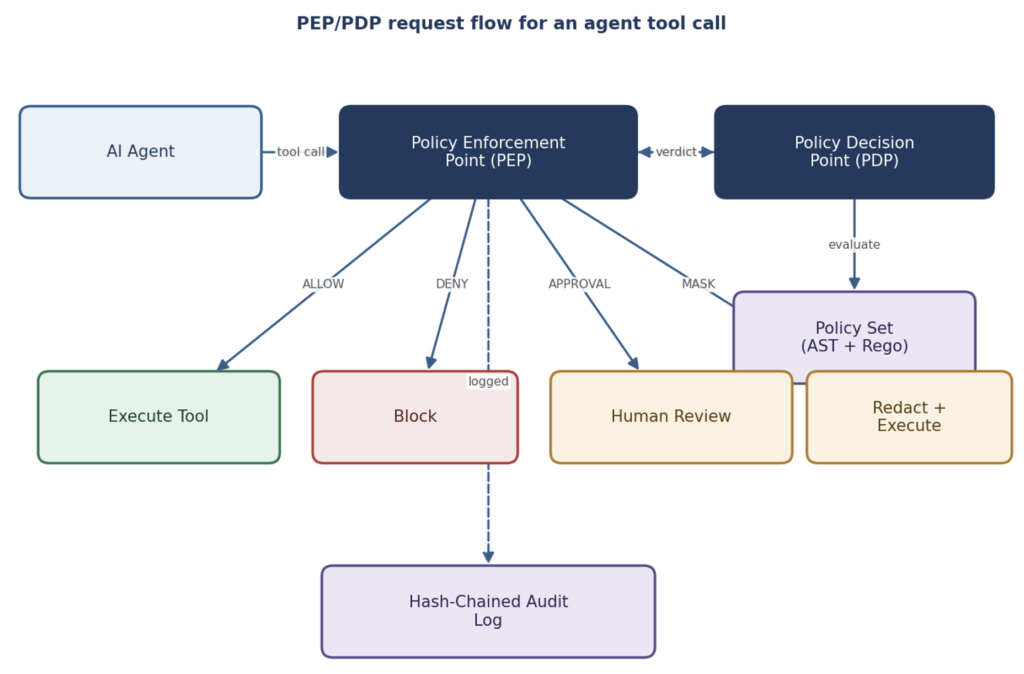
Here is how to add human approval to AI agents without slowing every task: let low-risk reads run and hold consequential actions for a named reviewer. DeepintShield returns Require approval for those calls, ties the approval to the exact arguments, and enforces separation of duties, so nobody approves their own request.
The challenge
Most teams agree that an agent should not move money, change a customer record or delete data without a person checking. Building that check well is harder than adding a “confirm” button:
- Prompt-level rules are not enforced. Telling the model to “ask first” does not stop a tool call.
- Approvals drift from actions. A reviewer approves one set of arguments and the agent executes another.
- Self-approval. The person who asked, or the agent’s owner, can approve their own request.
- Stale approvals. An approval from yesterday is reused for a different situation today.
- Rubber-stamping. Reviewers who see too little context approve by habit.
The approach
Decide which actions need review based on what they change, not on which agent asks. Send those actions to designated approvers who are independent of the request. Bind each approval to the exact call. Let approvals expire. Never let an approval override a hard denial. Make the application show “waiting for approval” rather than “done”. Give reviewers the full context so they do not approve by habit. Agree the rules with the business owner of each action, not only with engineering: they know which changes are hard to reverse.
How to add human approval to AI agents with DeepintShield
- Classify the actions. Discovered actions are treated as write and high risk until an operator classifies them, and an agent never classifies its own tools. The server classifies each action and ignores classes supplied by the caller. Write-like or unknown actions need a live approval tied to a digest of the arguments. See tool execution.
- Set approvers and rules. Name designated approvers and keep separation of duties: the requester cannot approve, and neither can the agent’s accountable owner. Pending approvals expire after five minutes by default, configurable up to 24 hours. Keep the approver group small enough to be accountable and large enough to respond in time. An approval cannot override a hard denial, and Advisory mode never bypasses Require approval. See the Agentic Security docs.
- Handle the result in the agent. A governed tool call that needs review returns HTTP 202
mcp_tool_approval_required, and a denial returns 403mcp_tool_authorization_denied. In the Python SDK the code isrequire_approval. In Agent Mode a Deny aborts the loop. Show the user that the action is pending, and re-check the outcome before reporting it complete. Write a clear message for each result: approved, declined and expired.
The same four-eyes rule applies to agent registration: a deferred decision always needs a reviewer other than the accountable owner. Agentic Security is available on the Business plan and above.
What you can show afterwards
- Each held action: who requested it, who approved or declined it, when, and for which arguments.
- Approvals that expired or were withdrawn, alongside the recorded-decision states.
- Every decision in the append-only, hash-chained ledger, with chain verification through the API.
- Evidence that separation of duties held, because self-approval is refused by design.
- How long held actions waited, which shows whether the approver group is the right size.
Test the whole flow before go-live: approve a held call, decline one, let one expire, and have the requester try to approve their own request. Then change one argument after approval and confirm the call no longer matches the approved digest.
Read why AI actions need clear controls for examples of actions worth holding.
Related
- Agentic Security: approvals, separation of duties and evidence
- AI security for banks: four-eyes checks on agent actions
- Control what AI agents can do: exact permissions for every action
- Prove AI decisions to an auditor: tamper-evident records of each decision