
Prove AI decisions to an auditor
Record each AI decision in a hash-chained ledger, verify the chain, export a tool inventory and map evidence to frameworks.
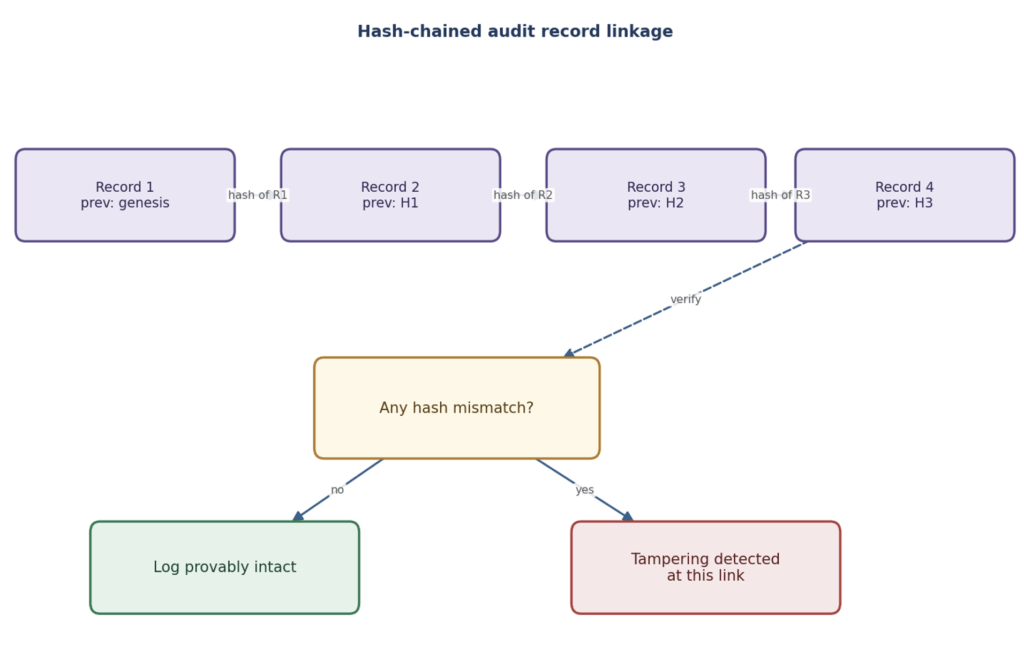
If you need to know how to prove AI decisions to an auditor, ordinary logs are not enough, because anyone with database access can change them. DeepintShield appends each agent decision to a workspace-scoped, append-only, hash-chained ledger before the call proceeds, and lets reviewers check the chain in the console or through an API.
The challenge
Auditors and risk teams ask simple questions that are hard to answer for AI systems:
- Can the record be trusted? A log table can be edited, deleted or reordered without a trace.
- Which rule applied? Evidence is spread across application logs, provider dashboards and spreadsheets.
- Which tools could the agent use? There is rarely an inventory of tools and their approved definitions.
- How does this map to the framework? Reviewers want evidence organised by the controls they assess.
- Who approved it? Approvals happen in chat threads and e-mails that are hard to match to actions.
The approach
Make records tamper-evident at the point of decision. Key the chain so a database writer cannot rebuild it. Keep an inventory of governed tools. Export evidence to stores your auditors already use, and organise it by framework. Be clear about scope: integrity shows records were not changed, not that every event was captured, and only traffic that crosses the gateway is recorded. Agree the evidence pack with your auditor before the period starts: which systems, which records, which period, and how integrity will be checked. Keep the evidence where your organisation already keeps records, with access limited to the people who need it.
How to prove AI decisions to an auditor with DeepintShield
- Turn on keyed evidence. Set
DEEPINTSHIELD_AUDIT_HMAC_KEY. Without it the chain is bare SHA-256, which a database writer could recompute, and withDEEPINTSHIELD_ENV=productionthe server refuses to start unkeyed. Evidence is kept for 730 days by default. Separately, audit logs are on by default in CADF format with a SHA-256 hash chain, covering authentication, authorisation, configuration, data-access and security events; check them with “Verify chain”. See the audit log docs. - Export the tool inventory. “Export AIBOM” produces a JSON inventory of governed tool contracts. It is signed when
DEEPINTSHIELD_AIBOM_SIGNING_SEEDis set (Business plan and above) and is explicitly marked unsigned otherwise. Pinned tool definitions show which contract was approved at each point. - Organise and export evidence. Agent decisions are classified against the OWASP Agentic Top 10, with crosswalks to NIST AI RMF, ISO/IEC 42001, the EU AI Act and MITRE ATLAS. Export decisions as CSV, schedule log exports to S3, Google Cloud Storage, Azure Blob, Snowflake, Redshift or BigQuery, and use HMAC-signed SIEM export or OpenTelemetry. See agentic observability.
What you can show afterwards
- A chain verification result for the period under review.
- The retention setting for evidence, and who can read or export it.
- Sample decisions with agent, tool, action, outcome and approver, with tool arguments stored as a digest.
- The AIBOM and the approval history of each tool definition.
- Configuration and policy changes from the audit view, and evidence grouped by framework: mapped to the controls, not a certificate.
Rehearse the audit. Pick a sample of decisions, export them, verify the chain for the period, and trace one decision back to its policy and approver. Write down any gaps, such as traffic that did not cross the gateway, and put them in the pack rather than leaving the auditor to find them.
Read how hash-chained audit logs work and what an AIBOM covers. Preparing for regulation? See the EU AI Act readiness guide.
Related
- Observability & Audit: logs, decision ledger and exports
- AI Compliance: controls mapped to frameworks
- Sovereign AI security for the public sector: evidence for public accountability
- Add human approval to AI agents: records of who approved what
- Control what AI agents can do: decisions worth proving