LLM Conversation Summarization: Keep Useful Context
A long support conversation often contains details the assistant still needs and exchanges it no longer needs to repeat in full. Conversation summarization creates a compact record of older turns while recent messages remain available. The aim is to preserve useful state for the next answer, with a clear way to consult the original conversation when exact wording matters.
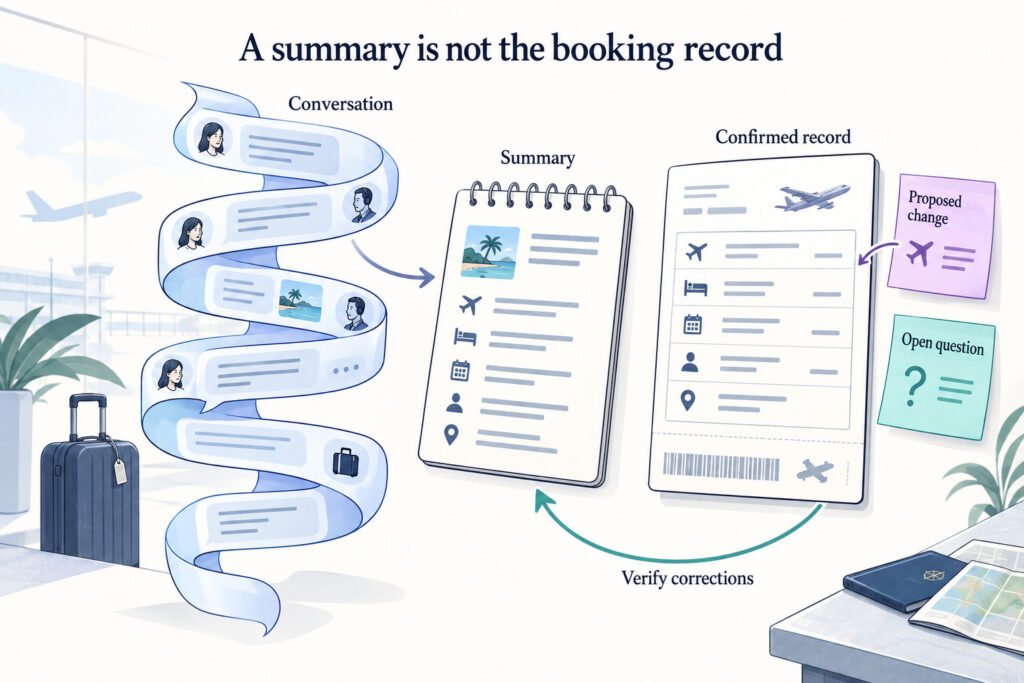
Figure: A booking conversation feeds a concise summary while confirmed reservation facts remain in a separate authoritative record. Proposed changes and open questions stay distinct from completed actions.
Choose the facts that must survive
For a troubleshooting assistant, a useful digest might record the product version, the reported symptom, checks already completed, the agreed next step and unresolved questions. It should distinguish what the user confirmed from what the assistant merely suggested. That distinction helps later responses stay grounded in the conversation.
Write down these requirements before selecting a summary length. A very short digest can be readable while omitting the one condition that changes the next action. Keep identifiers and exact values in their appropriate structured fields when the application needs reliable retrieval of them.
Keep recent and structured state intact
Recent turns usually carry the immediate question and conversational context. Preserve enough of them for the application to interpret references such as ‘that option’ or ‘the second file.’ The right window depends on message size and task design, rather than a universal number of turns.
Current DeepintShield documentation says text optimizations preserve structured messages, including attachments, tool history and reasoning state. Do not turn those items into a plain-language summary that loses their protocol meaning. In a tool workflow, a compact conversation digest and the required continuation state serve different purposes.
Account for producing the summary
Summarization itself consumes resources. A prepared digest may be reused while a background process produces a newer one, but an application must associate each digest with the correct session and history version. A summary of another user’s conversation or an earlier branch is not suitable context, even when it sounds relevant.
DeepintShield lists conversation summarization among the Team-and-above workspace cost controls. Its setting is independent of semantic caching, and supporting summarizer calls use a selected authorized Virtual Key. Check the deployed behavior and include those calls in the usage and latency evaluation rather than counting only the shorter final prompt.
Visual guide: LLM Conversation Summarization: Keep Useful Context
Figure: Illustrative optimization workflow: Conversation history splits into older turns for background summarization and recent turns kept verbatim; a cached digest and recent messages form the next model context. Available controls depend on the configured implementation.
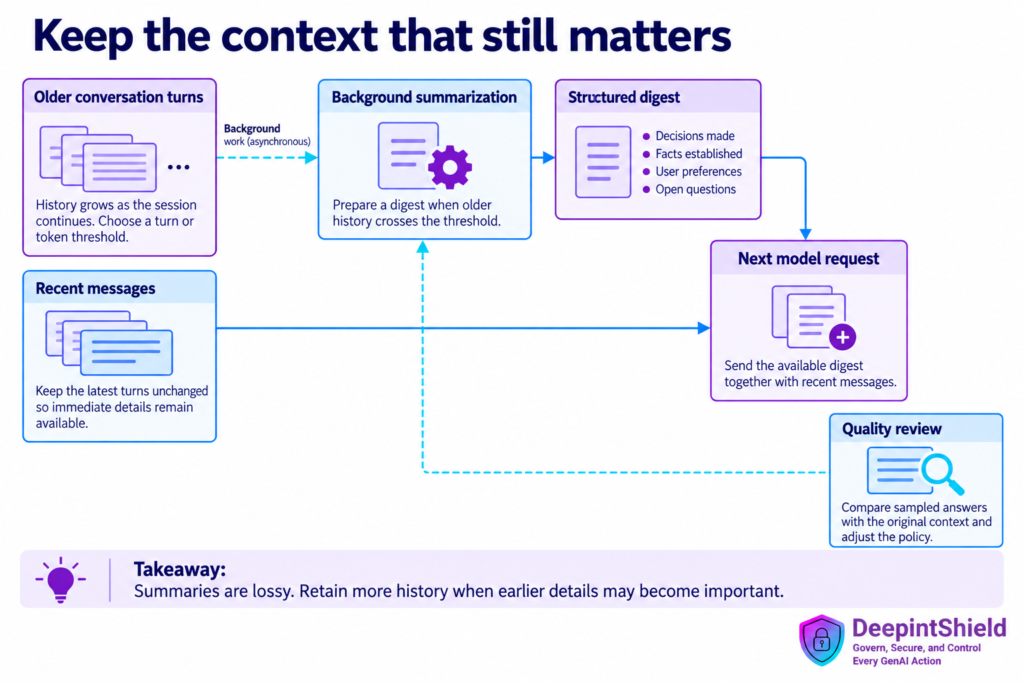
Test recall after several more turns
Ask questions that depend on important earlier details after the conversation has been summarized and continued. Check whether the assistant remembers the confirmed product, retains an exception, and recognizes a still-open question. Compare the answer with one produced from the original history.
Also test corrections: if a user updates a date or changes a preference, the next digest should carry the current fact with suitable context. Preserve the original record according to the application’s access and retention policy. A summary is useful working context, not a substitute for an authoritative transcript when a reviewer needs exact evidence.
Separate durable task state from conversational prose
A booking assistant may discuss several hotels before the employee chooses one. Keep the selected dates, party size, accessibility needs and confirmed property in structured application state where possible. Use the summary to describe the discussion and unresolved preferences, rather than making it the only storage location for every transaction-critical value. If a later turn changes the date, the application should update the authoritative value and make the change explicit instead of asking the model to infer which mention is newest.
Write a summary contract listing facts to retain, decisions already made, outstanding questions and the provenance of important constraints. Distinguish a customer request from an assistant suggestion and a confirmed reservation from a proposed one. A summary that merges those categories can invent commitments without introducing any obviously false sentence. DeepintShield offers summarization among its optimization controls, but the application’s state model and confirmation rules remain its own responsibilities. Optimization scope
Test memory after the original wording disappears
Create a conversation with an early exception, a later correction and a deliberately abandoned option. Produce the summary, remove the older turns from the candidate context and continue with questions that depend on each distinction. Ask about the corrected date, the accessibility requirement and whether the rejected property was ever booked. Compare the answer against an independent conversation ledger prepared before summarization, not against a second model’s impression of the summary.
Repeat the exercise across several summarization cycles. Small omissions can accumulate when each new summary is based partly on an older summary rather than the full source. Retain enough authorized source history to diagnose this process, and record which original interval each summary covers. Preserve provider-specific tool and reasoning state through the documented continuation path instead of converting every structured item into ordinary text. A readable narrative does not substitute for protocol fields required by the next request.
Recover from a disputed or outdated summary
If the employee says that an important fact is wrong, pause any action that depends on it and verify the relevant source turn or authoritative record. Correct the stored state and make the revised assumption visible. Do not ask the model to silently repair the summary while continuing to act on the disputed value. For a consequential transaction, obtain any required confirmation again when the correction changes the target, amount or intended outcome.
Measure the cost of producing summaries, the tokens retained afterward and the quality of later responses. Include requests that trigger another retrieval of original history because the summary was insufficient. Establish a practical fallback, such as retaining a larger recent window or bypassing summarization for a short sensitive interaction. The goal is useful continuity at an acceptable operating cost, with a way to inspect and repair lost context, rather than making every conversation as short as possible.
During summary repair, preserve a clear distinction between a customer’s requested booking change and the change actually confirmed by the reservation service. Reconstruct the latter from authoritative state where available. This prevents an earlier conversational proposal from becoming an apparent completed transaction after several rounds of summarization.
Frequently asked questions
Does summarization guarantee a fixed context size?
No. A bounded digest and recent-message window can limit history growth, but new messages and preserved structured state still affect size. Measure the actual request and the quality of later answers.
Can a conversation summary become the source of authorization?
It should not manufacture permission. Keep identity, resource ownership and approval state in the services that authoritatively manage them. A summary can explain what the participants discussed, but a later action still needs the current checks and exact required confirmation for its target and arguments.
Documentation and further reading
Related guide: LLM Cost Optimization: 12 Ways to Improve AI Efficiency
Related guide: Prompt Compression with LLMLingua-2: Practical Limits